

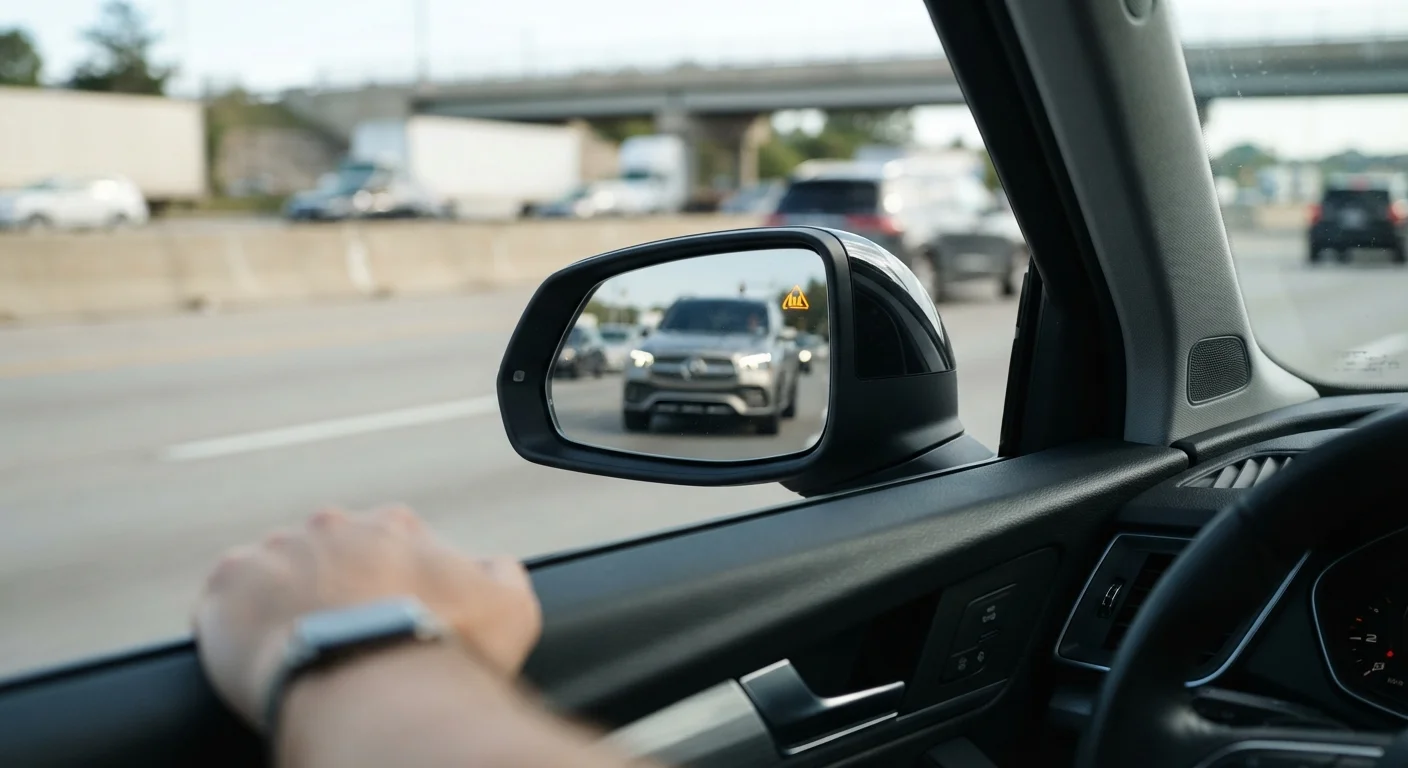
How the System Detects What Your Mirrors Miss
Your side mirrors cover a wide arc of view, but a narrow zone runs alongside your rear quarter panel — roughly from your back door to about one car length behind you — where another vehicle can sit almost completely out of sight. This is the classic blind spot, and it's where lane-change collisions most commonly begin.
Blind-spot monitoring addresses this gap using sensors, most often short-range radar units embedded discreetly in the rear bumper fascia on each side of the vehicle. These sensors continuously emit radio waves and measure what bounces back. When a moving vehicle enters the monitored zone, the system registers the return signal and triggers the driver alert.
Some vehicles use cameras instead of — or alongside — radar. Camera-based approaches process live video to identify vehicles in the detection area. Each technology has trade-offs: radar performs reliably in low visibility and darkness, while cameras can provide richer visual detail but may be more sensitive to lens obstructions.
BSM Is a Driver Aid, Not a Guardian
Blind-spot monitoring systems are classified as driver-assistance features, not autonomous safety systems. They provide information and alerts, but they do not steer, brake, or otherwise control the vehicle in response to a detected object in the blind zone. Safe lane changes still depend on the driver's judgment and attention.
For a broader look at how these and similar technologies work together, see our plain-language guide to driver-assist technology.
What the Warning Looks Like — and What to Do
The most common alert is a small amber or orange icon that illuminates on or near the corresponding side mirror — on the left mirror if a vehicle is on your left, on the right if the vehicle is on your right. The symbol is often a car outline or a simple rectangular shape.
The alert becomes more urgent in most vehicles when you then signal a lane change. At that point, many systems escalate to an audible chime, a series of rapid beeps, or a vibration in the steering wheel — the vehicle's way of saying don't change lanes yet.
The correct response is straightforward: maintain your current lane, confirm the warning visually with a mirror check and a shoulder glance, and wait until the adjacent lane is genuinely clear before proceeding. The system narrows the information gap; it does not make the decision for you, and it does not steer or brake the car.
Build the Habit: Warn, Then Verify
When the blind-spot warning activates, treat it as the beginning of your lane-change check — not the end. Glance at your mirror, then do a brief shoulder check before moving over. This two-step habit keeps you in control and ensures you catch anything the sensors may have missed.
Limitations Every Driver Should Know
Blind-spot monitoring is a useful supplement to attentive driving, but it has well-documented limitations worth understanding before you rely on it.
- Speed thresholds: Most systems activate only above roughly 20–30 mph. In slow-moving traffic or parking areas, the warning may not trigger even if a vehicle is adjacent.
- Sensor obstructions: Mud, ice, or snow covering the rear bumper can block the radar signal. Your dashboard will typically display a message when the system is unavailable — see our guide to dashboard warning lights if that message appears.
- Towing: A trailer can cause persistent false alerts because the sensors detect the trailer itself. Many owners disable BSM when towing for this reason.
- Fast-approaching vehicles: A car closing on your blind spot very rapidly may not trigger the alert until it's already alongside you, or may be missed entirely in edge cases.
For a balanced assessment of what this technology does and doesn't accomplish for senior drivers specifically, the article Blind Spot Monitoring: How Useful Is It Really for Older Drivers? provides a thorough look at both sides.
~27%
Reduction in lane-change crashes with BSM
Research published by the Insurance Institute for Highway Safety (IIHS) has found that blind-spot monitoring systems are associated with meaningful reductions in lane-change crash rates and injury claims.
~70%
New vehicles with BSM available
Industry surveys indicate that blind-spot monitoring is now offered as standard or optional equipment on a large majority of new vehicles sold in the United States, up sharply from a decade ago.
Related Features That Work Alongside BSM
Many vehicles pair blind-spot monitoring with a complementary function called Rear Cross-Traffic Alert (RCTA). While BSM monitors the zones beside your car when driving forward, RCTA detects vehicles — and sometimes pedestrians — crossing behind you when you are reversing out of a parking space. Together they address two of the most vulnerable maneuvers in everyday driving.
Rear Cross-Traffic Alert and backup cameras work as a safety pair that is increasingly standard on newer vehicles. If your car has a backup camera, it likely has at least some form of cross-traffic detection as well.
If you prefer a non-electronic way to reduce blind-spot gaps — for an older vehicle, for example — blind-spot mirrors offer a low-cost mechanical option worth understanding. And for the full picture of which safety systems matter most for senior drivers, see our overview of safety features that make the biggest difference for older drivers.
“Blind-spot monitoring is most valuable not as a replacement for the shoulder check, but as a consistent backup when attention briefly lapses — which is exactly when crashes happen.”
— IIHS Vehicle Research Staff, Insurance Institute for Highway Safety, vehicle safety research division
Frequently Asked Questions
The warning activates when a vehicle enters the detection zone alongside or slightly behind your car — typically within one to two car lengths. Most systems illuminate an amber icon on or near the side mirror. Some vehicles also produce a chime or vibrate the steering wheel if you activate the turn signal while a vehicle is detected in that zone.
Many systems are designed to activate only above a certain speed threshold — often around 20–30 mph — to reduce false alerts in parking lots or slow traffic. Below that speed, the warning light may not illuminate even if a vehicle is present. Check your owner's manual for the specific operating range of your vehicle's system.
Yes. Radar sensors embedded in the rear bumper can be temporarily blocked or degraded by heavy rain, snow accumulation, mud, or ice. Most vehicles will display a dashboard message indicating the system is temporarily unavailable. Clearing the rear bumper of debris or ice typically restores normal function.
No. A blind-spot mirror is a small convex lens attached to your standard side mirror that widens your field of view passively — no electronics involved. Blind-spot monitoring is an electronic system using radar or cameras that actively detects vehicles and triggers a visual or audible warning. Both address the same safety concern but work very differently.
Hold your current lane position and check your mirrors and shoulder before making any lane change. The warning light indicates a vehicle is in or near your blind spot — do not merge until the light is no longer active and you have confirmed through a physical mirror check that the adjacent lane is clear. The system supplements safe driving habits; it does not replace them.
Most vehicles allow the driver to disable blind-spot monitoring through the infotainment system or a dedicated button. However, unless you have a specific reason — such as towing, where false alerts are common — safety experts generally advise leaving the system enabled during normal driving.
The content on this site is for informational purposes only and is not a substitute for professional advice. Always consult a qualified professional for guidance specific to your situation.