

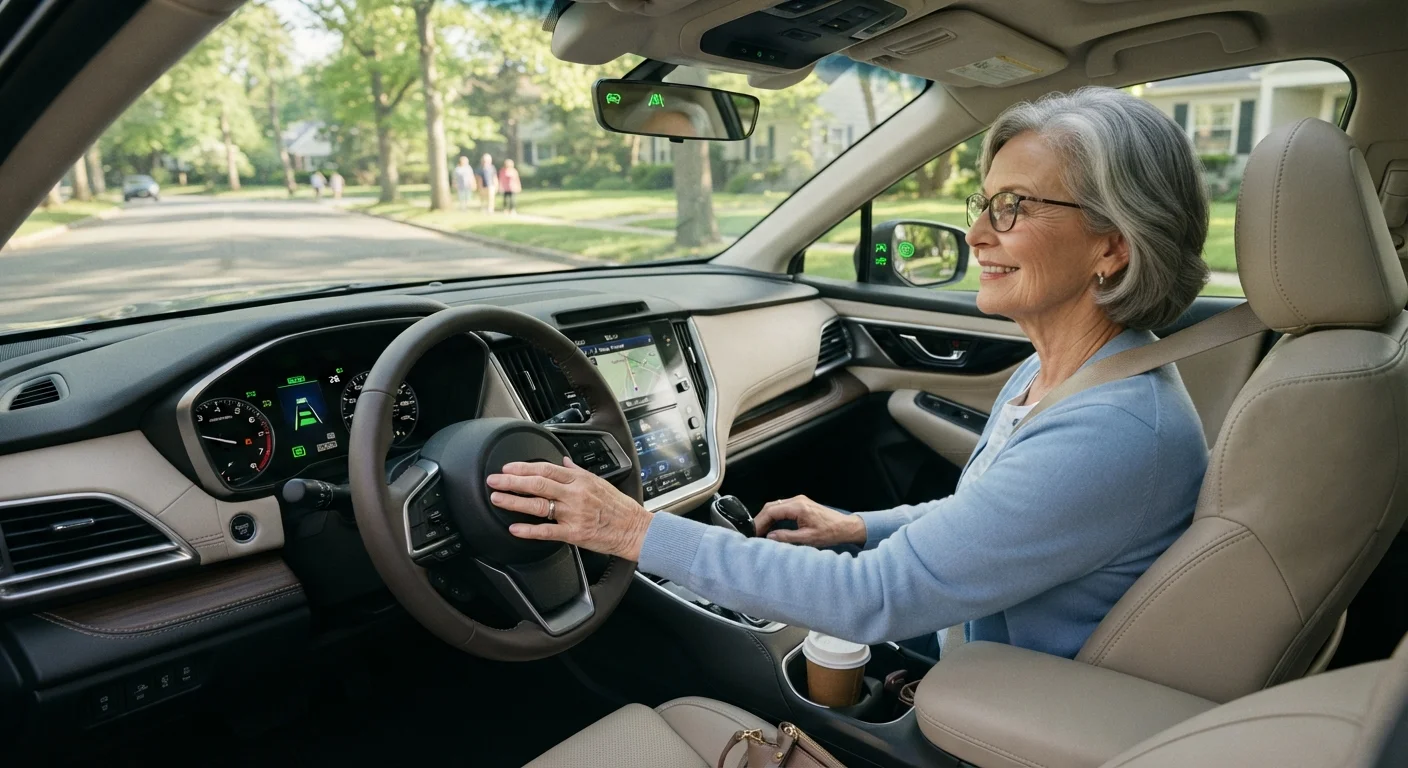
Why Safety Technology Matters More as We Age
As drivers age, certain physical changes become relevant to road safety: reaction times may slow, neck and shoulder flexibility can decrease, and night vision often diminishes. Modern vehicle safety technology wasn't designed exclusively for seniors — but many of its core features directly address these challenges.
Understanding which systems offer the most practical benefit is the first step toward driving with greater confidence. For a broader overview of how these systems work together, see our plain-language guide to driver-assist technology in today's new cars.
Automatic Emergency Braking (AEB)
Automatic emergency braking — often abbreviated as AEB — monitors the road ahead using cameras, radar, or both. When the system detects that a collision is imminent and the driver has not braked, it can apply the brakes automatically or amplify the force of the driver's own braking.
For older drivers whose reaction times may be slightly slower than in younger years, this fraction-of-a-second intervention can be meaningful. AEB is now required on all new passenger vehicles sold in the United States, meaning it's increasingly standard rather than a premium add-on. However, the sensitivity and capability of these systems varies across vehicles, so it pays to ask about performance during any test drive.
AEB can apply brakes automatically when a collision is imminent and the driver hasn't yet responded.
Blind-Spot Monitoring
Blind-spot monitoring uses sensors — typically mounted near the rear of the vehicle — to detect other vehicles traveling alongside in the driver's blind zones. When another vehicle is present, a visual warning (usually a light in or near the side mirror) alerts the driver. Some systems also sound an audible alert if the driver signals to change lanes while a vehicle is detected.
Reduced neck and shoulder flexibility is common with age and can make checking blind spots physically uncomfortable or incomplete. Blind-spot monitoring provides a reliable supplement to mirror checks. For a deeper look at visibility aids, our article on how blind-spot mirrors work covers a related low-tech option worth considering alongside electronic systems.
Blind-spot monitoring alerts drivers when another vehicle occupies a zone that's difficult to check physically.
Rear Cross-Traffic Alert
Reversing out of a parking space — especially a perpendicular spot in a busy lot — requires drivers to watch for crossing traffic that isn't visible until the car is partly in the lane. Rear cross-traffic alert systems detect vehicles, cyclists, or pedestrians approaching from the side while the car is in reverse, and warn the driver before contact is possible.
This feature works in conjunction with backup cameras, though it solves a slightly different problem: cameras show what's directly behind, while cross-traffic alerts detect what's approaching from the sides. Together they provide a more complete picture of what's happening around the rear of the vehicle. For more on how these two systems complement each other, see our article on backup cameras and rear cross-traffic alerts.
Rear cross-traffic alert detects approaching vehicles from the side when reversing — a scenario cameras alone can miss.
Forward Collision Warning
Forward collision warning (FCW) is closely related to AEB but serves a different function: rather than intervening directly, it alerts the driver that a collision is imminent, giving them the opportunity to brake or steer. The warning is typically visual, audible, or both — and activates earlier than AEB, providing more lead time to respond.
For many drivers, FCW is the first layer of protection. The system essentially extends the driver's effective reaction window by alerting them sooner than they might otherwise notice a slowing vehicle ahead. Some vehicles allow drivers to adjust how early the warning triggers, which can be useful for those who prefer more or less lead time.
Forward collision warning extends your effective reaction time by alerting you sooner than you might notice danger unaided.
Lane-Keeping Assist and Lane Departure Warning
Lane departure warning uses a forward-facing camera to monitor lane markings. If the vehicle begins to drift across a line without the turn signal being activated, the system alerts the driver — usually through a steering wheel vibration, an audible tone, or a dashboard indicator. Lane-keeping assist goes a step further: it can apply gentle steering corrections to guide the vehicle back toward the center of its lane.
These systems are particularly relevant when fatigue or a momentary distraction causes slight drift. They are not designed to steer the car autonomously for extended periods, and drivers should remain fully attentive. For additional context on how these and related technologies fit together, our guide to driver-assist technologies every senior should know about provides a useful reference.
Lane-keeping assist can gently correct steering when the vehicle begins drifting — a practical safeguard on long or familiar routes.
Backup Camera (Rear-View Camera)
Backup cameras have been federally required on all new U.S. passenger vehicles since 2018. When the vehicle is shifted into reverse, a live video feed of the area directly behind appears on the infotainment screen, typically overlaid with guidelines showing the car's projected path.
For seniors, the value is straightforward: the camera reveals what mirrors alone cannot — particularly low obstacles, small children, or pets directly behind the vehicle. Screen size and image clarity vary between vehicles, so evaluating the display quality during a test drive is worthwhile. Our article on reversing cameras and parking sensors explains how these two systems overlap and differ.
Backup cameras show what mirrors cannot — the area directly behind the vehicle during every reversing maneuver.
Making the Most of What Your Vehicle Offers
Owning a car with advanced safety features is only the starting point. Research consistently suggests that drivers who understand how their vehicle's systems function use them more effectively — and are less likely to be caught off guard when a system intervenes unexpectedly.
Ask for a Walkthrough at the Dealership
When purchasing or test-driving a vehicle, ask the sales representative or a service advisor to demonstrate each safety feature in a controlled environment. Many dealerships offer orientation sessions for new owners. Taking the time to see these systems in action — rather than reading about them later — helps build accurate expectations and confident, appropriate use.
It's also worth knowing that safety technology is evolving rapidly. Older vehicles may lack features that are now standard on new models. Our article on the safety technology gap between older and newer vehicles breaks down what differs across model years and why it matters.
For drivers who want to go further, why seniors get less from safety tech than they expect explores the common gaps between expectation and real-world performance — and how to close them.
This article is for general informational purposes only. Always consult your vehicle's owner's manual and, where appropriate, a qualified driving instructor for guidance specific to your situation.
The content on this site is for informational purposes only and is not a substitute for professional advice. Always consult a qualified professional for guidance specific to your situation.