

Our Verdict
Blind spot monitoring is a genuinely useful tool for older drivers, offering a meaningful safety net during lane changes where reduced mobility or vision can create risk. However, it has documented limitations — it can miss motorcycles in certain conditions, trigger false alerts, and may encourage reduced mirror-checking if misunderstood. Used as a supplement to attentive driving rather than a substitute, it adds real value.
Seniors with reduced neck rotation, limited peripheral vision, or high-frequency highway driving who want an additional layer of awareness during lane changes.
What Blind Spot Monitoring Actually Does
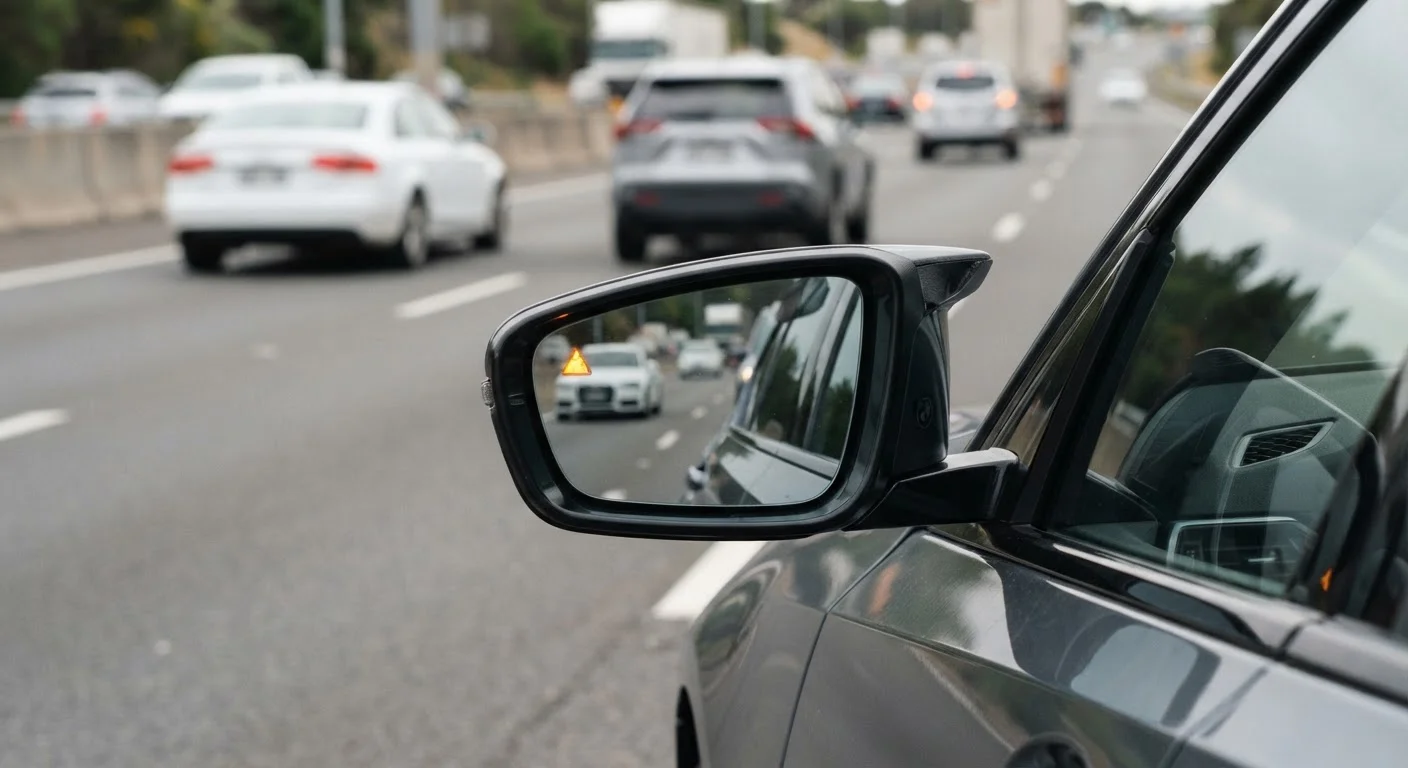
Blind spot monitoring (BSM) is a driver-assist system that uses radar sensors or cameras — typically mounted in the rear bumper or side mirrors — to detect vehicles traveling alongside your car in adjacent lanes. When another vehicle enters the monitored zone, the system triggers a visual alert, usually an amber indicator light on or near the side mirror. Many systems also add an audible or haptic warning if you then activate your turn signal while the zone is occupied.
For a clear explanation of how the sensor technology works in practice, see Blind-Spot Monitoring Explained: Cameras, Radar, and What the Warnings Mean.
The core purpose is simple: to alert you to vehicles that have entered a zone your mirrors alone may not fully capture. This is distinct from traditional blind spot mirrors, which are passive add-ons that widen your field of view without any active detection.
Why This System Matters Specifically for Seniors
Several well-documented age-related changes can make blind spot checks more physically challenging. Reduced neck and shoulder flexibility can limit how far a driver can turn to check a blind zone. Changes in peripheral vision narrow the field that's visible without head movement. Processing speed — how quickly the brain registers and responds to visual input — also tends to slow with age.
~40%
Reduction in lane-change crashes with BSM
Research published by the Insurance Institute for Highway Safety (IIHS) found that blind spot monitoring was associated with meaningful reductions in lane-change crashes and related injuries.
65+
Age group with greatest mobility-related benefit
Studies on age-related driving changes consistently identify reduced cervical spine mobility as a key factor limiting blind spot checks in drivers over 65.
BSM directly addresses these challenges. Rather than requiring a physical head turn, the system delivers a visual cue in the driver's forward line of sight — the mirror housing — reducing the physical demand of a lane-change check. This is one reason BSM consistently appears on lists of the safety features most relevant to older drivers. For a broader look at which technologies offer the most measurable benefit, see Safety Features That Make the Biggest Difference for Older Drivers.
The Real Advantages
BSM's benefits are grounded in how it interacts with realistic driving situations, not just ideal ones.
Reduces physical demand of blind zone checks
Drivers with limited neck mobility or shoulder stiffness benefit from an alert delivered to their mirror housing, reducing the need for a full head turn during every lane change.
Provides a real-time, continuous safety net
Unlike a mirror adjustment done once, BSM actively monitors adjacent lanes throughout the drive, catching vehicles that enter the zone at any moment.
Alerts activate at the critical decision moment
Because many systems escalate their warning when the turn signal is used, the alert fires precisely when the driver is about to act — a well-timed safety intervention.
Compensates for reduced peripheral vision
Age-related narrowing of the visual field makes lateral vehicle detection harder; BSM provides information the driver's vision may no longer reliably capture.
Works in conditions where mirrors are less effective
At highway speeds, vehicles can enter a blind zone quickly. Radar-based BSM detects approaching vehicles even when they move faster than a driver's attention can track.
For seniors who drive regularly on multi-lane roads or highways, the cumulative benefit of having a reliable alert system during frequent lane changes is significant. Paired with other safety accessories, it contributes to a more comprehensive safety setup.
The Limitations You Should Know About
BSM is not a complete solution, and understanding its boundaries is important for safe use.
Risk of over-reliance replacing active mirror checks
Some drivers reduce their mirror-checking habit once BSM is present, which is dangerous — the system is a supplement, not a substitute, and has documented detection gaps.
Sensors can struggle with motorcycles and cyclists
The smaller radar cross-section of motorcycles and bicycles can result in delayed or missed alerts, a limitation that matters in urban or suburban driving environments.
False alerts create distraction and alert fatigue
Guardrails, concrete barriers, and parked vehicles can trigger the warning in some systems, which may cause drivers to begin ignoring alerts over time.
Performance degrades in adverse weather
Heavy rain, snow, ice on sensors, or road spray can reduce the range and reliability of radar-based BSM — exactly the conditions when extra caution is needed.
Not available on most older used vehicles
Seniors working with a limited budget may find BSM absent on affordable used cars, requiring add-on mirror accessories as an alternative — which offer far less capability.
Alert modality may not suit all sensory needs
Drivers with hearing loss or reduced peripheral vision may not reliably notice audible-only or visual-only alerts, depending on how a particular system is configured.
BSM Doesn't Cover Every Blind Zone
Most BSM systems monitor the rear lateral zones alongside and slightly behind the vehicle. They are not designed to detect vehicles in your immediate front-side zones, nor do they replace the need to check for pedestrians or cyclists near the front of the vehicle when pulling out. Always treat BSM alerts as an addition to your existing mirror and head-check routine, not a replacement for it.
For a broader look at how expectations and reality often diverge when seniors use driver-assist technology, Why Seniors Get Less from Safety Tech Than They Expect covers this pattern in detail.
Availability and What to Look For
BSM is now standard or available as an option on a wide range of new vehicles. However, it is far less common on used cars, particularly those built before roughly 2017–2018. Seniors shopping in the new vs. used car market should confirm whether a specific vehicle includes BSM as standard equipment or as part of a technology package.
When evaluating a BSM system, consider the alert modality. A visual-only indicator may be easy to miss in bright sunlight; systems that combine visual, audible, and steering-wheel vibration alerts tend to be more reliably noticed. Ask for a demonstration during any test drive, and confirm the system's detection range — some cover a longer zone behind the vehicle than others, which matters when vehicles are approaching quickly.
It's also worth comparing BSM alongside other visibility aids. Night vision and enhanced headlight systems address a different but related challenge — reduced visibility in low-light conditions — and the two systems can complement each other well.
The content on this site is for informational purposes only and is not a substitute for professional advice. Always consult a qualified professional for guidance specific to your situation.