

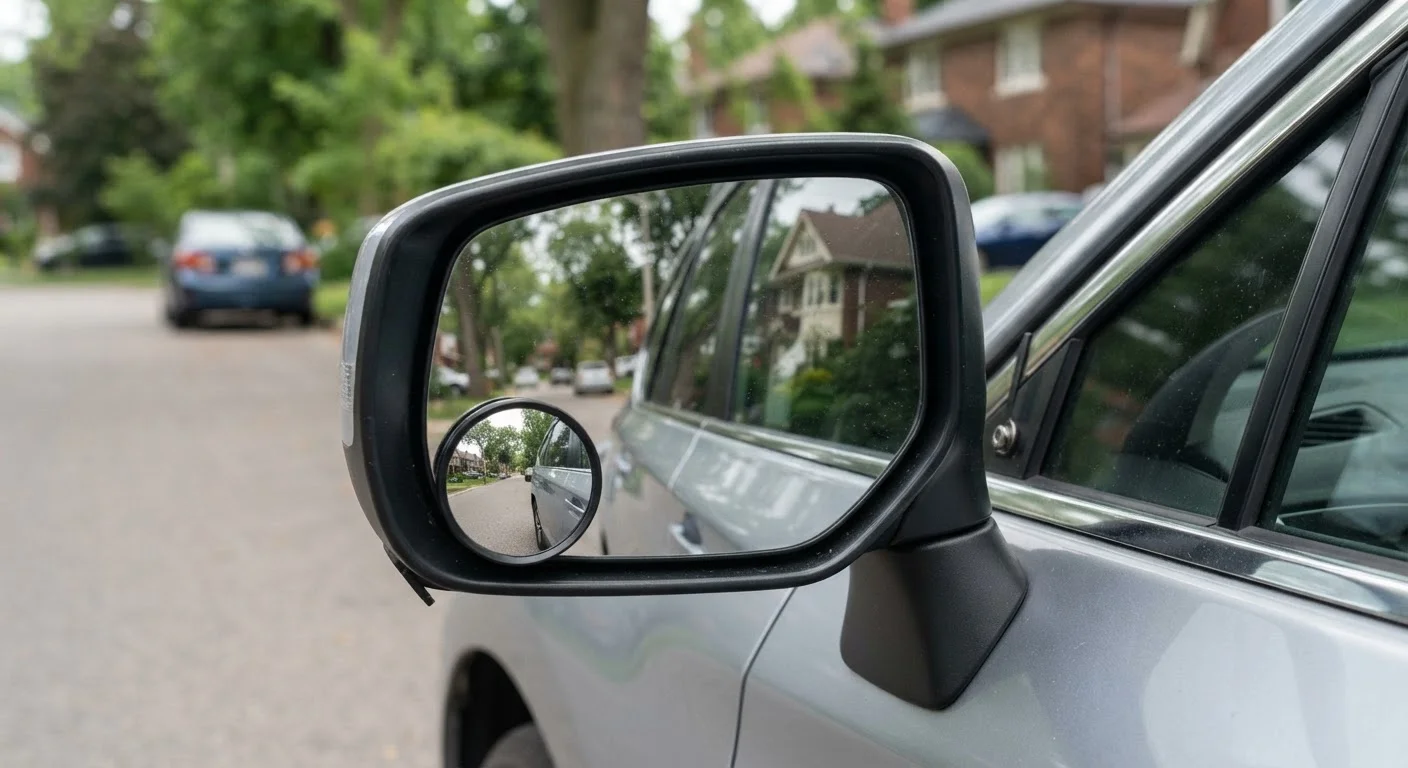
What a Blind Spot Mirror Is — and What It Isn't
Your car's standard side mirrors are flat, which means they reflect only a limited slice of the road behind and beside you. The zones just outside that reflected slice — typically alongside your rear quarters — are called blind spots. A vehicle traveling in those zones can be invisible to you even when your mirrors appear clear.
A blind spot mirror is a small add-on mirror, usually circular or rectangular, with a curved (convex) reflective surface. It attaches to your existing side mirror and bounces back a wider angle of the surrounding road. Because the surface curves outward, it can capture areas that fall outside the flat mirror's reflection.
It is worth being clear about what a blind spot mirror does not do. It doesn't eliminate blind spots entirely, it doesn't replace the need for a shoulder check before a lane change, and it isn't the same as an electronic system. For a comparison with technology-based solutions, see our article on how blind-spot monitoring systems use cameras and radar.
The Optics: How a Curved Mirror Expands Your View
The key difference between a flat mirror and a blind spot mirror is the shape of their reflective surface. A flat mirror reflects light at the same angle it arrives, producing an accurate but narrow image. A convex mirror — one that curves outward — reflects light from a broader range of incoming angles, effectively compressing a wide scene into the small surface.
Think of it like the difference between looking through a standard window versus a fisheye peephole on a door. The peephole shows you more of the hallway, but everything looks smaller and more distant. Blind spot mirrors work on the same principle.
~840,000
Annual US crashes involving blind spots
The National Highway Traffic Safety Administration (NHTSA) has estimated that blind-spot-related lane-change crashes number in the hundreds of thousands each year in the US.
~17°
Typical flat mirror field of view
Standard flat side mirrors generally cover around 15–20 degrees of the rearward field, leaving significant zones uncovered on each side of the vehicle.
This compression is important to understand. Objects you see in a blind spot mirror are closer than they appear. A vehicle that looks comfortably distant may actually be only a few car lengths away. Drivers should factor this in — especially when merging or changing lanes — and use the blind spot mirror as a guide, not as a precise distance gauge.
For a deeper look at the optical differences between convex mirrors and wide-angle mirror attachments, the article Convex Mirrors vs. Wide-Angle Mirror Attachments explains when each option is better suited to different driving situations.
Why Blind Spot Mirrors Matter for Older Drivers
For many older drivers, reduced neck and shoulder flexibility can make full head-checks — physically turning to look over your shoulder — more difficult or uncomfortable. This is one reason blind spot mirrors are considered a practical safety aid for seniors. By expanding what's visible in the mirror itself, drivers can get useful situational awareness with less physical strain.
Adjusting Your Mirror Before Every Drive
Before pulling away, take a moment to confirm your blind spot mirrors are still correctly angled. Vibration and temperature changes can shift adhesive-mounted mirrors over time. A 30-second check from your seated driving position ensures you're getting the coverage you expect. Do this as part of your standard pre-drive routine alongside checking your main mirrors and seat position.
Age-related changes in vision, including reduced contrast sensitivity and slower adaptation to light changes, can also affect how well drivers interpret what they see in mirrors. A wider-angle mirror helps by presenting more visual information in a single glance, reducing the number of separate checks needed.
That said, blind spot mirrors should be viewed as one layer of a broader safety approach. Our article on safety features that matter most for older drivers covers additional tools — from electronic alerts to vehicle design choices — that work alongside simple accessories like these.
If you're evaluating a vehicle purchase, assessing visibility from the driver's seat is a useful guide to understanding how pillar thickness, window size, and mirror placement affect your ability to see clearly in any car you're considering.
Placement, Adjustment, and Realistic Expectations
The effectiveness of a blind spot mirror depends almost entirely on where and how it is positioned. Most attach to the outer corner of each side mirror using adhesive. The correct placement varies by vehicle type and individual driver, so after attaching the mirror, take time to adjust the angle while seated in your normal driving position.
A useful starting point: position the blind spot mirror so that when you glance at your side mirror, you can see the lane running alongside you without the main mirror losing its coverage of the lane directly behind you. The two views should complement, not duplicate, each other.
Regularly check that the adhesive is holding firmly, particularly in very hot or cold climates where adhesive can weaken. A loose mirror that shifts position becomes unreliable quickly.
Finally, keep realistic expectations. Blind spot mirrors reduce a significant safety risk, but they are passive tools — they only help when you look at them. Pairing them with consistent mirror-checking habits and, where possible, electronic blind-spot monitoring gives you a more complete picture of what's happening around your vehicle.
Frequently Asked Questions
Yes, when properly positioned, blind spot mirrors do expand your field of rear and side vision. They cannot eliminate blind spots entirely, but they meaningfully reduce the area hidden from your standard mirrors. They work best as part of a broader habit of checking mirrors and performing head checks before changing lanes.
Most drivers attach them to the outer upper or lower corner of each side mirror. The correct position varies by vehicle and driver seating position, so adjusting the mirror angle after attachment is essential. You want to see the lane beside you without losing coverage from your main mirror.
Yes. Like all convex mirrors, blind spot mirrors make objects appear smaller and farther away than they actually are. This is a known limitation, and drivers need to account for it when judging the distance of approaching vehicles.
No. They serve a similar purpose but work very differently. Electronic blind-spot monitoring uses sensors or cameras and provides active alerts. Blind spot mirrors are passive optical tools that only work when you look at them. Both have value, and they can complement each other.
In general, adding a small auxiliary mirror to your side mirror is legal across US states, but regulations can vary. The mirror must not obstruct your primary mirror's function. If in doubt, check your state's vehicle equipment rules.
They can be particularly helpful for older drivers who may experience reduced neck flexibility, making full head-checks more difficult. By widening the mirror's field of view, they reduce how much a driver needs to turn to assess adjacent lanes. That said, no accessory replaces safe driving habits.
The content on this site is for informational purposes only and is not a substitute for professional advice. Always consult a qualified professional for guidance specific to your situation.