

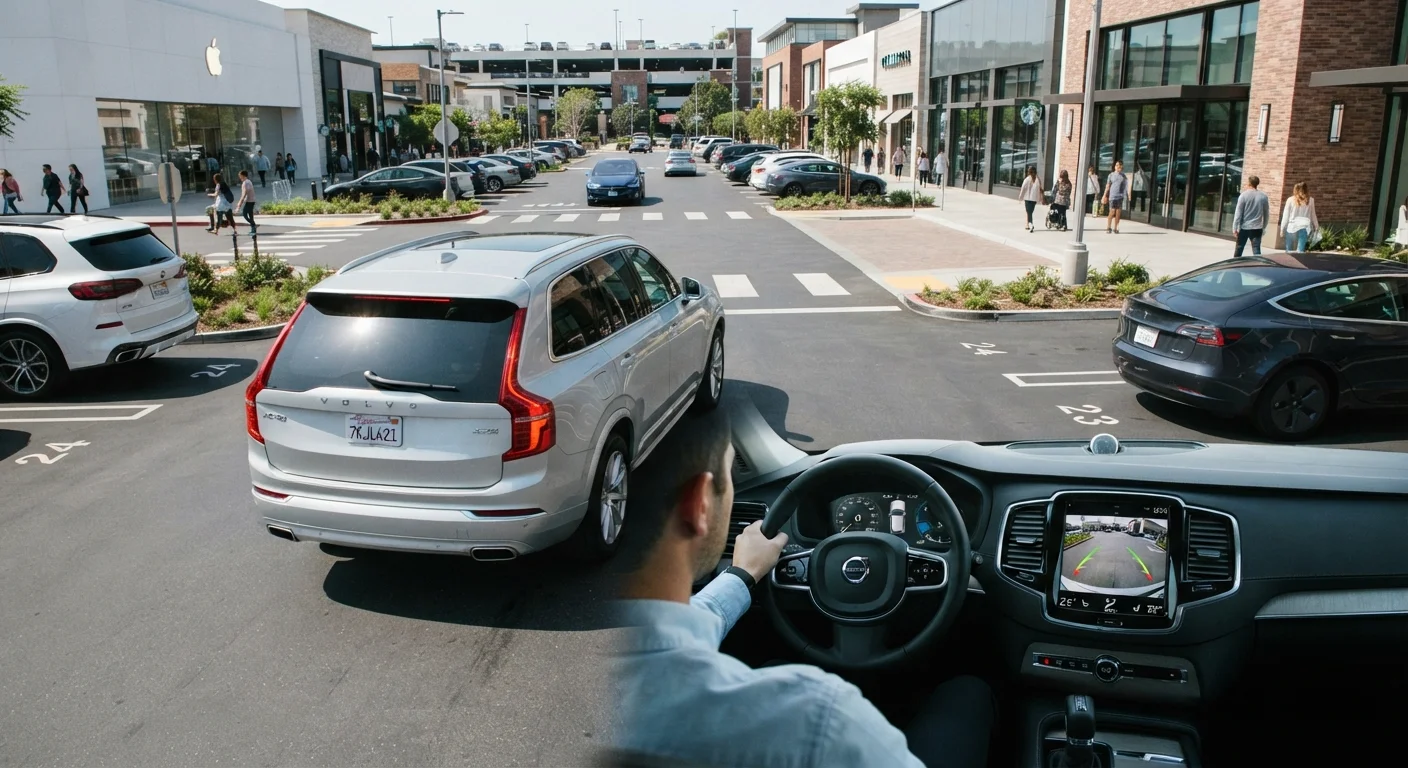
Why Reversing Deserves Special Attention
Backing out of a driveway, a parking space, or a garage accounts for a disproportionate share of low-speed collisions and close-call incidents. The geometry of a vehicle's rear end creates significant blind zones that mirrors — even well-adjusted ones — struggle to fully cover. Children, cyclists, and other low-profile hazards can disappear entirely from mirror view.
For older drivers, these challenges can be compounded by reduced neck flexibility that makes shoulder checks harder, or by changes in peripheral vision that affect how quickly lateral movement is noticed. Understanding how today's reversing-safety tools work — and what each one actually does — helps you use them more confidently and more correctly.
See our overview of safety features that make the biggest difference for older drivers for a broader look at the technologies most relevant to senior motorists.
2018
Year backup cameras became federally required on new U.S. vehicles
The National Highway Traffic Safety Administration (NHTSA) finalized a rule requiring rear visibility technology on all new light-duty vehicles sold in the U.S. from May 2018 onward.
~28 ft
Typical rear blind zone behind a passenger car
NHTSA research has documented that the area directly behind a vehicle invisible to the driver can extend roughly 28 feet for a typical passenger car, and farther for trucks and SUVs.
What a Backup Camera Actually Shows You
A backup camera — also called a reversing camera or rearview camera — activates automatically when you shift into reverse. It feeds a live image to a screen on your dashboard or infotainment display, showing what is directly behind the vehicle.
Most factory-fitted cameras overlay colored guide lines onto the image. These lines give a rough sense of distance and turning path: typically, a red zone very close to the bumper, an amber middle zone, and a green zone indicating more clearance. The camera's wide-angle lens means the image covers a wide swath, though it also introduces some visual distortion at the edges that takes a little practice to interpret correctly.
What backup cameras do well: they reveal stationary hazards — a low wall, a child's bicycle left on the driveway, a parking barrier — that would be invisible in mirrors. What they do less well: they capture only a still, centered slice of the rear. A car moving fast across the lot just outside the frame may appear only briefly, or not at all. That gap is exactly where rear cross-traffic alert steps in.
For a side-by-side look at backup cameras and parking sensors — another overlapping technology — see Backing Up Safely: What Reversing Cameras and Parking Sensors Each Do.
How Rear Cross-Traffic Alert Fills the Gap
Rear cross-traffic alert (RCTA) uses radar or ultrasonic sensors — typically embedded in the rear bumper — to scan the zones to the left and right of your vehicle as you back out. When a moving object (another car, a cyclist, a pedestrian) is detected approaching from the side, the system alerts you through an audible tone, a warning light on your dashboard, and often a visual indicator on the infotainment screen showing which side the hazard is coming from.
This is particularly valuable in situations where the camera alone cannot help: backing out of a tight parking garage bay flanked by large SUVs, or reversing out of a driveway where a hedge or fence blocks your view down the street. The sensors continue monitoring even when your rearward field of view is completely obstructed.
Get Familiar With Your System's Alerts Before You Need Them
Take time in a quiet, empty parking lot to learn exactly what your vehicle's RCTA alert sounds and looks like. Knowing the difference between a slow approaching alert and a rapid urgent warning means you will respond faster and more calmly in a real situation. Your owner's manual will describe the exact alert patterns for your specific vehicle.
RCTA is closely related to blind-spot monitoring technology. Both rely on similar radar principles — the key difference is the direction they watch. Learn more in our explainer on how blind-spot monitoring systems detect vehicles you can't easily see.
Using Both Systems Together — and Their Limits
The real value of this safety pair emerges when you treat the two systems as complementary rather than redundant. A practical reversing routine might look like this: check mirrors and perform a shoulder check before you begin moving, then use the backup camera to navigate backward while staying alert to RCTA alerts that flag approaching traffic from the sides. Neither system watches the front of the vehicle or warns about hazards well in front of you during a multi-point maneuver.
Knowing the limits is just as important as knowing the capabilities. Both systems can be degraded by dirt or ice on sensors and camera lenses. RCTA can occasionally produce false alerts from shopping carts, bollards, or parked cars depending on how a system is tuned. And neither system can react as quickly as an attentive driver — they provide warnings, not guaranteed stops.
These Systems Assist Drivers — They Don't Replace Judgment
Backup cameras and rear cross-traffic alert are classified as driver-assistance technologies, not autonomous safety systems. They are designed to supplement attentive driving, not replace it. Traffic safety organizations consistently emphasize that mirror checks and physical shoulder checks should remain part of every reversing maneuver, regardless of what technology is fitted to the vehicle.
Drivers considering a vehicle with surround-view imaging — which stitches multiple camera feeds into a bird's-eye perspective — will find a detailed comparison in our article on rear-view cameras vs. 360-degree surround-view systems. And for a grounded assessment of adding a camera to an older vehicle, see the case for and against aftermarket reversing cameras.
This article provides general educational information about vehicle safety technologies and is not a substitute for reading your vehicle's owner's manual or consulting a qualified automotive professional.
Frequently Asked Questions
Yes. Since May 2018, federal law has required a backup camera on all new passenger vehicles under 10,000 lbs sold in the United States. If you are buying a new car, a backup camera is standard equipment, not an optional add-on.
No. Rear cross-traffic alert is a supplemental aid, not a replacement for mirror checks and a physical shoulder check before reversing. Sensor coverage has limits, and the system can occasionally miss objects in certain conditions. Treat it as an extra layer of awareness.
Factory-fitted RCTA is found mainly on newer vehicles. Some aftermarket systems offer limited cross-traffic detection capability, though their accuracy and integration vary considerably. Consult a licensed installer to understand what options are realistic for an older vehicle.
Backup cameras use wide-angle lenses to maximize coverage, which naturally creates a curved or fish-eye appearance at the edges. This is normal and by design. With brief familiarity, most drivers learn to interpret the image accurately.
Yes. Heavy rain, snow, ice, or mud on camera lenses or sensors can degrade or block their function. Regular cleaning of the camera lens and sensor housings — typically located on the rear bumper or liftgate — helps maintain consistent performance.
Most systems combine an audible alert (a beeping tone that speeds up as an object gets closer) with a visual warning on the dashboard or infotainment screen. The exact presentation varies by vehicle make and model, so reviewing your owner's manual is worthwhile.
The content on this site is for informational purposes only and is not a substitute for professional advice. Always consult a qualified professional for guidance specific to your situation.