

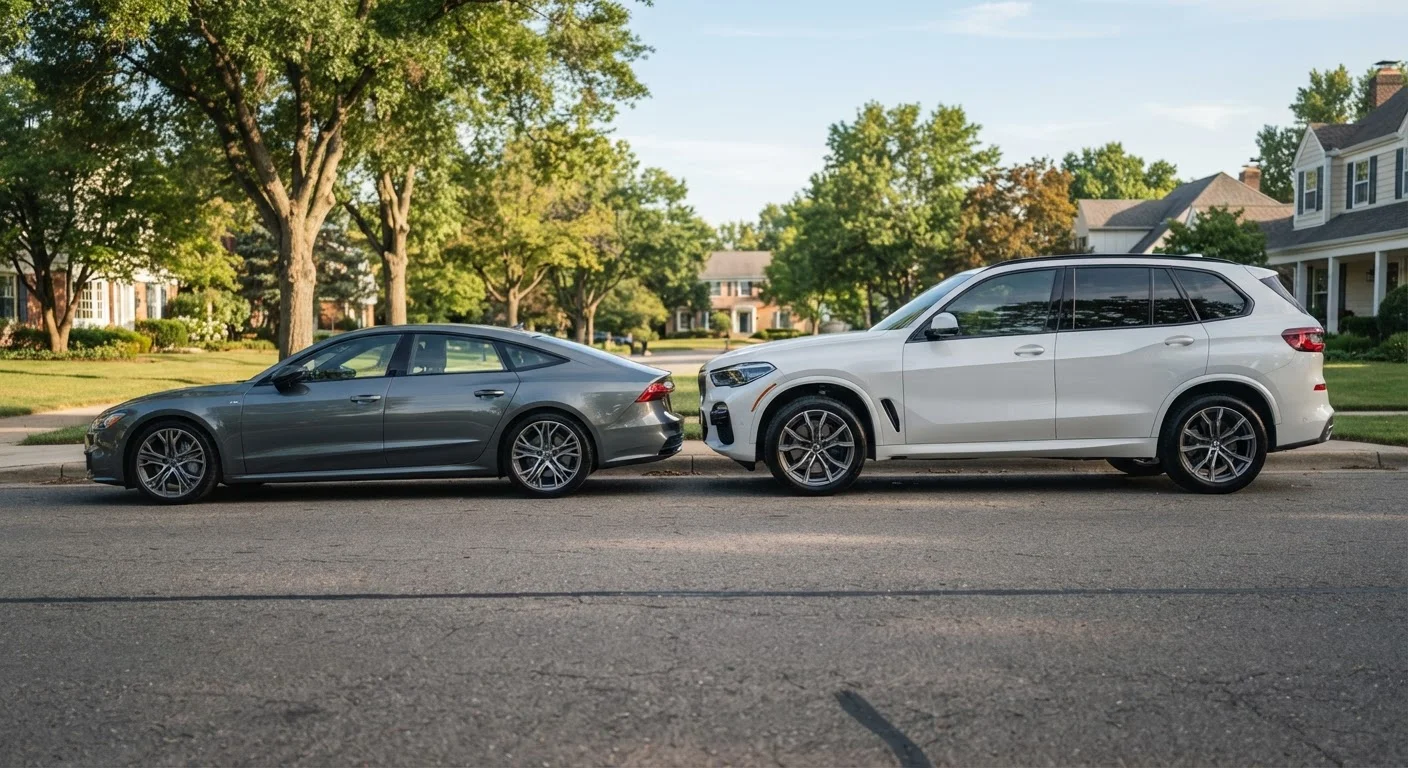
Option A
SUV (Sport Utility Vehicle)
The elevated, spacious option for easier entry.
Best for: Drivers who benefit from a higher seating position, reduced bending on entry, and greater cargo versatility.
Option B
Sedan
The low-profile, nimble classic for confident drivers.
Best for: Drivers who prefer a compact footprint, smooth highway ride, and easy parking in tight spaces.
Why Body Style Matters More as We Age
Choosing between an SUV and a sedan is rarely just about style preferences. For older drivers, the physical design of a vehicle — seat height, door clearance, step-in distance, and cockpit reach — can make a meaningful difference in daily comfort and confidence behind the wheel.
The good news is that newer models in both categories have improved considerably in recent years. Automakers have widened door openings, added power-adjustable seats, and incorporated driver-assistance technologies that reduce the physical and cognitive demands of driving. Understanding how these two body styles differ helps you match the vehicle to your specific needs rather than making assumptions based on size alone.
For a deeper look at what design features genuinely matter for older drivers, see what makes a new car model senior-friendly. And if you're also evaluating powertrain options, full electric vs. hybrid technology is worth reading alongside this comparison.
Entry, Exit, and Seating Height
This is often the deciding factor for seniors. SUVs generally position occupants between 21 and 26 inches off the ground — a range that aligns more closely with the height of a standard chair. This means sitting into the seat rather than lowering yourself far down, which is easier on hips and knees for many people.
Sedans, by contrast, typically place occupants 16 to 20 inches above the ground. Getting in requires a more pronounced downward motion, and rising from the seat demands greater leg strength. For drivers with good lower-body mobility, this is rarely an issue — but for those managing arthritis or joint pain, it can become a daily frustration.
That said, SUVs introduce their own challenge: the step up. If a vehicle sits very high, the initial step to enter can be difficult without a running board. Portable car steps and running boards can help, though they come with trade-offs worth understanding before you commit.
| Criterion | SUV | Sedan |
|---|---|---|
| Typical seat height | 21–26 inches | 16–20 inches |
| Entry ease for joint stiffness | Generally easier — less bending | Requires deeper lowering motion |
| Step-up challenge | Higher initial step required | Minimal step, low threshold |
| Road visibility / sightlines | Higher, commanding view | Lower, closer to road level |
| Highway ride stability | More body movement in turns | More planted, stable feel |
| Cargo space | Larger, flexible rear hatch | Smaller, fixed trunk |
| Parking maneuverability | Larger footprint, wider turns | Compact, easier in tight spaces |
| Driver-assist tech availability | Widely available in new models | Widely available in new models |
Ride Quality, Visibility, and Driving Confidence
Sedans sit lower, giving them a lower center of gravity and generally more composed handling. This translates to less body lean in turns and a more planted feel at highway speeds — qualities many experienced drivers appreciate. Road noise and vibration can also be better insulated in some sedan models.
SUVs offer a commanding view of the road ahead, which many older drivers find reassuring. Sitting higher improves sightlines over traffic and makes it easier to judge distances at intersections. However, taller vehicles do exhibit more body movement in turns and crosswinds, which some drivers find unsettling.
Modern driver-assist features — including automatic emergency braking, lane-keeping assistance, and adaptive cruise control — are now widely available across both body styles. The gap between SUVs and sedans on safety technology has largely closed in newer models. For a focused look at how these differences play out in everyday driving, the sedan vs. SUV guide on ageing joints explores the biomechanics in more detail.
~23 in
Average SUV seat height off ground
Industry measurements suggest most crossovers and SUVs place occupants roughly 21–26 inches from the ground, closer to chair height.
70%+
New vehicles with standard automatic emergency braking
As of the mid-2020s, automatic emergency braking is standard or near-universal on new U.S. passenger vehicles, per NHTSA reporting.
Cargo Access and Everyday Practicality
SUVs offer more interior cargo space and typically load through a rear hatch. For many seniors, this means easier access to groceries or luggage without deep bending — but it also requires lifting items to hatch height, which can strain shoulders. Many newer SUVs include power liftgates that open with a kick sensor or button, reducing the effort required.
Sedan trunks sit lower to the ground, so setting items down is easy — but reaching deep into a trunk can require bending at the waist. Whether this matters depends on what you carry and how often.
For those weighing three body styles at once, sedan, hatchback, or small SUV for seniors on a budget adds the hatchback into the conversation. And if the compact-versus-crossover question is relevant to you, compact cars vs. crossovers on ease of entry provides a useful side-by-side. Drivers specifically interested in sedan options can also explore new sedans worth a close look for comfort and visibility.
This article provides general vehicle information for educational purposes. Individual comfort and suitability vary depending on personal health, mobility, and driving needs. We recommend conducting an in-person test drive and consulting with a qualified occupational therapist or driver rehabilitation specialist if you have specific mobility concerns.
The content on this site is for informational purposes only and is not a substitute for professional advice. Always consult a qualified professional for guidance specific to your situation.