

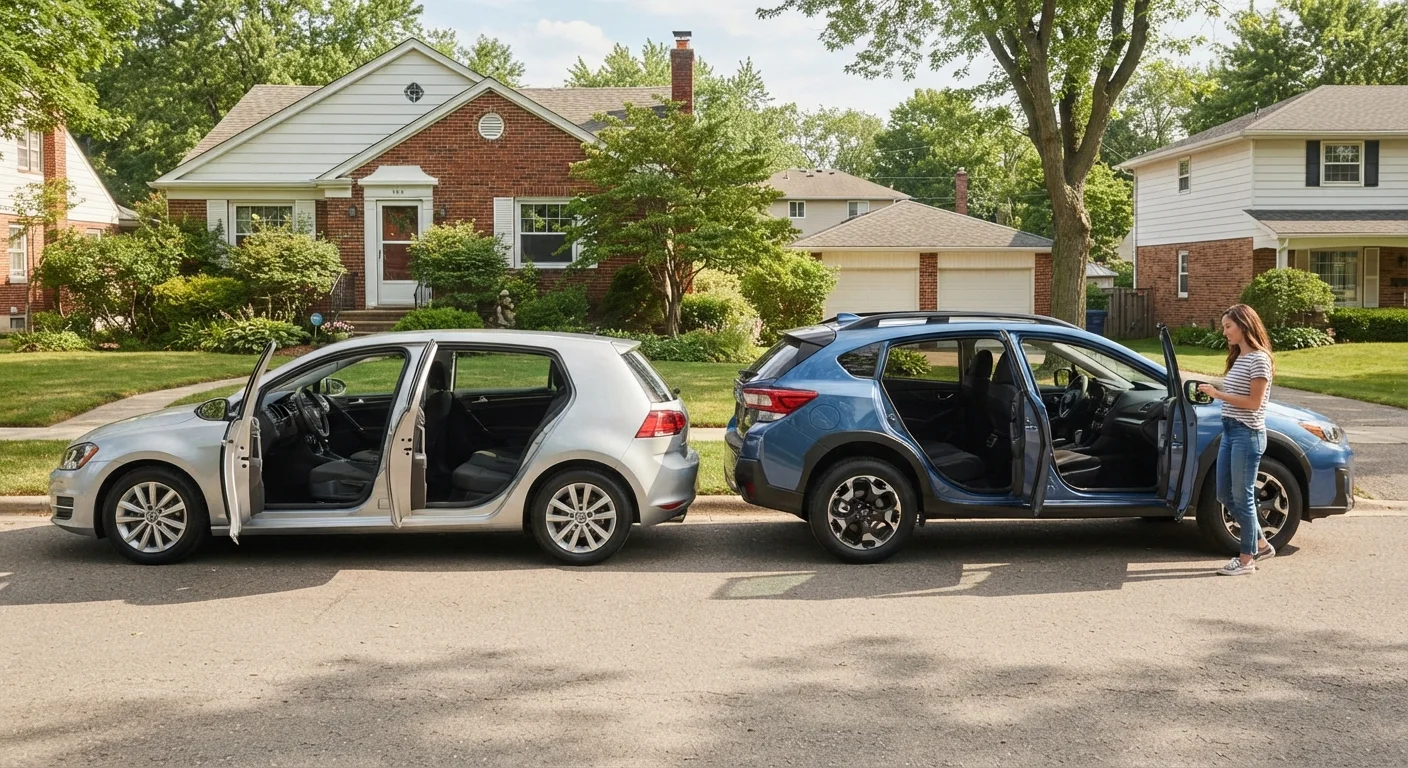
Our Verdict
Crossovers hold a meaningful advantage for seniors who have difficulty bending deeply at the hips or knees, thanks to their raised seat height and more upright entry posture. Compact cars, however, often provide wider door openings and a lower overall roofline that some drivers find easier to navigate laterally. Neither format wins outright — the right choice depends on your specific mobility considerations and how a vehicle feels during an in-person test.
| Best for | Recommended |
|---|---|
| Those with hip, knee, or bending limitations | Crossover |
| Those who prefer a wider door opening and lateral slide-in entry | Compact Car |
| Those prioritizing a lower purchase price and easier parking | Compact Car |
| Those who also carry mobility aids or need higher cargo floor access | Crossover |
Why Entry Ease Matters More Than Ever
For many older adults, the moment of getting into and out of a car is when discomfort — or even injury — is most likely to occur. Stiff joints, reduced flexibility, and balance concerns all become relevant the instant you swing a door open and prepare to sit down or stand up. Vehicle designers have responded with measurable changes in door geometry, floor height, and grab-handle placement, but those changes vary considerably between compact cars and crossovers.
Understanding those differences in practical terms — not just marketing language — helps you narrow your search before you ever visit a showroom. For a deeper look at which features matter most in newer vehicles, see what makes a new car model senior-friendly.
The Core Measurements: Step-In Height, Door Width, and Seat Position
Three physical dimensions drive most of the ease-of-entry experience:
- Step-in height — the distance from the ground to the vehicle's floor pan. Lower values mean you must lift your foot less, but you also sink lower when sitting. Higher values mean a shorter drop into the seat but require a larger initial step up.
- Door opening width — how far the door swings and how wide the resulting gap is. A narrow opening forces a more contorted entry, particularly for those with shoulder or hip limitations.
- Seat height — the distance from the floor to the top of the seat cushion. A seat positioned closer to chair height (roughly 18–22 inches) generally requires less bending effort than a very low sports-car-style seat.
Compact cars typically sit with floor pans 12–15 inches off the ground, while crossovers commonly range from 16–20 inches. That gap translates directly into how much you bend your knees to lower yourself in.
| Compact Car | Crossover | |
|---|---|---|
| Typical step-in height | 12–15 inches | 16–20 inches |
| Seat height from floor | Lower (more bending required) | Higher (chair-like sit-down) |
| Door opening width | Often wider relative to body | Varies; generally adequate |
| Roof clearance on entry | Lower roof, less head clearance | Taller roof, more head room |
| Grab handle availability | Less common, model-dependent | More commonly standard |
| Hip flexion required | Greater (deeper seat drop) | Less (more upright posture) |
| Overall vehicle footprint | Smaller, easier to park | Larger, requires more space |
Where Crossovers Have the Edge
The raised ride height of a crossover — achieved through a taller body structure rather than a truck-style frame — places the seat at a level that many older adults describe as a natural "sit-down" motion rather than a controlled lowering. Hip flexion (the bending angle at the hip joint) is reduced, which can matter significantly for anyone with arthritis, a hip replacement, or general stiffness.
Most current crossovers also integrate roof-mounted grab handles near the B-pillar (the vertical support between the front and rear doors), giving occupants something firm to grasp as they settle in. Combined with available power-adjustable seats that can tilt forward on exit, a well-equipped crossover reduces the physical effort of entry and exit considerably.
Test the Door at Its Widest Angle
When evaluating any vehicle, always open the door as far as it will go before attempting entry. Some models restrict the swing more than others, reducing the usable opening significantly. A door that opens past 80 degrees provides noticeably more room to maneuver. Ask the sales associate whether the door stop can be adjusted if it seems too restrictive.
For a broader comparison of how crossovers stack up against traditional sedans across multiple comfort dimensions, see our SUVs vs. sedans comparison.
Where Compact Cars Hold Their Own
Compact cars are often underestimated in the ease-of-entry conversation. Because their doors are proportionally large relative to the body, they frequently open to a wider angle and create a more generous lateral opening. For someone who slides sideways into a seat rather than stepping straight in, a compact car's door geometry can actually be more accommodating.
The lower roofline also means there is less risk of bumping your head during entry — a real consideration for taller individuals or those who use a rollator or cane and have an altered entry motion. Cabin width in modern compacts has grown substantially, and front seat legroom in many current models rivals larger vehicles.
If budget and ease of parking in tighter spaces are also factors, compact cars generally retain an advantage there as well. For a structured comparison of compact and hatchback options alongside small SUVs, explore our body-style guide for seniors on a budget.
Practical Steps Before You Decide
No published specification replaces a personal test. When visiting a dealership, bring someone who can observe your entry and exit motion from the outside — they will often notice awkward angles or strain that you may not feel in the moment. Pay attention to whether you are bending deeply at the hip, whether the door edge is easy to grip, and whether the grab handle (if present) is positioned where your hand naturally falls.
Mobility aids such as swivel seat cushions, door-frame grab handles, and leg-lift straps can meaningfully improve the experience in either vehicle type. Learn which mobility aids can help before committing to a body style. You can also find a structured checklist of what to evaluate during a test drive in our guide to evaluating comfort and access features.
This article provides general educational information about vehicle design and is not a substitute for personalised advice from a healthcare professional or occupational therapist regarding your specific mobility needs.
The content on this site is for informational purposes only and is not a substitute for professional advice. Always consult a qualified professional for guidance specific to your situation.