

Our Verdict
Passive and active safety systems are not competing alternatives — they are complementary layers of protection. Passive systems remain your last line of defense when a crash cannot be avoided, while active systems increasingly reduce the chances of a collision occurring at all. For senior drivers, a vehicle that offers both robust passive protections and modern active driver-assist technologies provides the strongest overall safety foundation.
| Best for | Recommended |
|---|---|
| Drivers prioritizing crash survivability and occupant protection | Passive safety focus (advanced airbag systems, reinforced structure) |
| Drivers wanting to reduce the likelihood of a collision occurring | Active safety focus (automatic braking, lane-keeping, blind-spot alerts) |
| Senior drivers seeking comprehensive, layered protection | Vehicles equipped with both passive and active safety systems |
Two Different Jobs, One Goal
When automakers talk about vehicle safety, they divide it into two broad categories: passive safety and active safety. Though they sound similar, they operate at entirely different moments in a crash sequence — and understanding the distinction can meaningfully change how you evaluate a car's protective value.
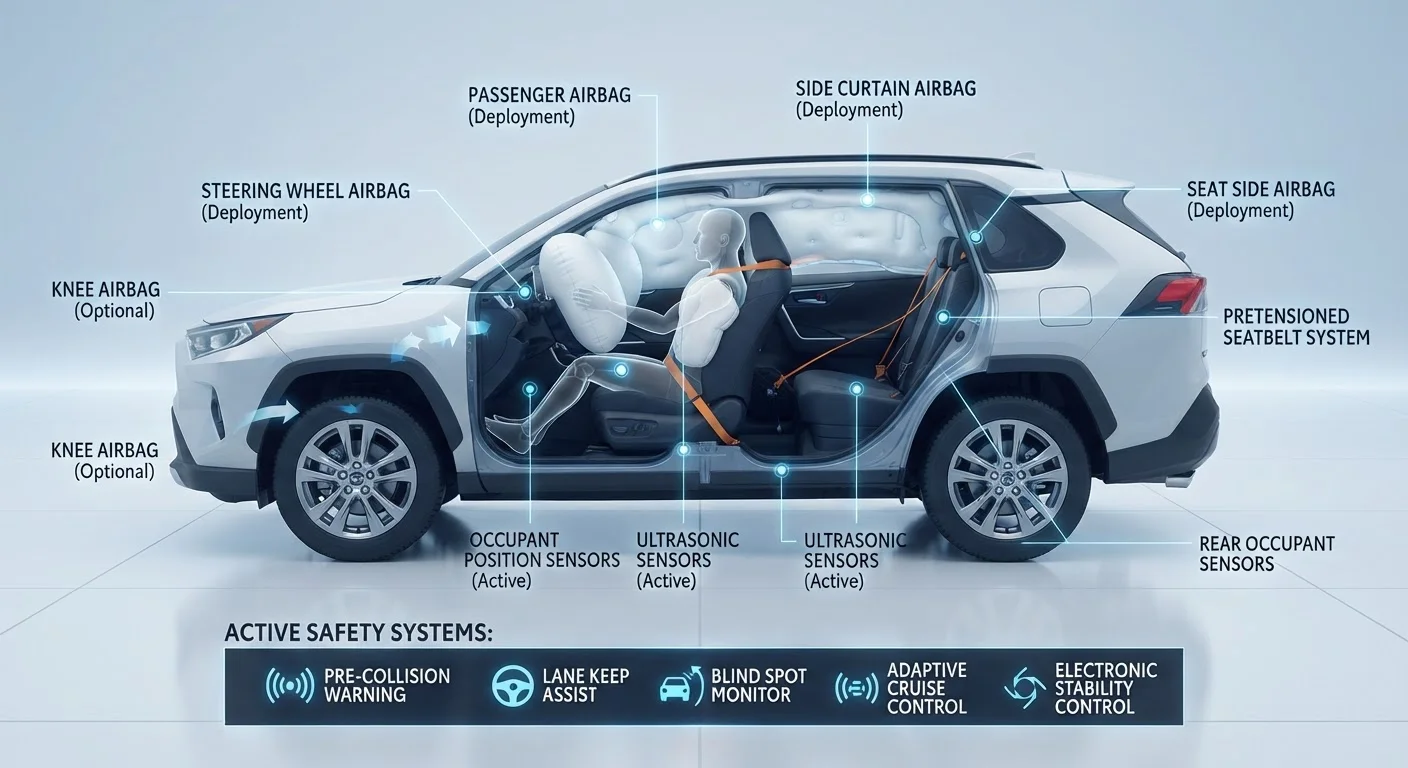
Passive safety systems are always present but only activate during or after a collision. They include seatbelts, airbags, crumple zones (sections of the vehicle body engineered to absorb impact energy), and padded interior surfaces. These systems cannot prevent a crash; their purpose is to reduce injury once one is already happening.
Active safety systems, by contrast, are continuously working before any collision occurs. They monitor your surroundings, alert you to hazards, and in many modern vehicles, intervene automatically. Examples include automatic emergency braking, lane-departure warning, and blind-spot monitoring. For a comprehensive look at how these technologies work together, see our complete overview of modern car safety technology.
Passive Safety: The Last Line of Defense
Passive systems have been the backbone of automotive safety for decades. Seatbelts — when worn correctly — remain among the most effective injury-prevention tools ever developed. Modern seatbelts include pretensioners (devices that tighten the belt instantly at impact) and load limiters that reduce chest injury during severe crashes.
Airbags have evolved significantly. Today's vehicles may include front, side, curtain, and even knee airbags, each calibrated to deploy within milliseconds and cushion specific parts of the body. Crumple zones, meanwhile, are built into the front and rear of vehicles so that collision energy is absorbed by the structure rather than transferred to occupants.
| Passive Safety | Active Safety | |
|---|---|---|
| When it operates | During or after a collision | Before a collision occurs |
| Driver action required | None — fully automatic | None to minimal — system-initiated |
| Primary examples | Airbags, seatbelts, crumple zones | Automatic braking, lane-keeping, blind-spot alerts |
| Goal | Reduce injury severity | Prevent crash from happening |
| Benefit for senior drivers | Protection regardless of reaction time | Compensates for slower response times |
| Assessed by | Crash-test ratings (NHTSA, IIHS) | Real-world crash avoidance studies |
These systems require no action from the driver — which is precisely their strength. Even in a sudden, unavoidable collision, passive protections activate automatically. Their limitation is equally clear: they cannot stop a crash from happening. To understand more about how passive and active safety differ in practical terms, see what the active vs. passive distinction actually means.
Active Safety: Prevention Before Impact
Active safety technologies have expanded dramatically over the past decade. These systems use cameras, radar, and ultrasonic sensors to continuously read the driving environment. When the system detects a potential hazard — a vehicle stopping suddenly ahead, a lane departure, or a pedestrian stepping into the road — it responds.
Responses can be tiered: first an audible or visual alert, then a physical warning (such as steering vibration), and finally an automatic intervention such as brake application or steering correction. Forward collision warning and automatic emergency braking are two distinct but related examples of this approach.
Ask About Standard vs. Optional Features
Not every active safety feature is included as standard equipment, even on newer vehicles. When evaluating a car, ask specifically which systems come as standard on the trim level you are considering, and which require an additional package. Features like automatic emergency braking are increasingly standard across many models, but blind-spot monitoring and rear cross-traffic alerts may still be optional add-ons.
For senior drivers, active systems are particularly relevant. Research from the Insurance Institute for Highway Safety and other bodies consistently suggests that systems like automatic emergency braking reduce rear-end and front-impact crashes. Slower reaction times — a normal part of aging — can be partially offset by systems that begin responding in milliseconds. Our plain-language guide to driver-assist technology explains these features in accessible detail.
Why Both Systems Matter Together
No active safety system is infallible. Sensors can be obstructed by weather, certain road geometries can confuse cameras, and some collision scenarios happen too fast for any system to fully prevent. This is why passive safety remains essential: even the safest modern vehicle is designed to protect occupants when a crash cannot be avoided.
Evaluating a vehicle solely on its airbag count or solely on its list of driver-assist features gives an incomplete picture. A vehicle with strong crash-test ratings — assessed by organizations such as the NHTSA (National Highway Traffic Safety Administration) and the IIHS (Insurance Institute for Highway Safety) — and a full suite of active driver-assist technologies offers the most layered protection.
Seniors exploring their options can find a full breakdown of relevant features in our complete overview of senior safety features, and may also find useful additions at our safety accessories hub. The goal isn't to choose between passive and active safety — it's to understand how both work so you can ask the right questions before you buy.
This article is for general informational purposes only. Vehicle safety performance varies by model, trim level, and specific equipment. Consult official safety ratings from NHTSA and IIHS, and speak with a qualified automotive professional when evaluating a specific vehicle.
The content on this site is for informational purposes only and is not a substitute for professional advice. Always consult a qualified professional for guidance specific to your situation.