

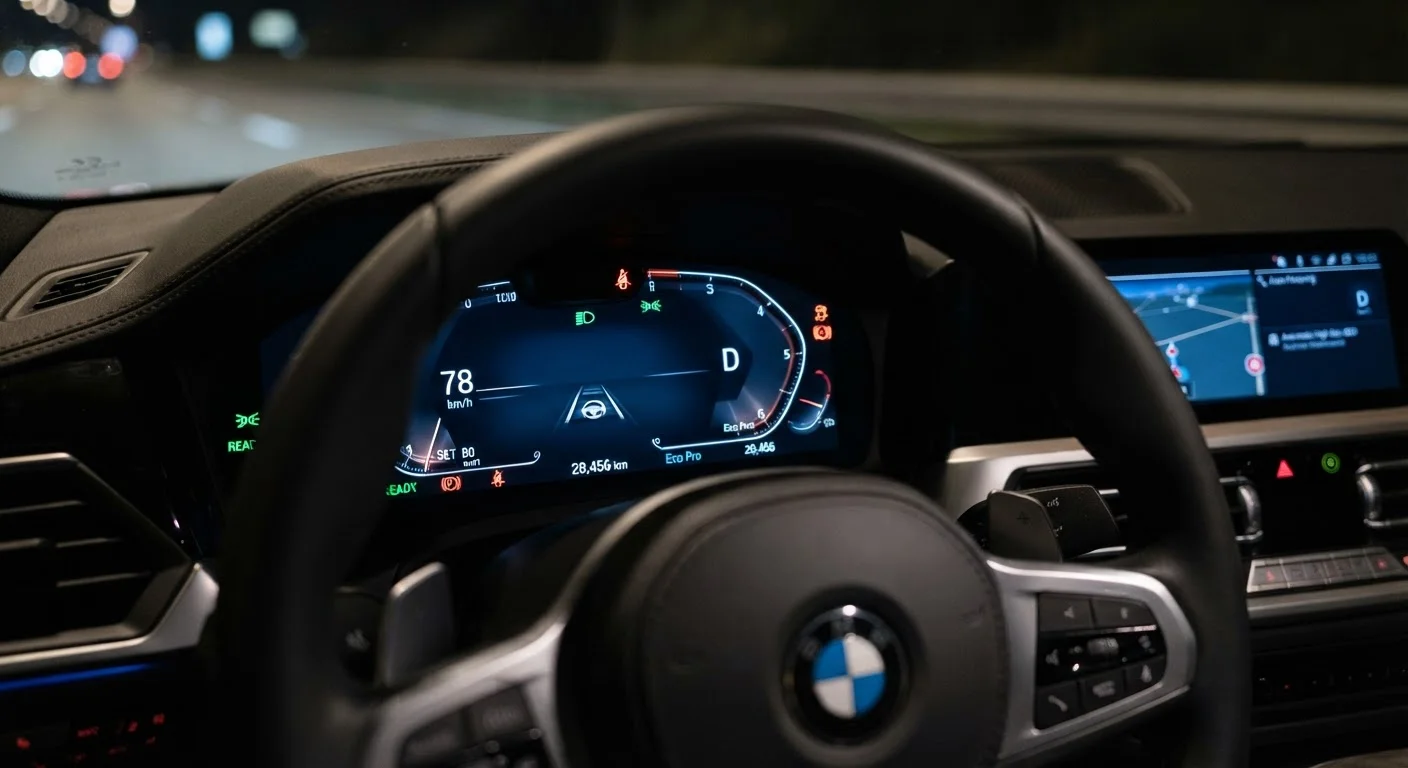
Option A
Active Safety Features
Technology that works to prevent crashes before they happen.
Best for: Drivers who want real-time assistance reducing the likelihood of collisions or loss of control.
Option B
Passive Safety Features
Engineered protection that activates once a crash has already occurred.
Best for: Drivers who want assurance that injury risk is minimized if a collision cannot be avoided.
Two Different Jobs, One Goal
When automakers and safety organizations describe vehicle safety, they consistently split it into two distinct categories: active and passive. Both exist to protect drivers and passengers, but they operate at fundamentally different points in any collision scenario.
Active safety features are systems that monitor conditions and intervene — automatically or through alerts — to help a driver avoid a crash. Passive safety features are structures and devices that do their work during and after impact, reducing harm once a collision is already happening.
Think of it this way: active systems are the vehicle trying to prevent the problem; passive systems are the vehicle managing the consequences. For seniors evaluating a vehicle purchase, understanding which category a feature belongs to clarifies exactly what protection it provides — and what it does not. See our overview of both safety pillars for a broader look at how these layers interact.
Active Safety: Preventing the Crash
Active safety systems use sensors, cameras, radar, and onboard computing to continuously assess what is happening around the vehicle. Common examples include:
- Automatic Emergency Braking (AEB): Detects an imminent forward collision and applies the brakes if the driver does not respond quickly enough.
- Lane-Keeping Assist: Gently steers or alerts the driver when the vehicle drifts out of its lane unintentionally.
- Blind-Spot Monitoring: Warns the driver of vehicles in adjacent lanes that may not be visible in mirrors.
- Adaptive Cruise Control: Maintains a safe following distance automatically, adjusting speed to match traffic.
- Rear Cross-Traffic Alert: Warns of approaching vehicles when reversing out of a parking space.
For older drivers, these systems are particularly meaningful. Reaction time naturally changes with age, and conditions like reduced peripheral vision or slower processing of complex traffic situations can increase risk. Active systems compensate for precisely these factors. To understand how specific driver-assist technologies work in practice, see our plain-language guide to driver-assist technology.
| Criterion | Active Safety Features | Passive Safety Features |
|---|---|---|
| When they operate | Before or during potential crash | During and after impact |
| Primary purpose | Prevent or mitigate collision | Reduce occupant injury |
| Driver input required | May require driver response to alerts | Fully automatic, no action needed |
| Examples | AEB, lane-keeping, blind-spot alerts | Airbags, seatbelts, crumple zones |
| Tested by | IIHS, NHTSA active safety protocols | IIHS, NHTSA crash-test ratings |
| Availability in older vehicles | Limited; often absent pre-2015 | Standard in most vehicles since 1990s |
| Benefit for seniors | Compensates for slower reaction time | Provides baseline protection regardless of age |
Passive Safety: Minimizing Injury When It Matters Most
Passive safety features require no action from the driver — they engage automatically the moment a crash occurs. Key examples include:
- Airbags: Front, side, curtain, and knee airbags deploy within milliseconds of impact to cushion occupants from hard surfaces.
- Seatbelts with Pretensioners: Tighten instantly on impact to hold occupants firmly in place, then relax slightly to manage ongoing force.
- Crumple Zones: Engineered sections of the vehicle body that deform in a controlled way, absorbing crash energy before it reaches the passenger cabin.
- Reinforced Safety Cage: The structural frame surrounding occupants, designed to maintain cabin integrity during a collision.
- Head Restraints: Correctly positioned, these reduce whiplash injury in rear impacts.
Passive systems are not optional extras — they are foundational to any vehicle's safety rating. Government crash-testing programs, such as those conducted by the National Highway Traffic Safety Administration (NHTSA) and the Insurance Institute for Highway Safety (IIHS), evaluate passive safety performance rigorously. Seniors should check how any vehicle they are considering performs in these independent assessments.
50%+
Rear-end crashes potentially avoidable with AEB
NHTSA research has suggested automatic emergency braking could prevent a significant proportion of rear-end collisions, which are among the most common crash types.
45%
Reduction in driver fatalities from frontal airbags
According to NHTSA data, frontal airbags have been associated with meaningful reductions in driver fatalities in frontal crashes since widespread adoption.
2024
Year AEB became a US federal standard requirement
NHTSA finalized a rule requiring automatic emergency braking on new passenger vehicles sold in the US, marking a milestone for active safety standardization.
Why Both Categories Matter Together
Neither active nor passive safety alone is sufficient. A vehicle with sophisticated active systems but weak structural protection leaves occupants vulnerable if a crash occurs despite those systems. Equally, a structurally excellent vehicle without active intervention features provides no help in the moments before impact.
The strongest safety profiles come from vehicles that score well in both dimensions. When reviewing a vehicle's safety credentials, it is worth asking two distinct questions: What does this vehicle do to help prevent a crash? And: What does it do to protect me if one happens?
Seniors shopping for a vehicle should also consider how much technology has evolved across model years. Our article on the safety technology gap between older and newer vehicles explains how active feature availability has changed dramatically even within the past decade.
For a deeper look at specific active systems — including how lane-keeping assist and lane departure warning differ — see our comparison of lane-safety systems. And for a comprehensive view of every safety category relevant to older drivers, the complete senior safety features overview covers the full spectrum from collision avoidance to parking aids.
Safety Ratings Reflect Both Categories
When you review NHTSA or IIHS ratings for a vehicle, look carefully at what each score actually measures. Crash-test ratings primarily reflect passive safety performance — structural integrity and airbag deployment. Active safety evaluations are often reported separately, covering systems like AEB and pedestrian detection. A high overall rating does not automatically mean a vehicle has robust active safety features; check both sections of the rating report for a complete picture.
The content on this site is for informational purposes only and is not a substitute for professional advice. Always consult a qualified professional for guidance specific to your situation.