

Why Safety Technology Matters for Senior Drivers
As drivers age, certain physical changes — reduced reaction time, decreased contrast sensitivity, and more limited neck rotation — can affect driving performance, even among experienced motorists. Modern vehicle safety systems are specifically engineered to compensate for precisely these kinds of challenges, providing an extra layer of protection without requiring the driver to do anything differently in ordinary circumstances.
Research by the Insurance Institute for Highway Safety (IIHS) and the AAA Foundation for Traffic Safety has consistently shown that many advanced driver-assistance systems (ADAS) reduce crash rates meaningfully across all age groups, with particular benefits observed among older drivers who may have slower emergency response times. Understanding the full range of available technologies — and how they interact — helps seniors and their families make informed decisions about the vehicles they drive. For a broader look at how these systems work together from the sensor level up, see our complete overview of modern car safety technology.
27%
Rear-end crash reduction with AEB
IIHS research has found that vehicles equipped with forward collision warning and automatic emergency braking experience materially fewer rear-end crashes than those without.
~20%
Lane-change crashes reduced by BSM
According to IIHS analysis, blind-spot detection systems are associated with a meaningful reduction in lane-change injury crashes.
1 in 6
Drivers aged 70+ involved in fatal crashes
NHTSA data indicates that older adults represent a significant share of fatal crash involvement, underscoring the importance of supportive vehicle technology.
Collision Avoidance and Automatic Emergency Braking
Automatic Emergency Braking (AEB) is one of the most consequential safety advances in recent automotive history. Using forward-facing radar and cameras, AEB systems detect a potential collision with a vehicle or pedestrian ahead and — if the driver does not respond in time — apply the brakes automatically to reduce impact severity or avoid the crash entirely.
For senior drivers, whose brake-response time may be slightly longer than it was at age 40, this intervention window can be decisive. Forward collision warning (FCW), the visual or audible alert that precedes automatic braking, also gives drivers a clear prompt to act sooner. Many AEB systems now include pedestrian and cyclist detection, making them valuable in urban environments where older pedestrians frequently travel.
AEB Does Not Prevent All Collisions
Automatic emergency braking is a supplemental safety system, not a fail-safe. It can be limited by sensor obstructions, adverse weather conditions (heavy rain, snow, or fog), and very fast-closing speed differentials. Drivers should never assume AEB will intervene and must always maintain appropriate following distances and attentive driving habits.
It is worth noting that AEB operates within defined speed ranges — typically up to highway speeds for vehicle detection and lower speeds for pedestrian detection. Drivers should review their specific vehicle's owner manual for operational limits.
Lane Keeping, Blind-Spot, and Cross-Traffic Systems
Lane departure warning (LDW) alerts a driver when the vehicle drifts across lane markings without a turn signal active. The more advanced version, lane keeping assist (LKA), applies gentle steering torque to guide the vehicle back into its lane. For seniors who experience any micro-fatigue on longer trips, these systems add a meaningful safety net.
Blind-spot monitoring (BSM) uses rear-facing radar to detect vehicles in adjacent lanes, illuminating a warning light in the corresponding mirror. Given that turning to check blind spots can be physically uncomfortable for drivers with arthritis or reduced neck mobility, BSM addresses a real and common challenge. Paired with rear cross-traffic alert (RCTA) — which warns of approaching vehicles when reversing — these systems collectively handle the most vulnerable angles in everyday driving.
For a focused comparison of which of these technologies provides the greatest day-to-day benefit, our editorial team has detailed these systems in the article safety features that make the biggest difference for older drivers.
When evaluating a vehicle's blind-spot system, test it during a brief highway drive before purchase: some systems have longer detection lag times or smaller detection zones that may not suit all driving styles.
Detection range and response speed vary between manufacturers, and a brief real-world test reveals practical differences that spec sheets rarely communicate.
Ask the dealership or delivery specialist for a dedicated 30-minute walkthrough of every ADAS feature before driving off the lot — many drivers only discover key features months later from the manual.
Studies on ADAS adoption consistently show that drivers who receive a structured demonstration use safety systems more correctly and confidently than those who self-learn.
Adaptive Cruise Control and Speed Management
Adaptive cruise control (ACC) extends traditional cruise control by automatically maintaining a set following distance from the vehicle ahead, adjusting speed in traffic without requiring repeated manual input. For seniors who drive on interstates or rural highways, ACC reduces the cognitive load of constant speed management and can diminish the fatigue associated with stop-and-go conditions.
More sophisticated versions — sometimes called traffic jam assist or low-speed follow — operate down to a complete stop and resume automatically, which is particularly useful in highway congestion where repeated braking and accelerating can be tiring. As with all ADAS features, understanding the limits of the system is important: ACC does not replace the need to watch for vehicles cutting in or for road hazards the system may not detect.
Parking Aids and Rear-View Technologies
Parking-related incidents account for a disproportionate share of low-speed vehicle damage and pedestrian interactions. Several technologies directly address this:
- Rear-view (backup) cameras are now federally mandated on all new vehicles sold in the United States. They provide a direct view of the area behind the vehicle that mirrors alone cannot cover.
- Parking sensors (front and rear ultrasonic sensors) emit audible tones that increase in frequency as the vehicle nears an obstacle, offering an intuitive proximity guide.
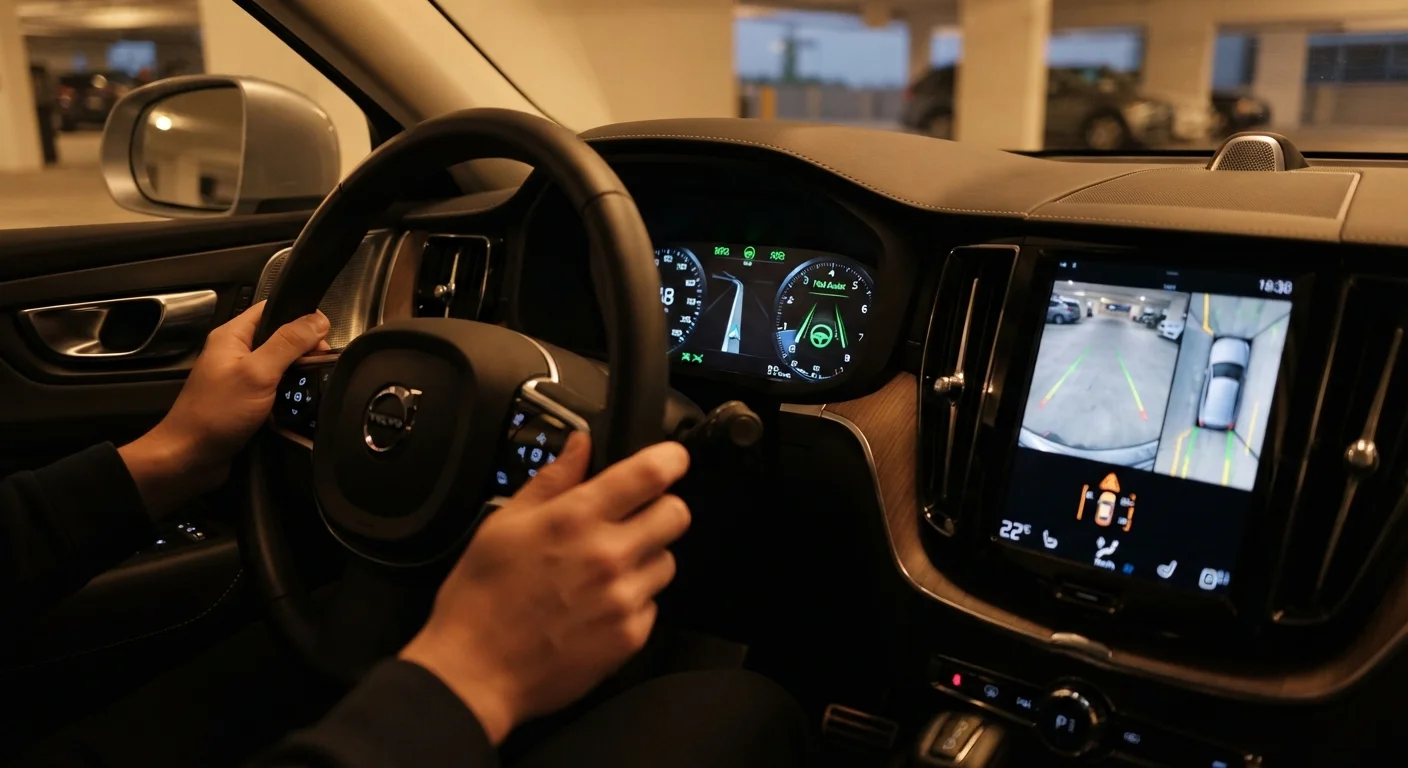
- Surround-view / 360-degree camera systems stitch together multiple camera feeds to create a bird's-eye view of the vehicle, making tight parking spaces considerably less stressful.
- Automated parking assist uses sensors and steering control to guide the vehicle into a parallel or perpendicular space while the driver manages the pedals — a significant aid for those who find spatial orientation in tight spaces challenging.
For drivers who want to augment an older vehicle's capabilities, safety accessories for older drivers covers aftermarket camera and sensor options worth considering.
Keep Cameras and Sensors Clean
Rear cameras and parking sensors can lose effectiveness when coated in mud, ice, or road grime. Make cleaning these components part of your routine vehicle wash — a soft cloth and mild cleaner on the camera lens is usually all it takes. In winter climates, briefly warming the vehicle before reversing can help clear frost from camera lenses.
In-Cabin Alerts and Driver Monitoring
A newer generation of safety tools focuses not on the road outside but on the driver inside. Driver monitoring systems (DMS) use in-cabin cameras to observe eye movement, head position, and blink rate. If the system detects signs of drowsiness or prolonged inattention, it issues an audible and visual alert prompting the driver to take a break.
These systems are increasingly relevant for older drivers who may experience fatigue more readily on extended trips, or who may be managing medications that affect alertness. Some vehicles also include attention assist features that track steering behavior for erratic micro-corrections associated with drowsiness.
“Driver monitoring technology represents a meaningful shift — we're moving from systems that watch the road to systems that also watch the driver, which is where a significant share of crash risk originates.”
— David Harkey, President, Insurance Institute for Highway Safety (IIHS)
Additionally, many modern vehicles include speed limit information displays that read roadway signs and show the current posted limit on the instrument cluster — a useful reference that removes the need to notice and process every sign in unfamiliar areas.
Evaluating and Using These Systems Effectively
Knowing which systems exist is only part of the equation. To benefit from them fully, drivers should take time to understand how each system on their specific vehicle behaves — including what it can and cannot do. Dealer demonstrations, owner's manual review, and programs offered by organizations such as AARP or AAA provide structured introductions to ADAS features tailored for older drivers.
It is also important to keep sensors and cameras clean and unobstructed; dirty lenses or blocked radar emitters can degrade system performance or trigger false alerts. Our tires and brakes maintenance hub is a useful companion resource, since well-maintained brakes are the foundation on which AEB systems operate most effectively.
For a structured walkthrough of individual driver-assist technologies in plain language, the article driver-assist technologies every senior should know about is an accessible starting point. Seniors evaluating aftermarket add-ons for older vehicles may also find the senior driving safety accessories resource and the safety accessories hub helpful for identifying practical supplemental tools.
This article provides general educational information about vehicle safety technologies. It is not a substitute for professional advice from a licensed mechanic, driving rehabilitation specialist, or medical professional regarding your individual driving needs and capabilities. Always consult your vehicle's owner manual and a qualified professional before relying on or modifying any safety system.
The content on this site is for informational purposes only and is not a substitute for professional advice. Always consult a qualified professional for guidance specific to your situation.