

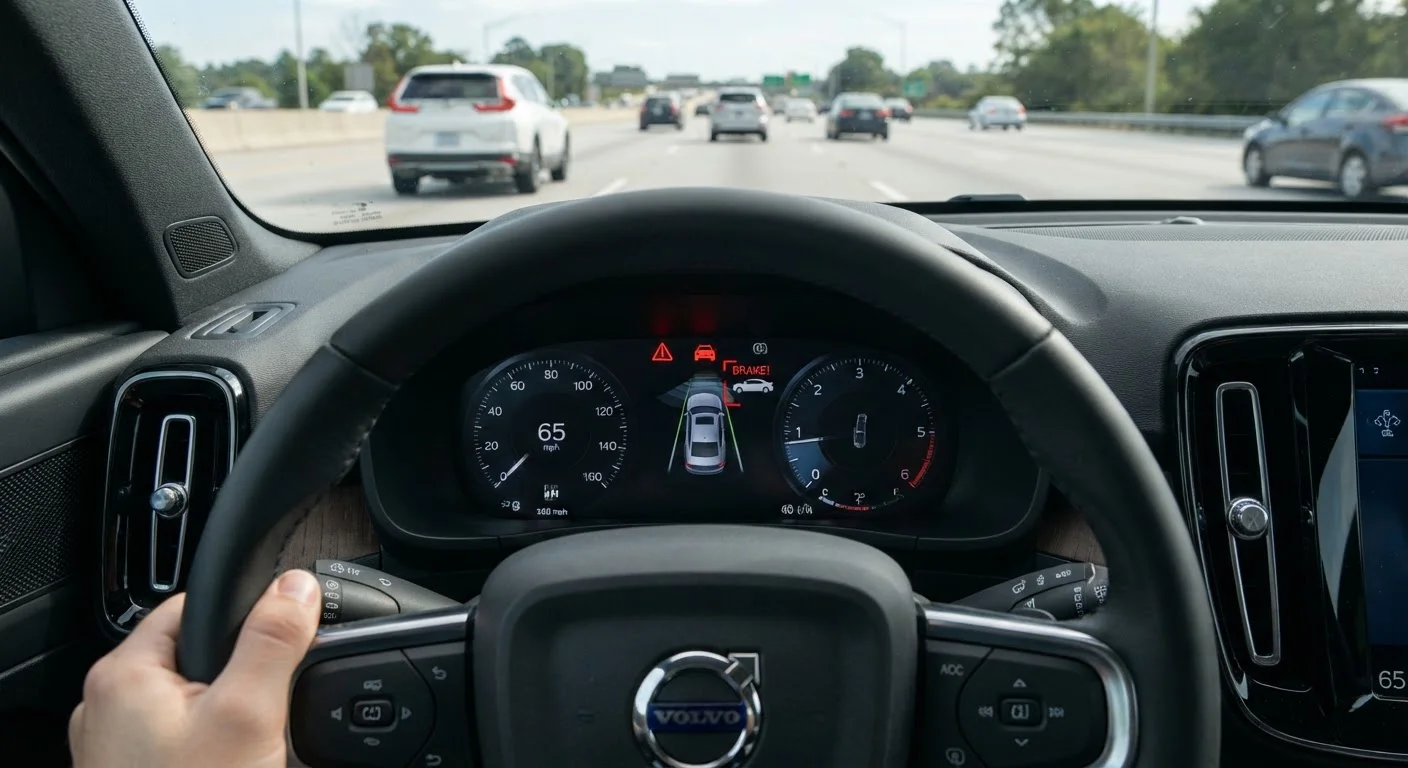
Option A
Forward Collision Warning (FCW)
The alert system that puts the driver in control.
Best for: Drivers who want earlier awareness of hazards but prefer to remain fully in command of braking decisions.
Option B
Automatic Emergency Braking (AEB)
The active system that intervenes when reaction time runs out.
Best for: Drivers who want a system that can physically reduce collision severity even when braking is delayed.
How Each System Works
Both Forward Collision Warning (FCW) and Automatic Emergency Braking (AEB) use sensors — typically radar, cameras, or a combination — to monitor the road ahead and detect objects that may be on a collision course with your vehicle. That's where the similarity largely ends.
FCW is a passive warning system. When it detects that your vehicle is closing in on another car, pedestrian, or obstacle too quickly, it triggers an alert — usually a beep, a visual indicator on the dashboard, or a vibration in the steering wheel or seat. The system is telling you: act now. But it does not act for you. Braking remains entirely your responsibility.
AEB is an active intervention system. It monitors the same hazard data, but if the driver fails to brake — or brakes insufficiently — the system can apply the brakes autonomously. Depending on the vehicle and speed, AEB may partially reduce speed to lessen impact force, or bring the car to a complete stop. For a deeper look at how this process unfolds, see what AEB does and what it can't.
| Criterion | Forward Collision Warning (FCW) | Automatic Emergency Braking (AEB) |
|---|---|---|
| Primary function | Alerts driver to imminent collision risk | Applies brakes autonomously if needed |
| Driver action required | Yes — driver must brake | No — system can brake independently |
| Sensors used | Radar, cameras, or both | Radar, cameras, or both |
| Alert type | Audio, visual, or haptic warning | May include warning before braking |
| Crash reduction potential | Depends on driver response speed | Can reduce severity even without driver response |
| Common availability | Standard on many new vehicles | Increasingly standard; may be optional on some trims |
| Limitation | Ineffective if driver reaction is too slow | May not fully stop vehicle at high speeds |
Why the Distinction Matters for Older Drivers
Reaction time naturally slows with age. Research consistently shows that the gap between perceiving a hazard and completing a braking response lengthens as drivers get older — even among those who are otherwise fully capable behind the wheel. This is not a reason to stop driving; it's a reason to understand which safety systems actually account for that gap.
FCW shortens the perception window by alerting the driver sooner than they might notice the hazard themselves. That's genuinely useful. But it still depends on the driver completing the braking action quickly and correctly.
AEB adds a second layer: if the alert doesn't produce a sufficient braking response in time, the system closes that remaining gap autonomously. Data from the Insurance Institute for Highway Safety (IIHS) has indicated that vehicles equipped with AEB show meaningful reductions in rear-end crash rates compared to vehicles without the technology — a finding directly relevant to older drivers navigating highway and stop-and-go traffic.
50%
Reduction in rear-end crashes with AEB
IIHS research has indicated that AEB can reduce police-reported rear-end crashes by approximately 50% compared to vehicles without the technology.
2–3 sec
Typical driver reaction time to hazard
Studies on older driver performance suggest hazard perception and braking response can span 2–3 seconds or more, a window where AEB may intervene.
That said, neither system is infallible. Both can struggle in heavy rain, snow, fog, or when objects are partially obscured. Understanding these limits is just as important as recognizing the benefits.
When Both Systems Are Present
Many vehicles now include FCW and AEB together as part of a broader collision avoidance package. In practice, they operate sequentially: FCW fires first as a warning; if the driver doesn't respond adequately, AEB steps in. This layered approach is designed to maximize the chance of avoiding or reducing the severity of a collision.
When evaluating vehicles, it's worth asking specifically about both systems — whether they're standard or optional, what speed ranges they cover, and whether they detect pedestrians and cyclists in addition to other vehicles. Some systems activate only above certain speeds, which affects their real-world usefulness in urban driving.
For a broader look at how AEB performs across different driving conditions, this overview of how AEB works and when it kicks in covers detection mechanics and practical limitations in detail.
You may also find it useful to compare how similar alert-versus-action distinctions play out in lane safety systems — lane-keeping assist vs. lane departure warning follows the same pattern and is worth understanding alongside these collision systems.
Check Whether AEB Is Standard or Optional
On some vehicle trims, AEB may be bundled into a higher-tier package rather than included as standard equipment. When comparing vehicles, verify specifically that AEB — not just FCW — is included at the trim level you're considering. The National Highway Traffic Safety Administration (NHTSA) has worked with automakers toward broader standard inclusion, but availability varies by model year and trim.
The content on this site is for informational purposes only and is not a substitute for professional advice. Always consult a qualified professional for guidance specific to your situation.