

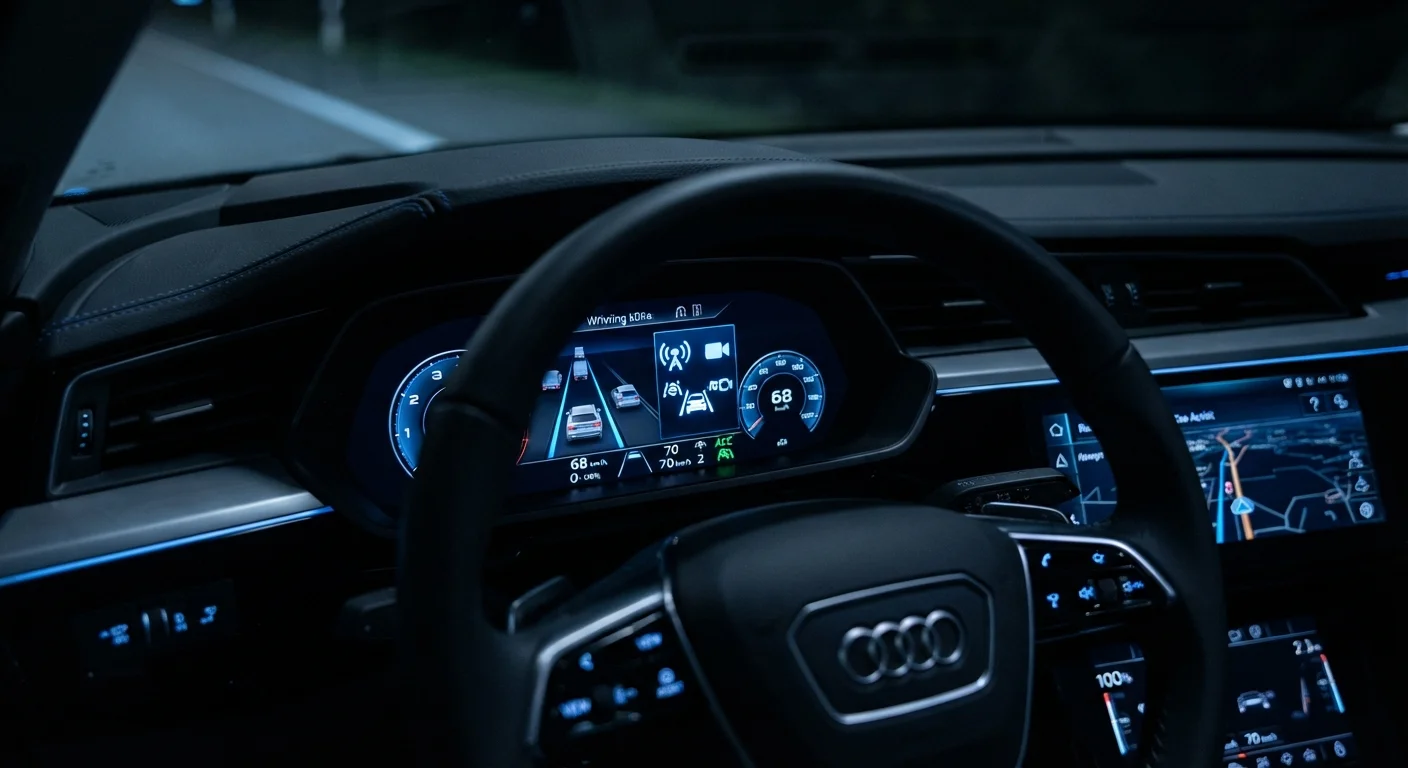
Why Modern Safety Technology Matters for Senior Drivers
Vehicles sold today carry more built-in safety technology than at any earlier point in automotive history. For senior drivers, these advances are particularly meaningful: features that monitor blind spots, warn of impending collisions, or gently keep a car centered in its lane can compensate for the slower reaction times and reduced peripheral vision that can develop with age — without requiring the driver to do anything differently.
This guide walks through every major layer of modern vehicle safety, from the hardware that senses the world around the car, to the systems that act on that information, to the crash structures that protect occupants if everything else fails. For a focused look at which individual features matter most for older drivers, see our plain-language guide to driver-assist technologies for seniors.
360°
Sensor coverage in fully equipped vehicles
Vehicles combining front radar, surround-view cameras, and side ultrasonic sensors can monitor a full circle around the car at low speeds.
~50%
Reduction in rear-end crashes with AEB
IIHS research has found that automatic emergency braking systems can substantially reduce the rate of rear-end police-reported crashes.
8+
Airbags in many modern vehicles
Where earlier vehicles had two front airbags, today's models commonly include front, side-curtain, knee, and sometimes rear-seat airbags.
The Sensors Behind the Systems
Every driver-assist feature depends on hardware that perceives the driving environment. Most modern vehicles combine several distinct sensor types, each suited to different conditions:
- Radar: Radio waves sent and reflected back measure the distance and speed of other vehicles. Radar works reliably in rain, fog, and darkness — conditions where cameras struggle. It is the backbone of adaptive cruise control and automatic emergency braking on most vehicles.
- Cameras: Forward-facing, rear-facing, and side-mounted cameras read lane markings, traffic signs, and pedestrians. A rear-view camera (now federally required on all new U.S. passenger vehicles) uses this technology. Cameras provide rich visual detail but can be affected by glare, dirt, or low light.
- Ultrasonic sensors: These short-range devices, usually embedded in bumpers, emit sound pulses to detect nearby objects — the same principle used in parking-distance warnings that beep as you approach a wall or post.
- LiDAR (Light Detection and Ranging): Uses pulsed laser light to build a precise three-dimensional map of surroundings. Currently more common in higher-end vehicles and autonomous test programs than in mainstream models.
No single sensor type covers every scenario perfectly, which is why vehicles fuse data from multiple sensors simultaneously — a process called sensor fusion. The result is a more accurate, redundant picture of the car's surroundings than any one sensor could provide alone.
When comparing vehicles, ask specifically which sensors power each safety feature — a system listed as 'standard' may rely only on a camera in one vehicle and on radar-camera fusion in another, with meaningful differences in all-weather reliability.
Sensor type directly affects how a system performs in rain, darkness, and low-contrast conditions — factors that are rarely spelled out in marketing descriptions.
After any bumper repair or sensor replacement, have the shop perform a sensor recalibration before relying on driver-assist features again — a misaligned radar or camera can give false confidence.
Collision repair can shift sensor angles by only a fraction of a degree, but that is enough to cause AEB or lane-keeping systems to behave incorrectly.
Key Active Safety Systems Explained
Active safety systems are features that can take some action — a warning, a corrective input, or an automatic brake application — rather than simply absorbing crash energy. The most widely available include:
- Automatic Emergency Braking (AEB)
- Detects an imminent collision and applies the brakes if the driver has not responded in time. Many systems also detect pedestrians and cyclists. AEB has been shown in real-world data to reduce rear-end crashes.
- Lane-Departure Warning (LDW) and Lane-Keeping Assist (LKA)
- LDW alerts the driver when the vehicle drifts across a lane line without a turn signal. LKA goes further, applying a gentle steering input to guide the car back toward the center. This distinction matters: LKA acts; LDW only warns.
- Blind-Spot Monitoring (BSM)
- Uses rear-side radar to detect vehicles in the adjacent lanes that fall outside normal mirror visibility. A light appears in or near the corresponding mirror; some systems also alert if you signal toward an occupied blind spot.
- Adaptive Cruise Control (ACC)
- Maintains a driver-set following distance behind the vehicle ahead, accelerating and braking automatically in highway traffic. Some versions work down to a full stop, useful in heavy congestion.
- Rear Cross-Traffic Alert (RCTA)
- Warns of vehicles or pedestrians crossing behind the car while reversing — particularly useful in parking lots where sightlines are limited.
For a side-by-side look at how these systems compare across vehicle classes, our driver-assist technology guide covers the topic in plain language.
Active Systems Have Real Limitations
Driver-assist technologies are designed to support attentive driving, not replace it. Automatic emergency braking, for example, may not detect stationary objects at highway speeds or may be impaired by heavy precipitation. Lane-keeping assist can be confused by faded road markings or construction zones. Never delegate full responsibility for a maneuver to an active safety system.
In-Cabin Alerts and How They Communicate
A safety system is only useful if the driver notices its warnings in time to act. Modern vehicles use three sensory channels to communicate urgency:
- Visual alerts: Warning lights in the instrument cluster or icons projected onto the windshield (a head-up display). Lights near the side mirrors indicate blind-spot hazards without requiring the driver to look away from the road.
- Audible alerts: Chimes, beeps, and tones of varying pitch and speed. A slow beep for a lane drift becomes a rapid alarm for an imminent collision. Volume typically adjusts based on how critical the warning is.
- Haptic alerts: Vibrations in the steering wheel or seat. These are especially effective because they reach the driver physically, even when background noise or hearing limitations make audio alerts harder to detect.
Systems that monitor driver attentiveness — sometimes called Driver Monitoring Systems (DMS) — use a cabin-facing camera or steering-input analysis to detect signs of drowsiness or inattention and prompt the driver to take a break. This type of feature is increasingly standard on newer models.
Alert Sensitivity Is Often Adjustable
Many vehicles allow the driver to adjust how early or how aggressively certain warnings activate — for example, the following distance threshold for adaptive cruise control or the sensitivity of lane-departure alerts. These settings are found in the vehicle's onboard menu system and are described in the owner's manual. Personalizing these settings can make alerts feel less intrusive while still providing meaningful safety coverage.
Passive Safety: What Protects You When a Crash Happens
While active systems try to prevent crashes, passive safety refers to features designed to protect occupants when a collision cannot be avoided. These include:
- Crumple zones: Sections of the vehicle body engineered to deform in a controlled way, absorbing crash energy before it reaches the passenger compartment.
- Airbags: Front airbags have been federally required since the mid-1990s. Modern vehicles typically include side-curtain airbags, knee airbags, and sometimes rear-seat airbags as well. Together, they cushion occupants from multiple impact directions.
- Seat belt pretensioners: At the moment of a crash, these devices retract the belt instantly to remove slack and hold the occupant firmly in place, working in concert with the airbag system.
- Reinforced roof and door structures: High-strength steel and advanced materials resist intrusion from side impacts and rollovers, maintaining survival space around occupants.
Passive safety improvements have compounded over decades. The combination of better structural engineering and more airbag positions means that occupants in newer vehicles benefit from substantially more protection than was available even fifteen years ago.
Understanding Safety Ratings and What They Tell You
Two independent U.S. organizations test vehicles and publish safety ratings that consumers can use when evaluating options:
- National Highway Traffic Safety Administration (NHTSA): A federal agency that conducts standardized crash tests — frontal, side, and pole impacts — and rates results in stars (one to five). NHTSA also administers the federally mandated rollover resistance rating.
- Insurance Institute for Highway Safety (IIHS): A nonprofit funded by auto insurers that conducts its own battery of tests, including a small overlap frontal crash designed to replicate common real-world collisions. IIHS also evaluates headlight quality and the effectiveness of front crash prevention systems, awarding a Top Safety Pick or Top Safety Pick+ designation to qualifying vehicles.
Neither organization promotes or sells vehicles. Their ratings reflect standardized, repeatable test conditions — not the full range of real-world crash scenarios — so they are best used as one input among several when assessing a vehicle's safety profile. For help decoding the feature names listed alongside ratings on vehicle spec sheets, our guide to safety feature names on window stickers is a useful quick reference.
“Crash test ratings give consumers a standardized, objective basis for comparison, but no test can replicate every real-world crash scenario. Ratings are best understood as one useful data point alongside factors like active safety feature availability and real-world ownership records.”
— IIHS Research Communications, Insurance Institute for Highway Safety — public research guidance
Making the Most of Your Vehicle's Safety Features
Owning a car with advanced safety technology is only the first step. These systems require correct setup and a basic understanding of what they do — and do not — cover.
- Read the owner's manual sections on driver-assist features. Each manufacturer implements these systems differently. Alert thresholds, sensor placement, and override behavior vary even among vehicles with the same feature name.
- Calibrate your expectations. Active safety systems are designed to assist, not replace, driver judgment. They can fail in heavy rain, direct sunlight, dirty sensors, or unusual road markings. Treat them as a backup layer, not an autopilot.
- Keep sensors clear. Camera lenses and radar emitters are often located behind badges, in bumpers, or near mirrors. A buildup of ice, mud, or car-wash residue can degrade performance. Many vehicles will display a sensor-blocked warning when this occurs.
- Test features in a safe environment first. Parking-assist systems, for example, are worth practicing in an empty lot before relying on them in a busy parking structure.
For step-by-step guidance on initial setup, see Getting the Most Out of Your Car's Safety Systems From Day One. Once you are comfortable with the basics, practical day-to-day guidance can help you build good habits over time. For a comprehensive look at the full range of features relevant to senior drivers, our complete overview from braking to parking aids covers each category in depth.
This article is for general informational and educational purposes only. Vehicle safety system behavior, availability, and performance vary by make, model, and trim level. Always consult your vehicle's owner's manual and, where relevant, a qualified automotive professional.
The content on this site is for informational purposes only and is not a substitute for professional advice. Always consult a qualified professional for guidance specific to your situation.