

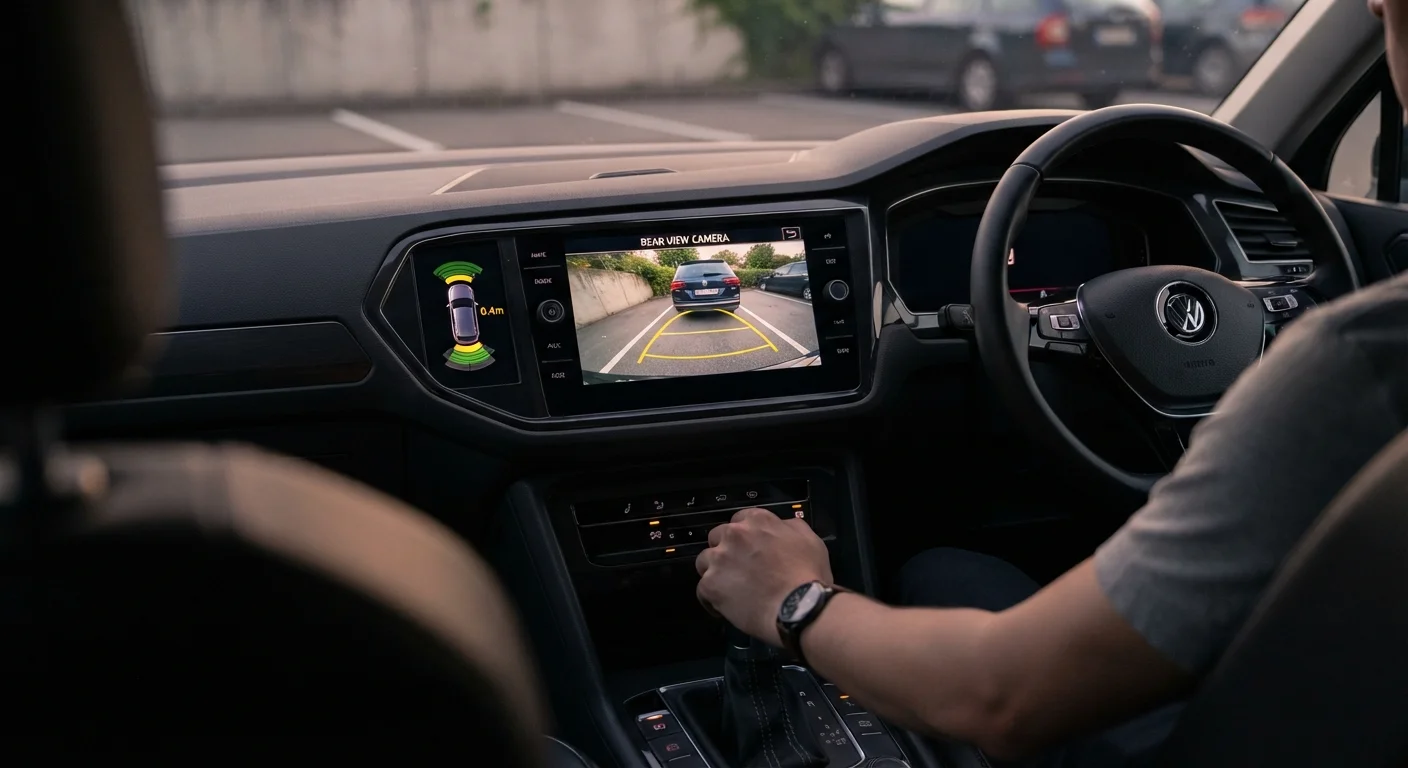
Option A
Reversing Camera
The visual, real-time view of what's directly behind your car.
Best for: Drivers who want to see exactly what — or who — is behind them as they reverse.
Option B
Parking Sensors
The audio and proximity alert system that measures distance to obstacles.
Best for: Drivers who need precise distance feedback when maneuvering in tight spaces.
How Each System Actually Works
A reversing camera (sometimes called a backup camera) is a small wide-angle camera mounted at the rear of the vehicle. When you shift into reverse, it automatically sends a live video feed to a screen — typically on the dashboard or rearview mirror — showing what is directly behind you. Many cameras also overlay colored guidelines that indicate your car's projected path.
A parking sensor works on an entirely different principle. Sensors — usually small discs fitted into the front or rear bumper — emit ultrasonic pulses. When those pulses bounce back off an object, the system calculates how close that object is and triggers an alert. Most systems use beeping tones that increase in frequency as you approach an obstacle, while some also show a visual distance reading on the dashboard.
Understanding this distinction matters: cameras tell you what is there; sensors tell you how far away it is. That is a meaningful difference in practice.
| Criterion | Reversing Camera | Parking Sensors |
|---|---|---|
| Output type | Live video image on screen | Audio beeps or visual distance bar |
| Primary strength | Identifies what is behind the car | Measures how close an obstacle is |
| Works in low light | Partially — depends on camera quality | Yes — unaffected by lighting |
| Detects thin objects | Yes, if in camera frame | Sometimes missed between sensors |
| Distance accuracy | Difficult — wide-angle distorts depth | Good — graduated alerts indicate proximity |
| Affected by weather or dirt | Yes — lens obstruction reduces visibility | Minimal impact on most systems |
| Required on new US vehicles | Yes — since May 2018 | No federal mandate |
What Each System Does Well — and Where It Falls Short
Reversing cameras excel at revealing the broad picture behind your vehicle. They are particularly helpful for spotting low objects, children, or cyclists that sit below the sightline of conventional mirrors. Since 2018, reversing cameras have been federally mandated on all new passenger vehicles sold in the United States, reflecting their established safety value.
However, cameras have real limitations. Image quality can degrade in heavy rain, glare, or dirt on the lens. A wide-angle lens also distorts distance perception, so an object that looks far away may be closer than it appears. Drivers sometimes over-rely on the screen and forget to check mirrors or physically scan the area.
Parking sensors, meanwhile, are very good at one thing: measuring proximity in a specific arc. They do not care about lighting conditions and they respond equally well to stationary and moving objects. But they cannot distinguish between a concrete pillar and a passing pedestrian — and thin objects like poles or bicycle frames can sometimes slip between sensors undetected.
For a broader look at technologies relevant to older drivers, see Safety Features That Make the Biggest Difference for Older Drivers.
Neither System Replaces Attentive Reversing
Both reversing cameras and parking sensors are driver-assistance tools, not substitutes for checking mirrors and physically scanning the area before and during reversing. No current system detects every hazard in every condition. Treating these aids as supplements to careful driving — not replacements for it — is the safest approach.
Why Many Vehicles Now Pair Both Systems
The strengths of each system neatly address the weaknesses of the other. A reversing camera gives you visual context that sensors cannot provide; sensors give you reliable distance measurements that a camera image alone makes difficult to judge accurately. Together, they offer a more complete picture of what is happening behind and around your vehicle at low speed.
This pairing is especially relevant for seniors, whose peripheral vision and neck rotation can be more limited than in younger drivers. Having both a visual reference and an audio distance alert means less physical strain and more confidence when reversing. You can read more about how these tools work in combination in Rear Cross-Traffic Alert and Backup Cameras: A Safety Pair Worth Understanding.
If your current vehicle has one system but not the other, aftermarket options exist for both. That said, installation quality and sensor placement significantly affect how well they perform. The Case For and Against Aftermarket Reversing Cameras covers the trade-offs worth considering before going that route. For a broader overview of parking and reversing technology — including 360-degree systems — see Rear-View Cameras vs. 360-Degree Surround-View Systems.
2018
Year reversing cameras became mandatory on new US cars
The National Highway Traffic Safety Administration (NHTSA) required reversing cameras on all new light vehicles sold in the US from May 2018 onward.
~46%
Rear-blind-zone fatalities involving children under 5
NHTSA data has indicated that young children represent a disproportionate share of backing fatalities, underlining the importance of rear visibility aids.
The content on this site is for informational purposes only and is not a substitute for professional advice. Always consult a qualified professional for guidance specific to your situation.