

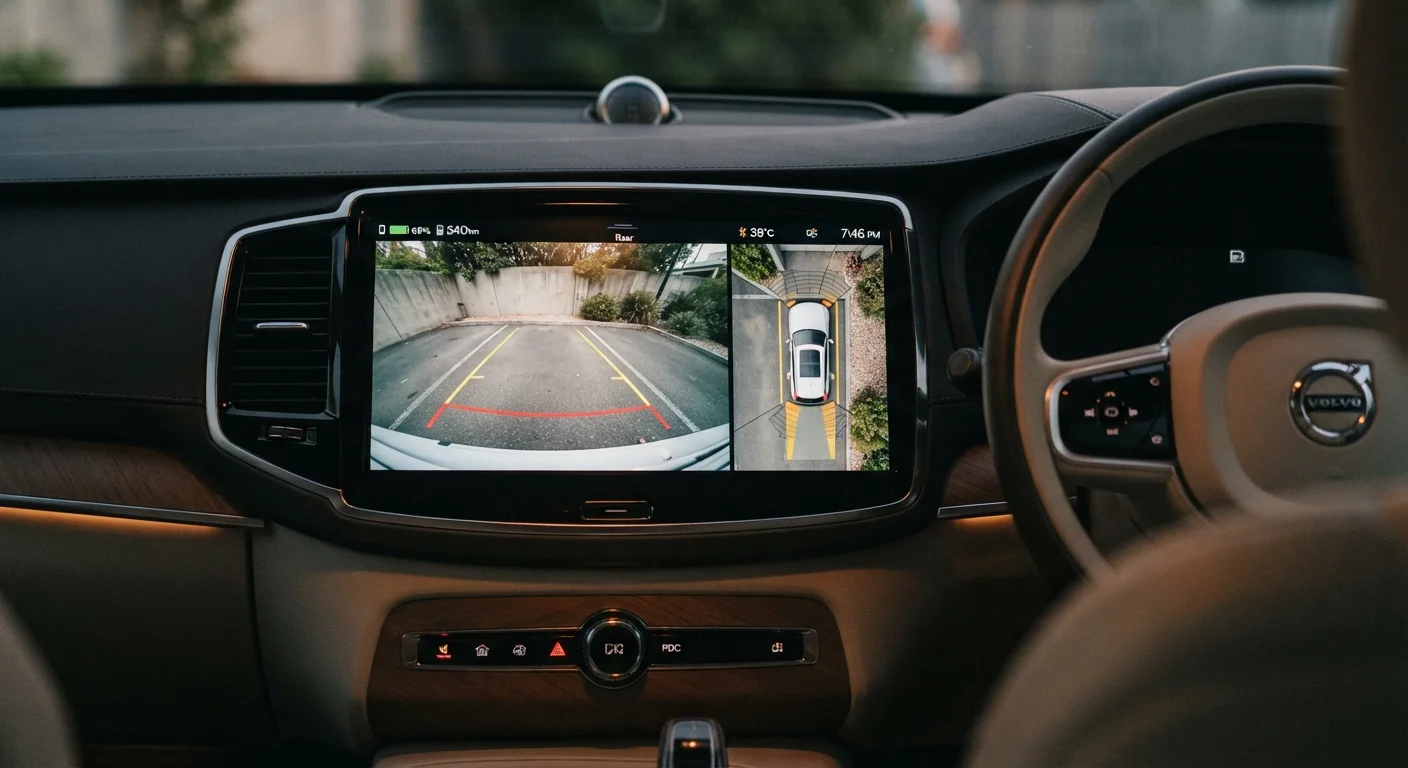
Option A
Rear-View Camera
The federally mandated, widely available baseline.
Best for: Drivers who primarily need help reversing straight out of a driveway or parking space.
Option B
360-Degree Surround-View System
The comprehensive, multi-angle upgrade for tighter situations.
Best for: Drivers who navigate tight parking garages, crowded lots, or frequently maneuver in confined spaces.
How Each System Works
A rear-view camera (also called a backup camera) is a single wide-angle lens mounted at the vehicle's rear. When you shift into reverse, a live video feed appears on the dashboard screen, typically overlaid with colored trajectory guidelines that show where the vehicle is heading. The image is wide but flat — you see behind the car, not beside it.
A 360-degree surround-view system uses four or more cameras — usually mounted at the front, rear, and both side mirrors. Software stitches those feeds together in real time, producing a composite image that looks as though a drone is hovering directly above your car. Most systems also let you toggle to individual camera views for detail. For context on broader visibility factors beyond cameras, see our guide to driver's seat visibility.
| Criterion | Rear-View Camera | 360-Degree Surround-View System |
|---|---|---|
| Number of cameras | One (rear-mounted) | Four or more (all sides) |
| View provided | Direct rear feed with guidelines | Composite bird's-eye overhead view |
| Standard on new vehicles | Yes — federally required since 2018 | No — typically an optional upgrade |
| Ease of image interpretation | Straightforward single image | Requires brief learning period |
| Coverage of side blind spots | None | Yes — via side mirror cameras |
| Added cost | Included in base price | Often bundled in mid/upper trims |
Practical Differences That Matter to Senior Drivers
For most everyday reversing situations — backing out of a garage, pulling out of a perpendicular parking space — a rear-view camera does the job well. The single image is straightforward to interpret, and the colored guide lines give immediate feedback on steering angle.
Where the rear-view camera falls short is in situations that require awareness beyond the car's immediate rear. It won't show you a bollard inches from your front bumper while you're completing a three-point turn, nor will it reveal how close your driver's side mirror is to a concrete pillar.
That's where a surround-view system earns its keep. The overhead perspective makes it dramatically easier to center a vehicle in a parking bay or judge clearance when squeezing into a tight garage. However, the stitched image can appear slightly distorted, particularly at the seams where camera feeds join. Some drivers — especially those less familiar with digital displays — find the composite image takes a few weeks of practice to read confidently.
2018
Year rear-view cameras became federally required
The U.S. National Highway Traffic Safety Administration (NHTSA) mandated rear visibility technology on all new passenger vehicles from May 2018.
4+
Cameras used in a typical surround-view system
Most 360-degree systems use at least four wide-angle cameras — front, rear, and one per side mirror — stitched together by onboard software.
Both systems share an important limitation: they cover low-speed maneuvering only. Neither replaces a careful mirror check before reversing or a scan for cyclists and pedestrians. For a broader look at how backup cameras and alert systems work together, see how rear cross-traffic alerts pair with backup cameras.
Cost, Availability, and What to Look For
Because rear-view cameras are federally mandated on all new U.S. passenger vehicles sold since May 2018, they come standard regardless of trim level. The quality of the screen that displays the image, however, varies. A base-trim display may be small or lower resolution; a higher trim may offer a larger, crisper image — which can matter more than people expect as screen readability becomes a priority.
Surround-view systems are almost always optional packages, often bundled with other driver-assist features in a mid or upper trim. Depending on the vehicle, this can add anywhere from a few hundred to over a thousand dollars to the purchase price. If you're weighing aftermarket alternatives, a look at aftermarket reversing cameras outlines the trade-offs clearly.
Screen Size and Resolution Matter
Even the best camera system is only as useful as the screen displaying it. When comparing vehicles, check the display's size, brightness, and how it performs in direct sunlight. A high-quality camera paired with a small or dim screen can be harder to use than a modest camera on a large, clear display. This is especially relevant for drivers who find small text or images harder to read.
When evaluating either system on a test drive, pay attention to: how quickly the image appears when you shift into reverse, whether the screen washes out in bright sunlight, and how naturally the guidelines correspond to your steering inputs. These practical details vary more than the technology category alone suggests. You may also find it helpful to compare how reversing cameras compare to parking sensors as complementary tools.
The content on this site is for informational purposes only and is not a substitute for professional advice. Always consult a qualified professional for guidance specific to your situation.