

Why Night Vision Declines with Age
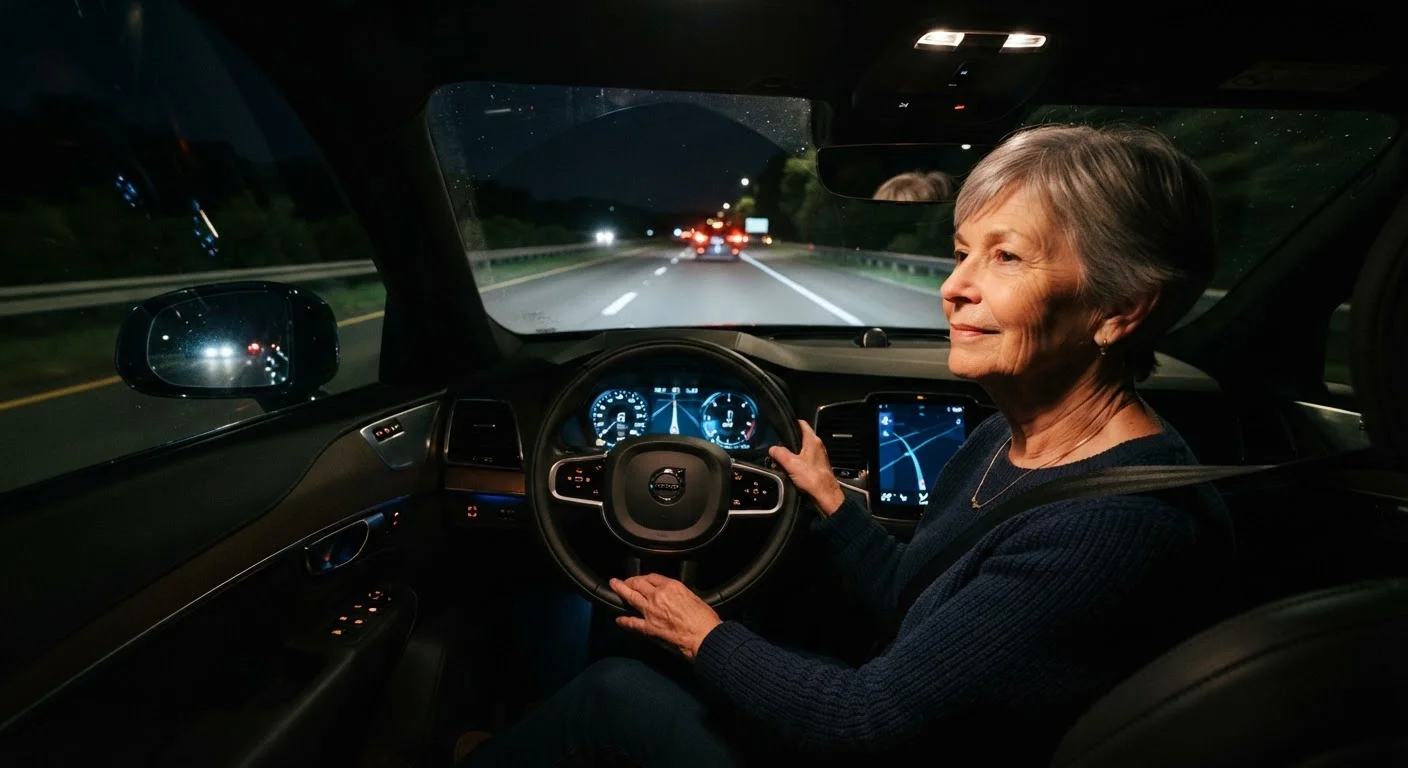
The human eye undergoes measurable structural changes over decades of use. By the time a driver reaches their late 60s, several of these changes directly affect night driving performance. The pupil's maximum dilation decreases, meaning less light reaches the retina in dark conditions. The lens gradually loses some of its transparency, scattering incoming light and creating more perceived glare from oncoming headlights or streetlamps.
Contrast sensitivity — the ability to distinguish objects from similarly-toned backgrounds — also declines with age. This makes it harder to spot a pedestrian in dark clothing at the edge of a roadway, or to read faded lane markings on an unlit highway. Recovery time after a bright light source passes (called glare recovery) slows as well, leaving drivers temporarily dazzled longer than younger drivers would be.
These are well-documented physiological changes, not rare conditions. They affect the majority of drivers over 60 to some degree and represent the primary reason that night driving becomes a concern as people age. Understanding the mechanism helps explain precisely why modern lighting technologies can make a practical difference.
Regular Eye Exams Are the First Line of Defense
No vehicle technology fully compensates for undertreated vision conditions. Cataracts, which are highly treatable, are among the most common causes of reduced contrast sensitivity and increased glare sensitivity in drivers over 60. Discussing night driving concerns with an eye care provider — before evaluating vehicle technology — is the most practical starting point for most older drivers.
How Adaptive and High-Performance Headlights Compensate
Standard fixed headlights point straight ahead regardless of where the vehicle is turning. On a curve, this means the road ahead is briefly outside the lit zone — a gap that matters more when reaction time is slower. Adaptive headlights address this by pivoting the light beam to follow the steering wheel's direction or by anticipating curves using map data. The practical result is that the driver sees the road they are about to enter, not just where the car currently points.
LED and matrix LED headlights offer a different but complementary advantage. They produce a crisper, whiter light spectrum that improves contrast at the road surface — particularly useful for drivers whose color processing has shifted slightly with lens yellowing. Matrix systems can also selectively dim segments of the beam to avoid blinding oncoming drivers while keeping the surrounding road well-lit, reducing the glare exchange that older eyes handle less efficiently.
For seniors who drive regularly after dark, these features are among the most relevant considerations when evaluating a vehicle. They are part of a broader set of technologies covered in our guide to safety features that make the biggest difference for older drivers.
Check Headlight Aim Before Night Driving Season
Even correctly installed headlights can lose proper vertical aim over time due to road vibration or minor suspension wear. Misaimed headlights reduce effective lighting distance and may blind other drivers. Ask a qualified mechanic to inspect headlight aim during routine service — it is a quick and inexpensive adjustment that can meaningfully improve nighttime visibility.
Active Night-Vision Systems: What They Do and Don't Do
Active night-vision systems use infrared cameras — either near-infrared or thermal (far-infrared) — to detect objects beyond the reach of standard headlights, typically up to 300–500 feet ahead. The processed image is displayed on a dashboard screen or head-up display, often with automatic highlighting when the system detects a pedestrian or large animal.
The practical benefit for older drivers is extended reaction time. If a deer or a pedestrian appears at 400 feet on a dark road, a driver using low beams alone may have only a few seconds to respond. A night-vision system can provide that information earlier, allowing a more measured response rather than an emergency reaction.
These systems are not without limitations. They require the driver to divide attention between the windshield and an additional screen — a cognitive demand that should be factored in. Thermal systems excel at detecting warm-bodied animals and people but may not highlight road debris or static hazards as clearly. And like all driver-assistance technologies, they function as a supplement to attentive driving, not a replacement for it.
~160 ft
Typical low-beam headlight range
The U.S. Department of Transportation notes that standard low-beam headlights illuminate approximately 160 feet ahead, while stopping distance at 60 mph can exceed 200 feet.
3×
More light needed by age 60 vs. age 20
Vision researchers have estimated that the average 60-year-old requires roughly three times as much light as a 20-year-old to see the same level of detail in low-light conditions.
500 ft
Potential night-vision detection range
Thermal infrared night-vision systems in some vehicles can detect large warm-bodied objects such as pedestrians or deer at distances up to approximately 500 feet, depending on conditions.
Drivers considering broader safety technology options can also explore safety technologies addressing common senior driving challenges for a fuller picture of available systems.
Practical Steps for Older Drivers
Not every senior driver needs or wants a vehicle equipped with a full matrix LED or night-vision system. There are practical steps that apply regardless of vehicle age or technology level.
- Schedule regular eye exams — ideally annually after age 60 — and discuss night driving specifically with your eye care provider. Cataracts, for example, are correctable and can dramatically improve night vision after treatment.
- Check and aim headlights — even modern headlights can drift out of proper alignment over time, reducing effective range. A qualified mechanic can inspect and adjust aim as part of routine service.
- Reduce dashboard glare — interior light reflected on the windshield competes with the driver's ability to see outside at night. Our companion article on dashboard glare and night vision accessories for older eyes covers specific products that address this.
- Limit unfamiliar night routes — familiar roads require less cognitive effort to navigate, preserving more attention for hazard detection.
For drivers exploring accessory-level solutions rather than full vehicle upgrades, our broader guide to practical safety accessories for age-related driving challenges provides additional options grounded in the specific physical changes seniors commonly experience.
This article provides general educational information about automotive safety technologies. It is not a substitute for professional medical advice regarding vision health, or for guidance from a qualified mechanic regarding vehicle lighting systems. Individual results and technology capabilities vary by vehicle make, model, and configuration.
Frequently Asked Questions
As the eye ages, the pupil becomes smaller and reacts more slowly to changing light. The lens also yellows slightly and scatters more light, reducing contrast sensitivity and making glare recovery slower. These changes are gradual and cumulative, often becoming noticeable in a driver's 60s.
Adaptive headlights are systems where the headlight beam direction adjusts based on steering input or GPS curve data, so they illuminate the road ahead rather than pointing straight while the car turns. This gives the driver more preview time on winding roads, which matters more as reaction times lengthen with age.
That depends on individual driving patterns and the specific system. For drivers who regularly travel rural or unlit roads at night, an active night-vision system can provide meaningful additional warning of pedestrians or large animals. However, the technology requires a brief learning period and should be evaluated carefully before purchase.
LED headlights produce a whiter, higher-color-temperature light that renders road markings and obstacles with better contrast than traditional yellow-tinted halogen bulbs. Research generally supports that better color rendering improves hazard detection, which is relevant for older eyes with reduced contrast sensitivity.
Some aftermarket accessories — such as anti-glare mirror coatings, polarized driving glasses, and clip-on dashboard dimmer shields — can modestly reduce glare-related problems. Our related guide covers these in more detail.
Not necessarily — many seniors drive safely at night for years. The practical guidance from driving safety researchers is to have regular eye exams, ensure headlights are clean and properly aimed, and limit night driving in unfamiliar or poorly lit areas where reasonable. Technology can help extend the window of safe night driving.
The content on this site is for informational purposes only and is not a substitute for professional advice. Always consult a qualified professional for guidance specific to your situation.