

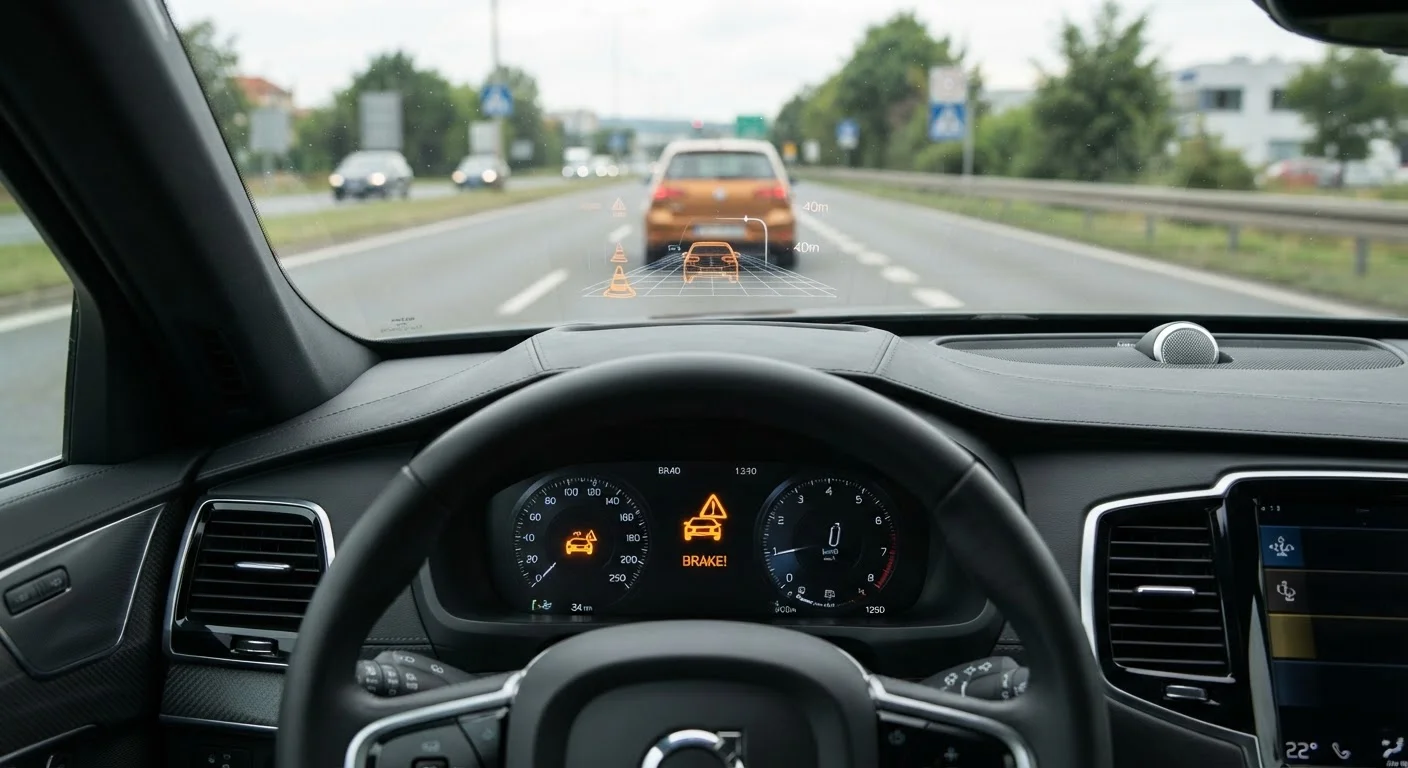
How AEB Detects a Potential Collision
Automatic Emergency Braking depends on a network of sensors mounted at the front of the vehicle — most commonly forward-facing radar, a camera positioned near the rearview mirror, or sometimes a LiDAR unit. These sensors continuously scan the road ahead, measuring the distance to the vehicle or obstacle in front and calculating how quickly that distance is shrinking.
When the system's onboard computer determines that a collision is likely based on the vehicle's current speed and the rate of closure, it moves through a staged response. First, it issues an audible or visual alert to prompt the driver to brake. If the driver brakes but not with enough force, AEB can supplement that braking pressure — a function called brake assist. If the driver does not respond at all within the system's calculated window, the vehicle applies full autonomous braking.
For a broader look at how sensors and cameras work together across the vehicle, see our complete overview of modern car safety technology.
50%
Reduction in rear-end crashes with AEB
The Insurance Institute for Highway Safety (IIHS) has reported that vehicles equipped with AEB show substantially lower rates of rear-end collisions compared to vehicles without the system.
~1.5 sec
Typical human brake reaction time
Transportation safety researchers generally cite a perception-reaction time of around 1.5 seconds, during which a vehicle traveling at 60 mph covers approximately 132 feet before braking begins.
Standard
AEB availability on new U.S. vehicles
Following a voluntary industry commitment coordinated with NHTSA, AEB became standard equipment on nearly all new passenger cars and light trucks sold in the U.S. by the mid-2020s.
What AEB Can and Cannot Do
AEB is most effective in clear daylight conditions where radar and cameras can reliably identify vehicles ahead. It performs well in common rear-end scenarios — such as when traffic slows suddenly on a highway or a car stops unexpectedly at an intersection.
However, every AEB system has boundaries. Pedestrian and cyclist detection, while increasingly common, is less reliable in low-light or nighttime conditions. Heavy rain, snow, or road spray can partially obstruct camera-based sensors. The system may also react to stationary objects — like an overpass or a parked car close to the road — differently than it would to a moving vehicle.
It is equally important to understand that AEB is distinct from Forward Collision Warning (FCW), which only alerts the driver without applying the brakes. See our article on how Forward Collision Warning and AEB differ for a clear comparison of what each system contributes.
Test Your AEB Settings Before You Need Them
When you get a new vehicle, take a few minutes to locate the AEB settings in the vehicle's menu or owner's manual. Confirm the system is active, understand what warning sounds it produces, and note whether your model includes pedestrian detection as part of the package. Knowing how your specific system behaves builds confidence before an emergency arises.
Why AEB Matters Especially for Senior Drivers
Reaction time naturally slows with age — research in driver physiology consistently shows that older adults take slightly longer to perceive a hazard and physically apply the brakes. AEB directly compensates for this gap. By initiating braking in the fractions of a second when the driver has not yet responded, the system can meaningfully reduce impact speed or prevent a crash entirely.
For drivers managing conditions such as reduced peripheral vision or slower processing speed, AEB provides an additional safety margin without requiring any learning curve or active operation. The system runs automatically from the moment the car is started.
“Automatic emergency braking is one of the most promising crash avoidance technologies we have seen in decades. The data consistently show that it reduces both the frequency and severity of front-to-rear crashes.”
— David Zuby, Former Executive Vice President of Vehicle Research, Insurance Institute for Highway Safety (IIHS)
Seniors exploring which safety technologies matter most will find a comprehensive breakdown in our guide to senior safety features from braking to parking aids. For context on how AEB fits alongside other driver-assist systems like adaptive cruise control, the article on how adaptive cruise control works is a useful companion read.
Keeping AEB Working Properly
Like any sensor-based system, AEB requires basic upkeep to function reliably. The forward-facing camera and radar sensors must remain unobstructed — a cracked windshield, accumulated dirt, or a damaged front bumper can interfere with detection. After any front-end collision or bumper repair, the sensors typically need professional recalibration to restore accuracy.
Maintaining the vehicle's braking system itself is also important. AEB applies the brakes through the same hydraulic system a driver would use, so worn brake pads or low brake fluid can limit the system's stopping ability. Routine brake inspections are a straightforward way to keep both manual and automatic braking operating as intended. For guidance on brake maintenance basics, visit our hub on tires and brakes.
AEB Is Not the Same as Self-Braking on Demand
Some drivers assume they can rely on AEB to stop the car in routine situations, such as approaching a stop sign. AEB is engineered to activate only in imminent collision scenarios — it is not a general braking aid. Using it as one could cause unexpected behavior or unnecessary wear on the braking system. Always apply the brake pedal yourself during normal deceleration.
This article provides general educational information about automatic emergency braking technology and is not a substitute for your vehicle's owner's manual, professional mechanical advice, or guidance from a certified driving instructor. System capabilities vary by vehicle make, model, and trim level.
Frequently Asked Questions
Many AEB systems are designed to function across a range of speeds, but their effectiveness varies by system and manufacturer specification. At higher highway speeds, some systems may reduce crash severity rather than prevent it entirely. Always consult your vehicle's owner's manual for speed range details.
On most vehicles, AEB can be temporarily disabled through the vehicle's settings menu, though it typically reactivates when the car is restarted. Safety experts generally advise keeping the system active during normal driving, as it provides a meaningful backup to human reaction time.
No — AEB is a backup system, not a replacement for attentive driving. It is designed to act in the final moments before a collision when a driver has not reacted. Maintaining focus on the road remains essential for safe driving.
Adverse weather can reduce the effectiveness of AEB systems, particularly those that rely primarily on cameras. Radar-based components tend to be more resilient in poor weather, but no system is guaranteed to perform fully in all conditions. Driving cautiously in reduced visibility is still necessary.
Major automakers in the U.S. reached a voluntary agreement with the National Highway Traffic Safety Administration (NHTSA) to make AEB standard on new passenger vehicles. Federal regulations are also moving toward mandating the feature, making it increasingly common across vehicle segments.
The content on this site is for informational purposes only and is not a substitute for professional advice. Always consult a qualified professional for guidance specific to your situation.