

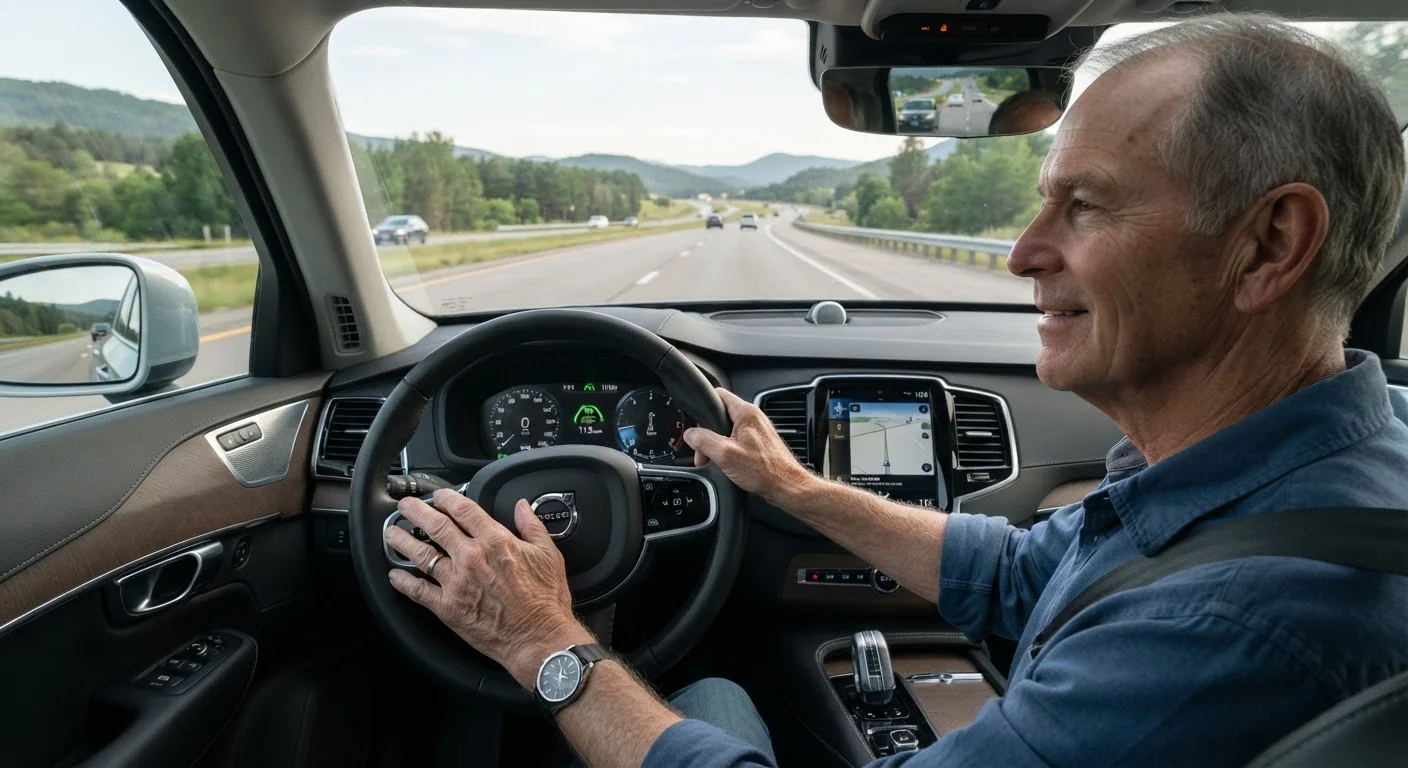
What Adaptive Cruise Control Actually Does
Conventional cruise control holds a fixed speed — useful on empty roads, but frustrating in real traffic where you must constantly brake and reset. Adaptive cruise control (ACC) solves that limitation by pairing speed-holding with automatic distance management.
Using forward-facing radar, cameras, or both, ACC continuously monitors the gap between your vehicle and the one ahead. If traffic slows, the system reduces engine power and applies gentle braking to maintain a safe following gap. When the road clears, it smoothly accelerates back to your preset speed. The driver sets the target speed and, on most systems, selects a preferred following-distance gap.
For a broader look at where ACC fits among modern driver-assist technologies, see our plain-language ADAS glossary.
~70%
New vehicles with ACC available
According to the Insurance Institute for Highway Safety (IIHS), a large share of new vehicle models now offer ACC as standard or optional equipment.
3–4 seconds
Recommended minimum following gap
Safety organizations generally recommend maintaining at least a 3-to-4-second following gap in normal highway conditions — a distance ACC can help sustain automatically.
When ACC Is Most Helpful — and When It Isn't
ACC genuinely shines during highway and interstate driving. Sustained highway travel demands continuous attention to changing vehicle speeds ahead, which can be mentally taxing over long distances. By automating the throttle-and-brake response, ACC reduces that cognitive load and helps drivers arrive less fatigued.
Situations where ACC works well include:
- Long stretches of highway with moderate, consistent traffic
- Road trips where speed and spacing need steady management
- Driving in lanes with predictable flow and clear road markings
ACC is less effective — and in some systems, unavailable — in these conditions:
- Heavy stop-and-go city traffic with frequent signal changes
- Poor weather (rain, snow, or fog) that degrades sensor accuracy
- Tight curves where sensors may lose track of the vehicle ahead
- Roads with vehicles that cut in abruptly at close range
Understanding these boundaries matters. ACC is a driver-assist tool, not an autopilot. The driver must stay alert and be prepared to take over at any moment. This is a distinction explored further in our article on whether ACC is a comfort feature or a safety tool.
Start With Your Owner's Manual
ACC systems vary considerably between vehicle makes and model years. Before using it in heavy traffic or unfamiliar conditions, read your vehicle's specific instructions and practice in low-risk settings such as light highway traffic. Knowing exactly how your system behaves — including how to disengage it quickly — builds the confidence to use it effectively.
How ACC Relates to Other Safety Systems
ACC rarely operates alone. In many vehicles, it works alongside other Advanced Driver Assistance Systems (ADAS) that collectively reduce the likelihood of a collision. A closely related technology is automatic emergency braking (AEB), which can apply harder, faster braking than ACC when an imminent collision is detected. For a detailed explanation of how that system operates, see our guide to automatic emergency braking.
Some vehicles also pair ACC with lane-centering assist, keeping the car centered in its lane while ACC manages speed and spacing — a combination sometimes marketed under names like "highway driving assist." These combined systems can meaningfully reduce driver fatigue on long trips, which is a legitimate safety benefit, particularly for older drivers who may notice that extended highway driving is more tiring than it once was.
“Driver assistance technologies like adaptive cruise control are designed to support the driver, not replace them. The human must remain engaged and ready to respond at every moment.”
— IIHS Communications Office, Insurance Institute for Highway Safety — a leading U.S. vehicle safety research organization
ACC is one of several technologies worth understanding alongside adaptive physical controls. For context on how vehicle adaptations differ from electronic driver-assist systems, see our overview of pedal extensions and adaptive controls.
Frequently Asked Questions
Some ACC systems — often called "stop-and-go" ACC — can bring the vehicle to a complete stop and resume automatically. Basic ACC systems may only work above a minimum speed, typically around 20–25 mph. Check your owner's manual to understand your specific system's capabilities.
ACC can reduce physical and mental fatigue on long highway drives, which many safety researchers consider a benefit for all drivers, including older adults. However, it is a driver-assist tool, not a replacement for full attention. Drivers should understand how their specific system works before relying on it.
Yes. Heavy rain, snow, ice, fog, and even road debris can interfere with the radar or camera sensors that power ACC. Most systems will alert you when sensor performance is degraded and may disengage automatically. In poor conditions, rely on manual driving and increase your following distance.
Most ACC systems let you select from two to four following-distance settings, often labeled as short, medium, or long gaps. The control is typically a button on the steering wheel. Safety advocates generally recommend using a longer gap setting, especially on highways.
Basic ACC systems are designed primarily for highway use and may not function below a certain speed threshold. Advanced stop-and-go versions handle slower city traffic better, but frequent signal changes, pedestrians, and complex intersections still require full driver control.
The content on this site is for informational purposes only and is not a substitute for professional advice. Always consult a qualified professional for guidance specific to your situation.