

Our Verdict
Adaptive cruise control is genuinely both a comfort feature and a safety tool — but only when drivers understand its boundaries. It reduces fatigue and helps maintain consistent following distances on highways, two benefits that matter meaningfully to senior drivers. However, it is not a substitute for attentive driving and performs less reliably in conditions outside its design envelope.
Senior drivers who regularly travel on highways or open roads and want to reduce physical fatigue while maintaining safe spacing from other vehicles.
What Adaptive Cruise Control Actually Does
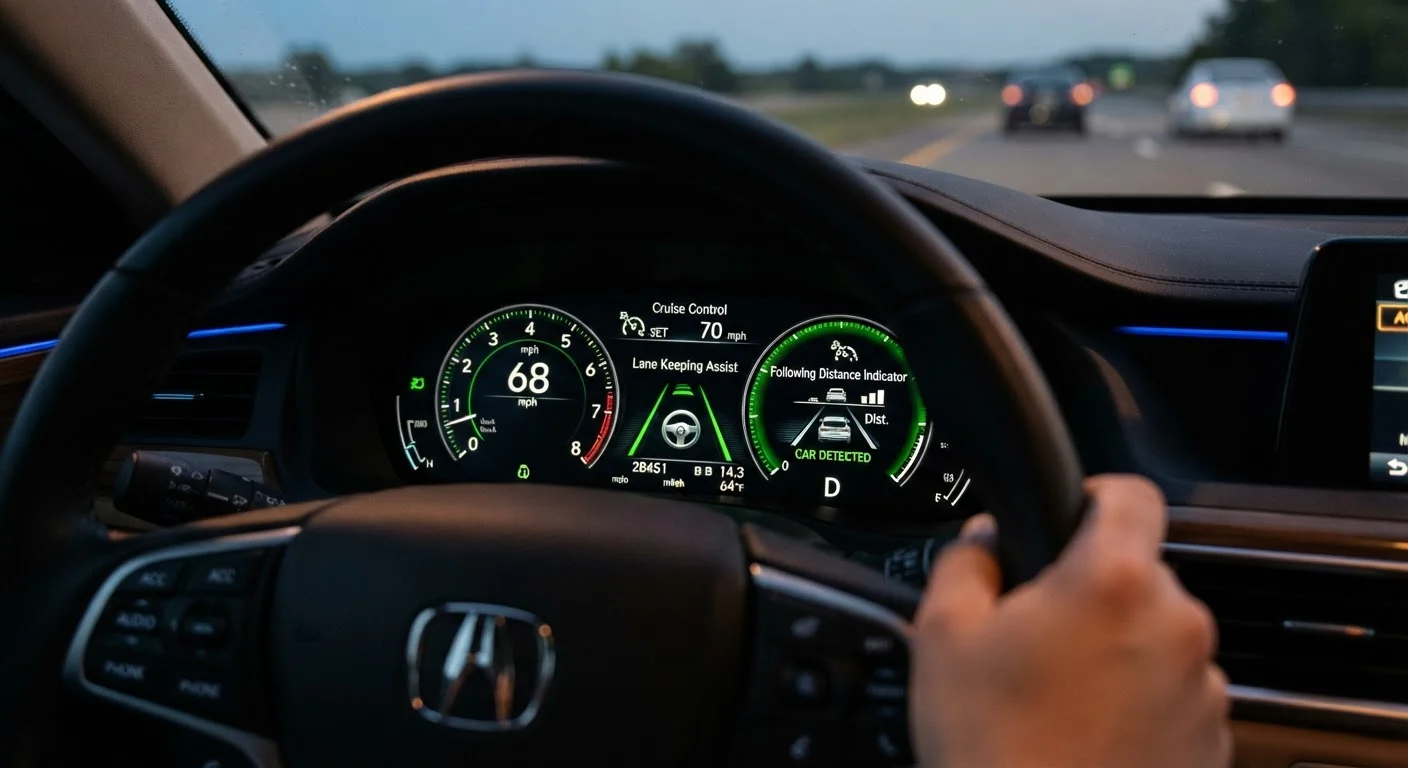
Standard cruise control holds a fixed speed you set manually. Adaptive cruise control (ACC) goes a step further: it uses sensors — typically radar, cameras, or a combination — to detect the vehicle ahead and automatically slow down or speed up to maintain a preset following gap. When traffic clears, ACC returns to your chosen speed without any input from you.
This is part of a broader category of technology called Advanced Driver Assistance Systems (ADAS). If those terms are unfamiliar, the ADAS plain-language glossary covers the vocabulary you'll encounter in owner's manuals and on window stickers. ACC is also discussed in the context of other modern features in our driver-assist technology guide.
Most ACC systems allow you to choose from several following-distance settings — typically expressed as short, medium, or long gaps. A longer setting gives more reaction time and is generally the wiser choice.
The Real Safety Case for Senior Drivers
For senior drivers, two aspects of ACC carry genuine safety value. First, maintaining a consistent following distance is one of the most effective ways to avoid rear-end collisions, and research by highway safety organizations consistently identifies tailgating as a leading collision factor. ACC automates this discipline, which is especially useful when attention temporarily shifts or reaction times are slightly longer.
Second, highway driving demands sustained concentration over long periods. ACC reduces the repetitive micro-adjustments of accelerating and easing off the throttle, lowering physical fatigue during longer trips. Less fatigue generally means steadier attention — a meaningful benefit.
~7.5 sec
Average reaction time gap at highway speed
At 65 mph, a two-second following distance leaves roughly 190 feet of stopping buffer — ACC is designed to help drivers maintain that gap consistently without manual effort.
~30%
Rear-end crashes among all U.S. crashes
The National Highway Traffic Safety Administration (NHTSA) has reported that rear-end collisions account for roughly 30% of all crashes, highlighting the value of consistent following-distance management.
It is worth noting that ACC works in close coordination with other safety systems. On many vehicles it is paired with automatic emergency braking, which can apply the brakes if the driver does not respond in time. Together, these features form a layered safety net rather than a single solution. Explore the full picture of senior safety features to understand how they work together.
Advantages and Disadvantages
Like any technology, ACC has clear strengths and meaningful limitations. Both deserve honest examination before you decide how much to rely on it.
Maintains safe following distance automatically
ACC continuously monitors the gap to the vehicle ahead and adjusts speed accordingly, removing the need for constant manual throttle management on highways.
Reduces driver fatigue on long trips
By handling repetitive speed adjustments, ACC lowers the physical and mental workload during extended highway drives, helping drivers stay more alert overall.
Supports consistent, predictable highway speed
Holding a steady speed reduces the risk of inadvertent speeding and can contribute to smoother traffic flow, particularly in light highway conditions.
Often paired with automatic emergency braking
Many ACC-equipped vehicles also include forward-collision warning and automatic braking, creating a more comprehensive safety layer than ACC alone provides.
Does not replace attentive driving
ACC manages speed and spacing, but the driver must still steer, monitor the road environment, and be ready to brake or maneuver immediately. It is not autopilot.
Performance degrades in poor weather
Radar and camera sensors can be compromised by heavy rain, snow, fog, or road spray, causing the system to disengage or behave inconsistently when conditions are most challenging.
Limited usefulness in urban or stop-and-go traffic
Basic ACC systems are designed for highway use and may not function reliably below certain speeds. Only vehicles with a dedicated stop-and-go mode handle slow city traffic effectively.
Can create a false sense of security
Drivers who over-trust ACC may reduce their situational awareness, which is dangerous because the system cannot handle all hazards — including pedestrians, cyclists, or debris in the road.
Drivers interested in broader vehicle comfort and control adaptations — beyond electronic aids — may also want to read about pedal extensions and adaptive controls, which address physical ergonomics rather than electronics.
What ACC Cannot Do — and Why That Matters
Misunderstanding ACC's limits is the most common and consequential mistake drivers make with the system. ACC is not a self-driving feature. It does not steer the car, does not respond to pedestrians or cyclists crossing the road, and does not perform reliably at very low speeds on city streets unless the specific vehicle offers a "stop-and-go" variant designed for that purpose.
ACC Requires an Alert Driver at All Times
Most vehicle manufacturers and safety regulators explicitly state that ACC is a driver-assistance feature, not an autonomous system. Drivers are legally and practically responsible for vehicle control at all times. If your ACC disengages — which it will signal with a dashboard alert — you must resume manual control immediately. Never use ACC as a substitute for attention.
Sensor performance can also degrade in heavy rain, snow, fog, or when sensors are obscured by dirt or ice. In these conditions, ACC may disengage automatically or behave unpredictably. Drivers should always be prepared to take manual control immediately.
If you have encountered claims that adaptive driver-assist features work universally or require no driver attention, the common misconceptions about adaptive car accessories article addresses several of those myths directly.
For a deeper practical look at when and how to use ACC on actual trips, see how adaptive cruise control works and when to use it.
The content on this site is for informational purposes only and is not a substitute for professional advice. Always consult a qualified professional for guidance specific to your situation.