

Why This Glossary Exists
Window stickers, dealer brochures, and owner's manuals are filled with acronyms like ADAS, FCW, and LKA. For many buyers, especially those encountering these technologies for the first time, the alphabet soup can be more confusing than helpful. This quick-reference glossary translates the most common driver-assist terms into plain, everyday language so you can evaluate features confidently before or after a purchase.
For a broader look at how these systems work together and why they matter for older drivers, see our introduction to driver-assist technology. If you want to decode window-sticker language more broadly, our companion piece on safety feature names on window stickers is a useful companion.
| What ADAS stands for | Advanced Driver Assistance Systems |
| AEB availability | Standard on most new U.S. passenger vehicles (NHTSA voluntary commitment, effective 2022) |
| Number of core ADAS categories | 12 terms defined in this glossary |
| Primary sensor types used | Cameras, radar, and ultrasonic sensors |
| Key limitation | Performance can degrade in rain, snow, or low light (Per IIHS and NHTSA guidance) |
The Core ADAS Terms You Need to Know
ADAS (Advanced Driver Assistance Systems) is the umbrella term for any technology that uses sensors, cameras, or radar to monitor the driving environment and assist — or warn — the driver. The individual systems below fall under this umbrella.
ADAS
Advanced Driver Assistance Systems. The collective name for electronic safety features that use sensors and cameras to monitor surroundings and alert or assist the driver. Examples include automatic emergency braking and lane-keep assist.
Adaptive Cruise Control (ACC)
A version of cruise control that automatically adjusts vehicle speed to maintain a set following distance from the car ahead. Unlike standard cruise control, it can slow down or speed up in response to traffic without the driver touching the pedals.
Automatic Emergency Braking (AEB)
A system that detects an imminent collision and applies the brakes automatically if the driver does not respond in time. Some systems also warn the driver before acting. AEB is now required on most new passenger vehicles sold in the U.S.
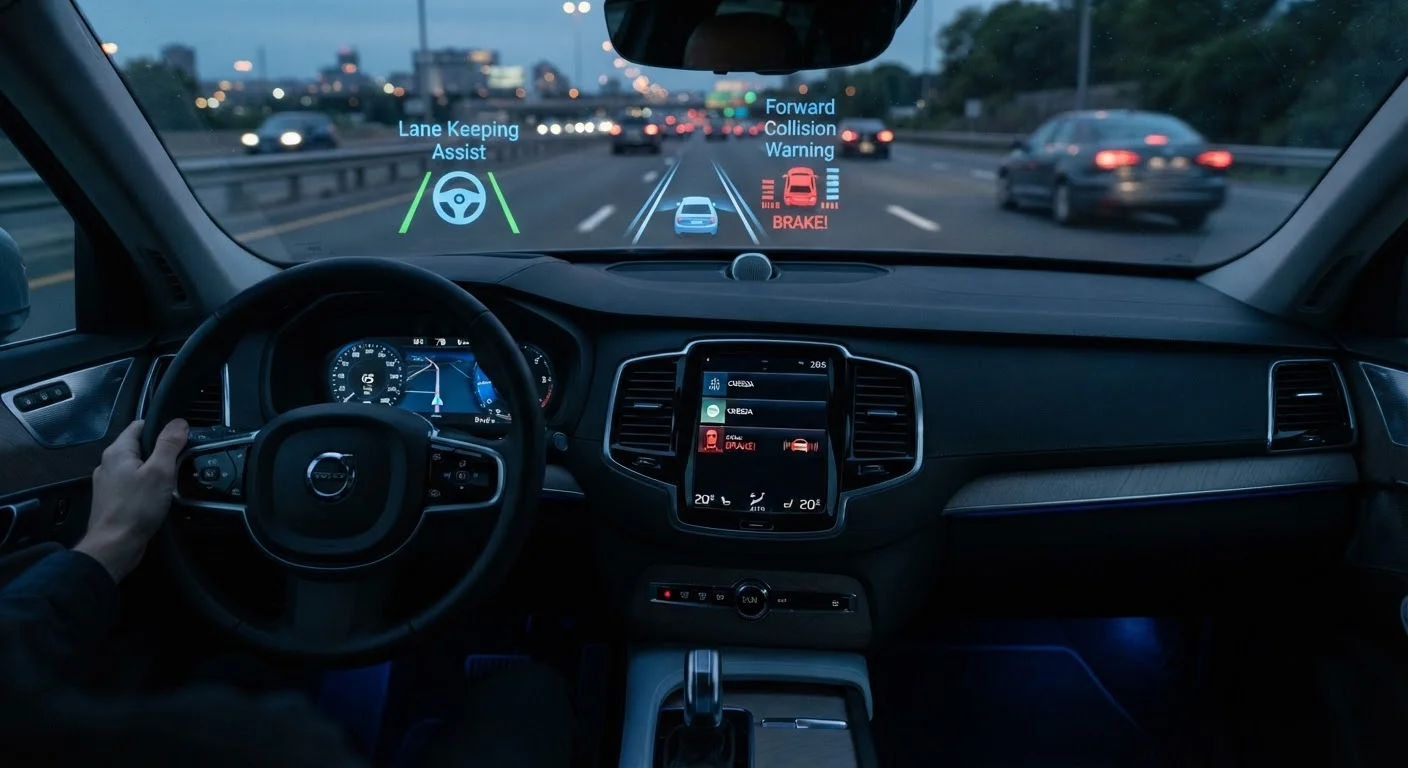
Forward Collision Warning (FCW)
An alert — usually a sound, a light, or both — that warns the driver when the vehicle is closing in on the car ahead too quickly. It warns but does not brake; AEB is the system that acts.
Lane Keep Assist (LKA)
A feature that detects lane markings and gently steers the vehicle back toward the center of the lane if it begins to drift without a turn signal. It is not autopilot — the driver must remain engaged at all times.
Lane Departure Warning (LDW)
An alert that notifies the driver when the vehicle crosses a lane line without signaling. Unlike Lane Keep Assist, it warns only and does not steer.
Blind-Spot Monitoring (BSM)
Uses rear-facing sensors to detect vehicles in the driver's blind spots — the areas not visible in mirrors. A warning light typically appears in or near the relevant mirror when another vehicle is detected there.
Rear Cross-Traffic Alert (RCTA)
Warns the driver of vehicles, cyclists, or pedestrians approaching from the side while backing out of a parking space or driveway. Works alongside — but independently of — the backup camera.
Pedestrian Detection
An extension of AEB that specifically identifies pedestrians or cyclists in the vehicle's path and can trigger braking. Performance varies across systems and conditions.
Driver Monitoring System (DMS)
Uses a camera pointed at the driver to detect signs of inattention or drowsiness, such as prolonged eye closure or head drooping. The system then issues an alert to refocus the driver's attention.
Traffic Sign Recognition (TSR)
Reads road signs — most commonly speed limit signs — using a forward-facing camera and displays the information on the instrument cluster or head-up display to help drivers stay informed.
Parking Sensors
Ultrasonic sensors mounted on the front and/or rear bumper that detect nearby obstacles at low speed and alert the driver through beeping tones that increase in frequency as the vehicle gets closer.
Understanding which of these systems are standard and which cost extra is an important step in comparing vehicles. Our guide to driver-assist technologies for seniors walks through how each system supports safety as driving needs evolve.
Note that ADAS features supplement — but do not replace — attentive driving. Every system has limits, including reduced performance in heavy rain, snow, or low light. Always review your owner's manual to understand exactly what your vehicle's systems can and cannot do.
ADAS Has Real Limits — Read Your Manual
No driver-assist system is foolproof. Cameras can be obscured by dirt, ice, or sun glare; radar can struggle in heavy precipitation. Driver Monitoring Systems, Lane Keep Assist, and AEB all work within specific speed ranges that vary by manufacturer. Reviewing the relevant section of your owner's manual — or asking a dealer to walk through each feature — is the most reliable way to understand what your specific vehicle's systems will and will not do.
For more detail on how these features are explained to shoppers, the plain-language guide to driver-assist technology in new cars provides helpful context. You may also find our Senior Safety Features hub useful when researching specific vehicles.
The content on this site is for informational purposes only and is not a substitute for professional advice. Always consult a qualified professional for guidance specific to your situation.