

From Battery to Wheels: The Basic Flow of Power
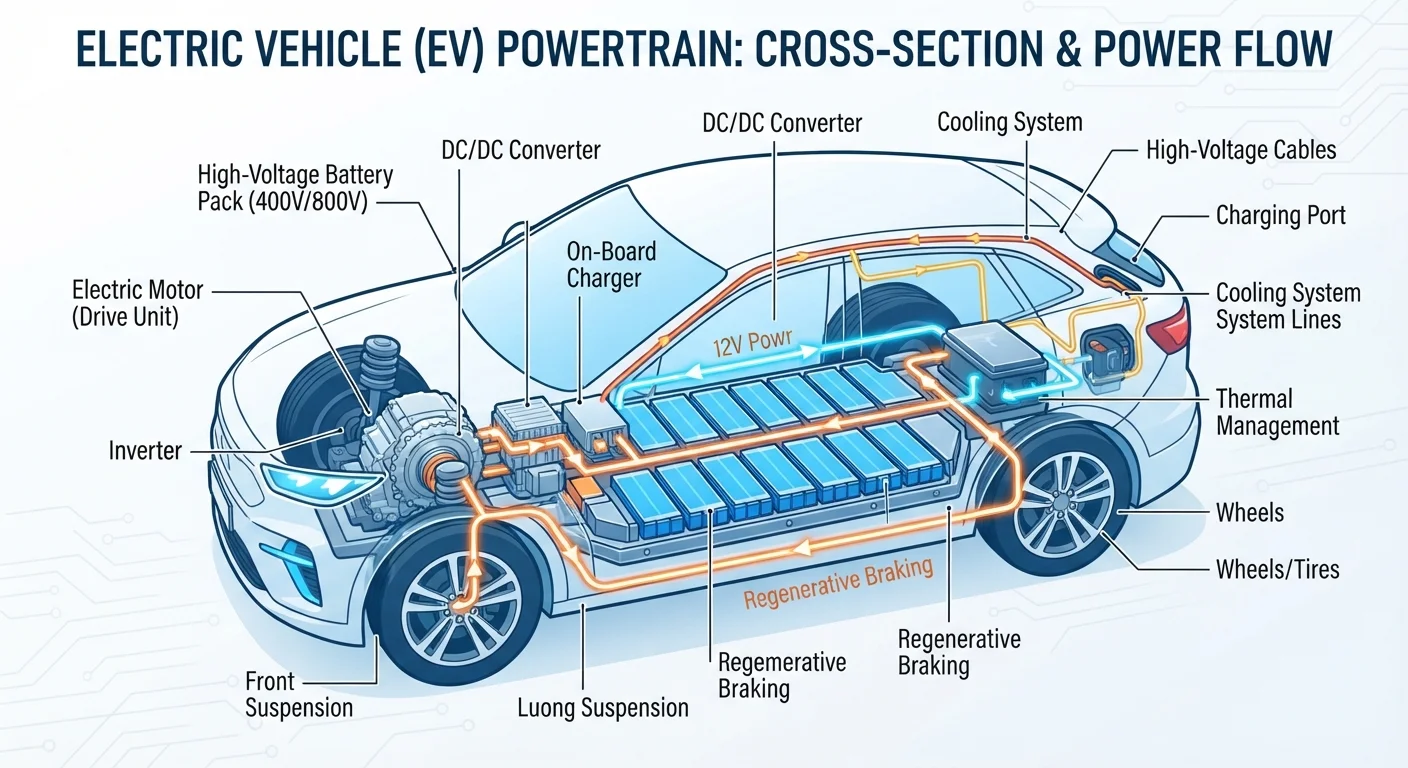
To understand how an electric car moves, picture a simple chain: battery → controller → motor → wheels. When you press the accelerator pedal, a signal goes to the power electronics controller, which draws electricity from the large battery pack and sends it to the electric motor. The motor converts that electrical energy into spinning motion, which travels through a simplified single-speed transmission to the drive wheels.
Because there is no combustion — no fuel being ignited — the process is quiet, smooth, and remarkably efficient. A gasoline engine typically converts only about 20–40% of the fuel's energy into forward motion; the rest is lost as heat. An electric drivetrain converts roughly 85–90% of the battery's stored energy into actual movement, according to the U.S. Department of Energy.
85–90%
Energy efficiency of an electric drivetrain
The U.S. Department of Energy estimates EVs convert roughly 85–90% of stored battery energy into wheel movement, compared to 20–40% for gasoline engines.
~20
Moving parts in a typical EV motor
An electric motor contains far fewer moving parts than a comparable internal combustion engine, which can have hundreds of precision-fitted components.
Up to 30%
Range extension from regenerative braking in city driving
Industry estimates suggest regenerative braking can recover a meaningful portion of energy in stop-and-go urban driving conditions, though actual results vary by vehicle and driver behavior.
For a broader introduction to how EVs and hybrids compare, see our plain-English guide to electric and hybrid cars.
What the Electric Motor Actually Does
An electric motor works through electromagnetism. Inside the motor are two main parts: a stator (the stationary outer ring) and a rotor (the spinning inner shaft). When electricity flows through coils of wire in the stator, it creates a rotating magnetic field. That field pulls and pushes on the rotor, making it spin — and that spin is what ultimately turns your wheels.
One practical benefit seniors often appreciate: because peak torque is available immediately, there is no hesitation when pulling out of a driveway or merging onto a highway. The response is direct and predictable.
Listen for What You Don't Hear
One of the easiest ways to appreciate an EV's simplicity is the near-total absence of engine noise at low speeds. No idling rumble, no gear changes, no exhaust note. If you get a chance to ride in or test-drive an EV, pay attention to how quiet and vibration-free the experience is — that calm is a direct result of the motor's straightforward design.
EVs also skip several components entirely — no spark plugs, no timing belt, no multi-speed gearbox, no exhaust system. This mechanical simplicity is one reason EV maintenance differs from a gasoline car, though some upkeep is still required.
Regenerative Braking: Getting Energy Back
One of the cleverest features of an electric drivetrain is regenerative braking. When you ease off the accelerator or press the brake pedal, the electric motor switches roles: it becomes a generator. The car's forward momentum spins the motor in reverse, producing electricity that flows back into the battery pack.
In everyday driving, this can meaningfully extend how far you travel on a single charge — particularly in city driving with frequent stops. Most drivers notice a gentle slowing sensation when they lift off the gas, which is the system capturing that energy rather than losing it as brake-pad heat.
Regenerative Braking Varies by Vehicle Setting
Many EVs let you adjust how aggressively the car slows when you lift off the accelerator — from barely noticeable to quite strong, sometimes called 'one-pedal driving.' If the feel seems unfamiliar at first, check the vehicle's settings menu or ask the dealer to demonstrate the different modes. Most drivers adjust comfortably within a few days of regular use.
If you are weighing whether an EV suits your regular routes and driving habits, our article on questions to ask before buying your first EV or hybrid offers a practical checklist to work through.
The Battery Pack: Storing the Energy
The battery pack in an EV is a large collection of individual lithium-ion cells grouped into modules, typically installed flat under the vehicle floor. This placement keeps the center of gravity low, which contributes to stable handling. The pack is managed by a Battery Management System (BMS) — a computerized monitor that tracks temperature, charge level, and the health of individual cells to protect the battery and optimize its lifespan.
Charging replenishes the battery either slowly through a standard home outlet, faster through a dedicated home charger, or quickly at a public DC fast-charging station. The BMS governs how fast the battery accepts a charge to prevent overheating.
Understanding real-world ownership costs — including how battery longevity factors in — is covered in detail in our article on the real long-term cost of owning an electric car. And if you have heard worrying claims about EV batteries or range, our piece on common myths about electric cars separates fact from fiction.
Frequently Asked Questions
No. An electric car replaces the combustion engine with one or more electric motors powered by a large battery pack. There is no fuel tank, no exhaust pipe, and no oil to change in the motor itself.
Electric motors deliver their full torque — the rotational force that moves the car — almost instantly from a standstill. Gasoline engines need to rev up through a range of speeds first, which is why EVs often feel noticeably quicker off the line.
When you lift off the accelerator or apply the brakes, the electric motor reverses its role and acts as a generator. It converts the car's forward momentum back into electricity, which is fed into the battery to extend your driving range.
No. An EV's drive battery is a large, high-voltage lithium-ion pack — often located under the floor of the car — that stores the energy to run the motor. The small 12-volt battery found in all cars (including EVs) powers accessories like lights and electronics separately.
The electric motor itself does not require oil changes because it has no pistons or combustion. Some EVs do have a small amount of gear lubricant in the drive unit that may be checked over time, but the frequent oil-change schedule of a gasoline car does not apply.
Electric motors are mechanically simpler than combustion engines, with fewer components that can wear out. This generally translates to fewer unexpected repair visits, which many drivers find reassuring — though overall reliability still depends on the specific vehicle and how it is maintained.
The content on this site is for informational purposes only and is not a substitute for professional advice. Always consult a qualified professional for guidance specific to your situation.