

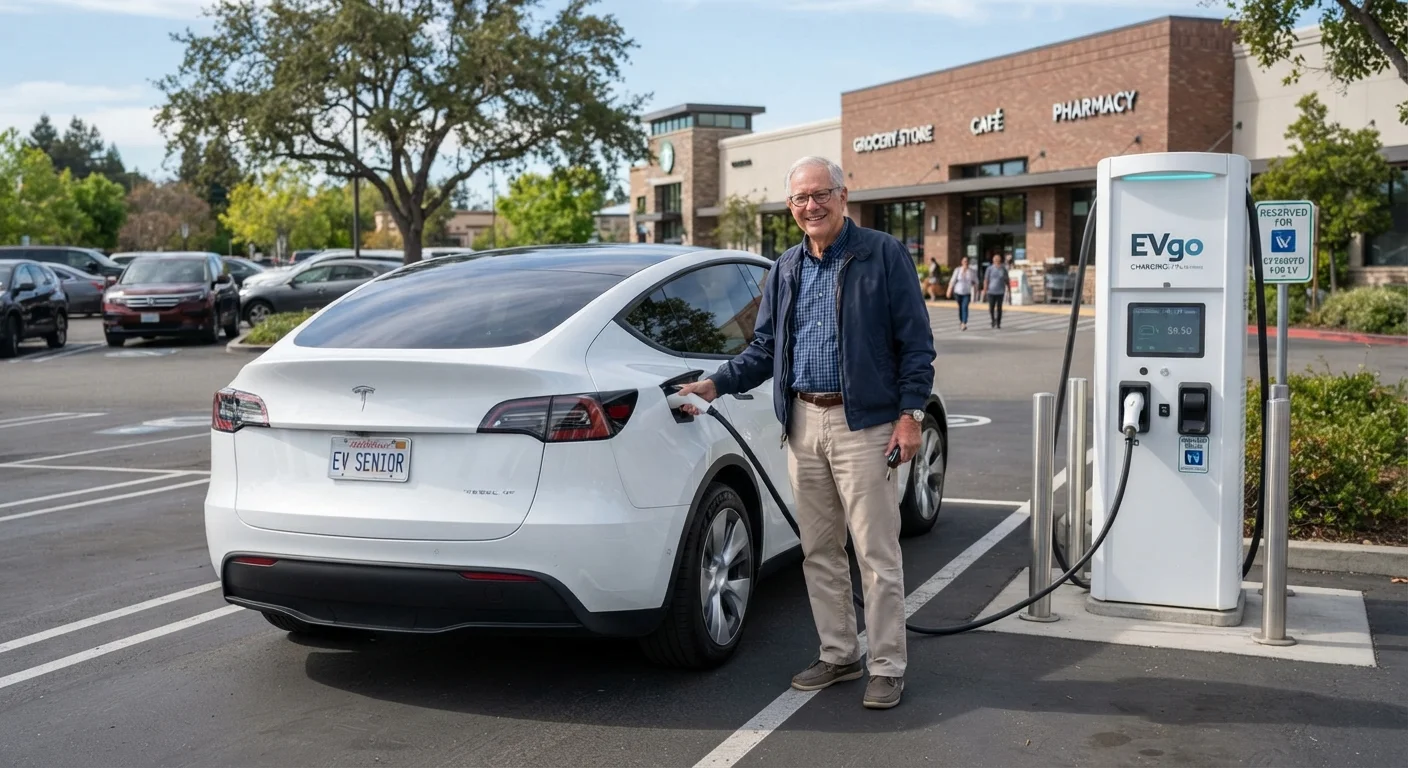
Understanding the Charging Speed Tiers
Public EV charging comes in two practical tiers. If you're new to the terminology, our senior-friendly EV glossary explains kilowatts and charging levels in plain language.
Level 2 chargers are the most common type at everyday destinations — shopping malls, grocery stores, hotels, and workplaces. They deliver roughly 10–30 miles of range for every hour connected, making them ideal for longer stops. You arrive, plug in, run your errands, and return to a meaningfully fuller battery.
DC Fast Chargers (sometimes called Level 3) are designed for highway travel and quick top-ups. They can push a battery from near-empty to approximately 80% charge in 20–45 minutes, depending on the vehicle. Most manufacturers recommend stopping fast charging at 80% to protect long-term battery health — a detail your car's system often manages automatically.
~185,000
Public EV charging ports in the U.S.
The U.S. Department of Energy's Alternative Fuels Station Locator tracks publicly available EV charging ports nationwide, with numbers continuing to grow.
80%
Recommended DC Fast Charge stop point
Most EV manufacturers and charging guides suggest stopping DC fast charging at approximately 80% to support long-term battery health.
20–30 mi
Range added per hour on Level 2
A typical Level 2 public charger delivers roughly 20–30 miles of driving range per hour of charging, suitable for destination stops.
How to Find a Charging Station
Locating a public charger is easier than many people expect. Most EV manufacturers include a built-in navigation system that can route you to available stations. Dedicated apps — such as those provided by major charging networks — show station locations, real-time availability, connector types, and pricing before you arrive.
Many general mapping apps also display EV charging stations as a searchable category. When planning a longer trip, it's worth identifying charging stops in advance and building them into your route, just as you might plan rest breaks. This approach removes the guesswork entirely.
Plan Your Charging Stops Before You Leave
Before a longer trip, use your vehicle's navigation app or a charging network's route planner to identify stations along the way. Knowing where you'll stop — and that chargers are available — removes uncertainty and makes the journey feel no different from any other road trip.
Paying for a Charge
Payment methods at public stations have become notably more consumer-friendly. Newer stations are increasingly required — by federal infrastructure standards — to accept credit and debit cards directly, without any app or account. This is a significant improvement for drivers who prefer simplicity.
Network apps remain useful: they can store payment details, show charging history, and sometimes offer lower per-kWh rates for members. RFID cards (small key-fob-style cards linked to your account) are another straightforward option offered by most networks.
Pricing structures vary: some stations charge by the kilowatt-hour of energy delivered, others by the minute connected, and some offer flat session fees. A kWh-based rate is generally more transparent, because it directly reflects how much energy your car actually received. For broader context on how public charging fits into everyday EV ownership, see our guide on making the most of an EV in your daily routine.
Practical Habits That Make Public Charging Stress-Free
A few simple habits significantly reduce any friction around public charging. First, avoid waiting until your battery is nearly empty before seeking a charger — most drivers aim to charge between 20% and 80% for routine stops. This mirrors refueling a gas car before the warning light appears.
Second, be mindful of charging etiquette: move your vehicle once charging is complete rather than occupying a space beyond your session. Many stations can send a notification to your phone when charging finishes.
Third, understand that not all networks work together. The U.S. charging landscape includes multiple independent operators, and while interoperability is improving, it helps to recognize the two or three networks most prevalent along your usual routes.
If you're still weighing whether an EV suits your lifestyle, our article on common EV myths addresses range anxiety and charging concerns with facts rather than assumptions. And if home charging is part of your plan, EV charging at home walks through what to consider before getting set up.
Connector Compatibility Varies by Vehicle
Not every EV uses the same charging connector, particularly for DC Fast Charging. Before relying on a specific network or station type, confirm which connector your vehicle supports by checking the owner's manual or the manufacturer's website. This one step prevents arriving at a station only to find an incompatible plug.
This article provides general educational information about public EV charging infrastructure. Availability, pricing, and network features vary by region and change over time. Consult your vehicle's documentation and the relevant charging network's materials for details specific to your car and location.
Frequently Asked Questions
Not always. Many public chargers accept credit or debit cards directly at the station without a membership. However, signing up for a network's app or card can sometimes reduce per-charge costs. It's worth checking which networks are common in your area.
It depends on the charger type and your vehicle's battery size. A Level 2 charger might add 20–30 miles of range per hour, while a DC Fast Charger can bring a depleted battery to roughly 80% in 20–45 minutes. Your car's manual will list its maximum accepted charge rate.
Most public chargers are located in well-lit commercial areas. As with any parking situation, choose well-trafficked, illuminated locations and trust your judgment about the surroundings. Charging does not require you to stay with the vehicle.
Charger availability apps often show real-time status, including whether a station is in use or out of service. Arriving with adequate remaining range — rather than waiting until nearly empty — gives you flexibility to find an alternative nearby station.
Most Level 2 chargers use a standard connector compatible with nearly all EVs sold in the U.S. DC Fast Chargers have varying connector types, and not every EV can use every fast charger. Check your vehicle's documentation to understand which connector type it accepts.
Pricing varies by network, location, and state. Chargers may bill by the kilowatt-hour (kWh), by the minute, or by session. Some locations — like certain dealerships or retail parking lots — offer free charging as a customer perk.
The content on this site is for informational purposes only and is not a substitute for professional advice. Always consult a qualified professional for guidance specific to your situation.