

Why Daily Habits Matter More Than You Might Think
Owning an electric vehicle (EV) or a plug-in hybrid (PHEV — a car that combines a battery with a traditional engine) is a meaningful shift from conventional driving. The good news: most of the adjustments are minor, and many work in your favor. The way you charge, drive, and use onboard features each day has a direct effect on how far you can travel and how much you spend running the vehicle.
For seniors whose routines often include predictable local trips — errands, medical appointments, visiting family — EVs and hybrids can be a particularly good fit. Understanding a few core practices helps you get reliable, comfortable use from day one. Before committing to a purchase, review a practical checklist of key questions covering range, charging access, and insurance.
Plug in at home every night, even after a short day of driving.
Starting each morning with a full or near-full charge eliminates range anxiety and makes your car as predictable as any appliance in your home. It also means you rarely need to make unplanned stops at public chargers.
Use your vehicle's Eco mode for routine local driving.
Eco mode reduces the rate at which power is drawn from the battery, often extending your usable range by 10–15% without requiring any change in your route. For predictable, low-speed trips this comes at virtually no practical cost.
Pre-condition your cabin while the car is still plugged in during cold weather.
Heating a cold interior draws significantly on the battery. Running the heater while connected to a charger means the energy comes from the grid, not your battery, preserving your driving range.
Learn to read your vehicle's range and energy displays rather than ignoring them.
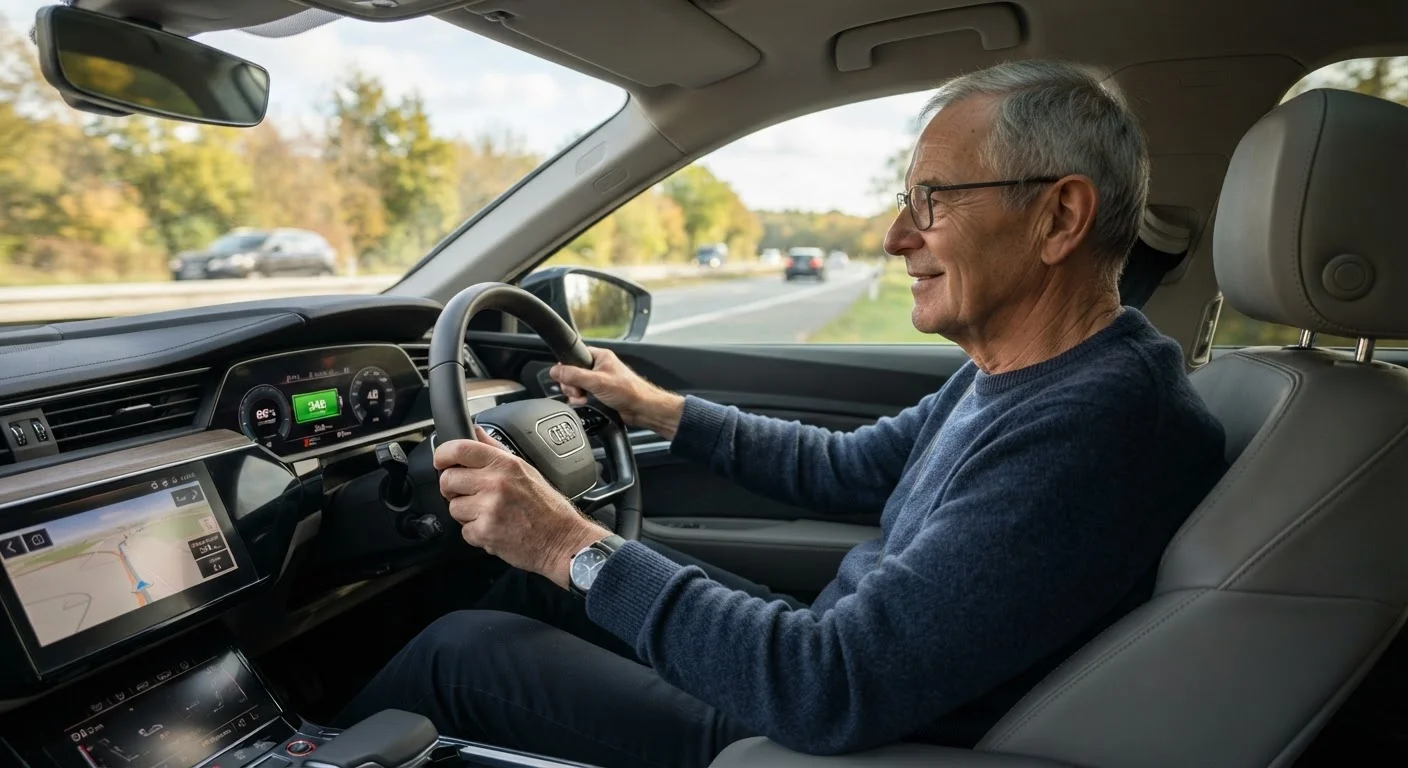
The dashboard on an EV or hybrid gives real-time feedback on how your driving style and conditions are affecting efficiency. Paying attention to this — even briefly — helps you build intuition about when to charge and when you have plenty of range.
Schedule software updates through the manufacturer's app when convenient.
Many modern EVs and hybrids receive over-the-air updates (delivered wirelessly, like a phone update) that improve battery management, charging efficiency, and safety features. Keeping the software current ensures you have the latest improvements.
Charging Smartly Every Day
Home charging is the backbone of EV ownership. Most drivers find that plugging in overnight — much like charging a phone — covers all their daily mileage without a second thought. If your electricity provider offers time-of-use rates (lower prices during off-peak hours such as late night or early morning), scheduling your charge for those windows can reduce your electricity costs noticeably over the course of a year.
Set a Charging Limit for Daily Use
Many EVs allow you to cap the charge level — commonly at 80% — for everyday driving. This is a straightforward setting found in the vehicle's charging menu or companion app. Following this guideline, which most manufacturers recommend for routine use, can help preserve battery health over the long term without affecting typical daily mileage.
Aim to keep your battery's state of charge between roughly 20% and 80% for everyday use. Manufacturers generally recommend avoiding a fully depleted or constantly full battery during normal routines, as this can affect long-term battery health. Reserve full charges for longer trips where the extra range is genuinely needed.
When you do need to charge away from home, public networks are more accessible than many people expect. Learn how public EV charging stations work, including how to find them and pay without hassle.
Using Your Vehicle's Features to Extend Range
Modern EVs and hybrids include settings specifically designed to stretch how far you can travel on a charge. Two worth knowing:
- Eco mode: A driving setting that reduces energy use by softening acceleration and, in some vehicles, adjusting climate control. It can meaningfully extend range on familiar routes.
- Regenerative braking: A feature that recaptures energy when you slow down, converting it back into battery charge. Most vehicles let you adjust its strength — a higher setting can add noticeable range in stop-and-go driving.
Temperature also plays a role. Cold weather temporarily reduces battery capacity because the battery chemistry operates less efficiently. In winter, pre-conditioning your car — warming the cabin while still plugged in — uses grid electricity rather than battery power, preserving range for the road. Many EVs allow you to schedule this through an app or the vehicle's own display.
Explore how fuel savings and maintenance costs affect long-term EV ownership to see how these daily habits compound into real financial benefit over time.
~$700
Estimated average annual fuel savings for EV owners vs. petrol drivers
The U.S. Department of Energy has estimated that EV drivers can save several hundred dollars annually on fuel compared with conventional vehicle owners, though actual savings vary by region and driving patterns.
80%
Recommended daily charge ceiling for most EV batteries
Most EV manufacturers recommend limiting routine charging to around 80% of battery capacity to help preserve long-term battery health, reserving full charges for longer trips.
While EVs require less routine maintenance than petrol vehicles, they are not entirely maintenance-free. Understand what still needs regular attention so you're never caught off guard.
Range Estimates Are Guides, Not Guarantees
The range figure shown on your dashboard is a real-time estimate based on current conditions — speed, temperature, terrain, and climate control use all affect it. Treat the displayed range as a helpful guide rather than a precise promise. Building in a comfortable buffer, particularly on unfamiliar routes, is always a sound approach.
The content on this site is for informational purposes only and is not a substitute for professional advice. Always consult a qualified professional for guidance specific to your situation.