

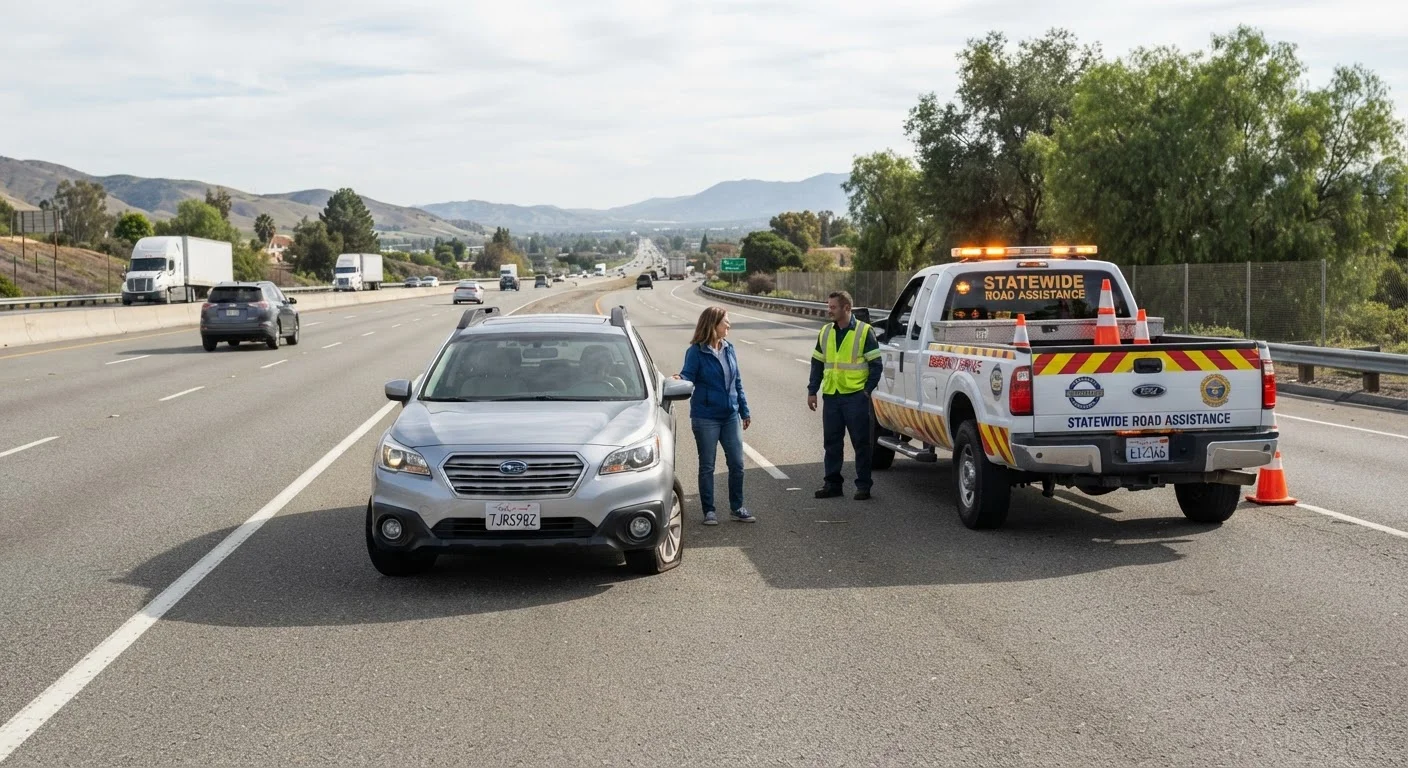
What Roadside Assistance Actually Covers
Roadside assistance through an auto insurer is designed to get you out of a jam when your car stops cooperating. Most policies that include this add-on cover a defined list of emergency services, typically:
- Towing — to the nearest qualified repair shop, often up to a set mileage limit
- Battery jump-start — when your battery is dead and won't turn the engine over
- Flat tire service — changing to your spare, not supplying a new tire
- Fuel delivery — a small amount of gas if you run out, though you pay for the fuel itself
- Lockout service — a locksmith to get you back into your car
- Winching — pulling your vehicle out if it's stuck in mud or snow, sometimes with limits on how far off the road you are
What it generally does not cover: parts or labor for mechanical repairs, the cost of a new tire, a second tow for the same incident, or service for vehicles over a certain weight. Towing limits can be restrictive — if you're in a rural area and the nearest shop is 60 miles away but your policy only covers 25 miles, you pay the overage.
Coverage Limits Vary Significantly by Insurer
There is no standard definition of what roadside assistance or rental reimbursement must include — each insurer sets its own terms. One policy might tow up to 15 miles; another might cover 100. One rental reimbursement plan might cap at $30 a day; another at $75. Always compare the specific terms of any add-on you're considering, not just the general category name.
For a broader look at how these add-ons fit alongside your core policy, see this overview of liability, comprehensive, and collision coverage.
What Rental Reimbursement Does — and Doesn't — Include
Rental reimbursement is straightforward in concept but often misunderstood in practice. It pays toward the cost of renting a replacement car while your vehicle is being repaired after a covered claim. The key phrase is covered claim — if your car is in the shop for a reason your policy doesn't cover, rental reimbursement won't apply.
Common scenarios where it kicks in:
- Your car is damaged in an at-fault or not-at-fault collision and needs body work
- A tree falls on your car (a comprehensive event) and it needs structural repair
- Vandalism or theft results in a covered claim that takes days or weeks to resolve
It does not apply when:
- You drop your car off for an oil change or scheduled tune-up
- Your car is in the shop for a mechanical breakdown not tied to a covered claim
- You need a second vehicle for convenience while your car is running fine
~1 in 3
Drivers who experience a roadside emergency each year
Industry estimates suggest roughly one-third of drivers encounter a roadside event — flat tire, dead battery, or lockout — in any given year, according to general motor club usage data.
$30–$50/day
Typical rental reimbursement daily limit
Many standard auto policies cap rental reimbursement at $30 to $50 per day, while average US rental car rates often exceed these limits depending on location and vehicle type.
Dollar limits matter here. A policy might reimburse $40 per day up to $1,200 total. If your repair takes three weeks and the rental costs $65 a day, you'll owe roughly $350 out of pocket. Reviewing the fine print on daily limits before a claim happens — not during one — is the practical move.
Checking for Duplicate Coverage Before You Pay
One of the most common mistakes drivers make is paying for roadside assistance through their insurer when they already have similar coverage elsewhere. Before adding either add-on, check these sources:
- Motor club memberships
- Organizations like AAA offer roadside assistance as their core service, often with broader towing distances and more flexibility than insurer add-ons.
- Credit cards
- Many travel and general-purpose credit cards include roadside assistance and sometimes rental car coverage as cardholder benefits. Terms vary widely.
- New vehicle warranty or manufacturer programs
- Some automakers include complimentary roadside assistance for new vehicles during the warranty period.
- Dealer add-ons or service contracts
- If you purchased a service contract or extended warranty, it may include a roadside component. Compare it against what your insurer offers — as explained in our look at dealer add-ons worth keeping.
Check for Duplicate Coverage First
Before adding roadside assistance or rental reimbursement to your auto policy, review your credit card benefits, any motor club memberships, and your vehicle's warranty documentation. Paying twice for the same coverage is a common and avoidable expense. A quick call to each provider's customer service line can clarify exactly what you already have.
Understanding the full picture of what you already own — and what gaps remain — is also part of the broader question of full coverage versus minimum coverage. These add-ons fill specific, narrow gaps; they don't substitute for solid core coverage.
How to Evaluate Whether These Add-Ons Make Sense for You
Neither roadside assistance nor rental reimbursement is automatically worth buying or skipping. A few practical questions can help you think it through:
- Do you drive alone frequently? Drivers who travel solo — especially on longer routes or in less populated areas — may find roadside assistance more valuable than those who rarely leave familiar territory.
- Do you have a backup vehicle? If a second car is available in your household, the daily inconvenience of a shop visit may be manageable without rental reimbursement.
- What do rentals actually cost near you? Check local rental rates and compare them to your policy's daily limit. If the gap is large, weigh that against the annual premium cost of the add-on.
- How old is your car? Older vehicles may break down more frequently, making roadside assistance more practical. But if the car's value is low, you may already be carrying minimal coverage — check how these add-ons interact with your existing policy structure.
For questions about what your liability coverage does separately from these add-ons, this explanation of liability coverage lays out the distinction clearly.
This article provides general information about common auto insurance add-ons and is not personalized insurance or financial advice. Coverage terms, limits, and exclusions vary by insurer and by state. Read your actual policy documents carefully and consult a licensed insurance agent to understand what applies to your specific situation.
Frequently Asked Questions
Roadside assistance through your insurer typically covers mechanical breakdowns, flat tires, dead batteries, and lockouts — not just accidents. However, coverage details vary widely by provider and policy, so always check your specific terms.
No. Rental reimbursement only applies when your car is being repaired as a result of a covered insurance claim, such as a collision or a comprehensive event like hail damage. It does not cover oil changes, tire rotations, or other scheduled maintenance.
They serve a similar purpose but are different products. AAA and similar motor clubs are membership programs with their own fee structures and service networks. Insurer-provided roadside assistance is an add-on to your auto policy with its own limits and terms. Neither is automatically superior — comparing both for your situation is wise.
Common limits range from $30 to $50 per day, with a total cap per claim — often around $900 to $1,500. Rental car rates in your area may exceed these amounts, leaving you to pay the difference out of pocket.
Most insurers allow you to add optional coverages at any point during the policy period, not just at renewal. Contact your insurer or licensed agent to confirm the process and any effective-date rules that may apply.
The content on this site is for informational purposes only and is not a substitute for professional advice. Always consult a qualified professional for guidance specific to your situation.