

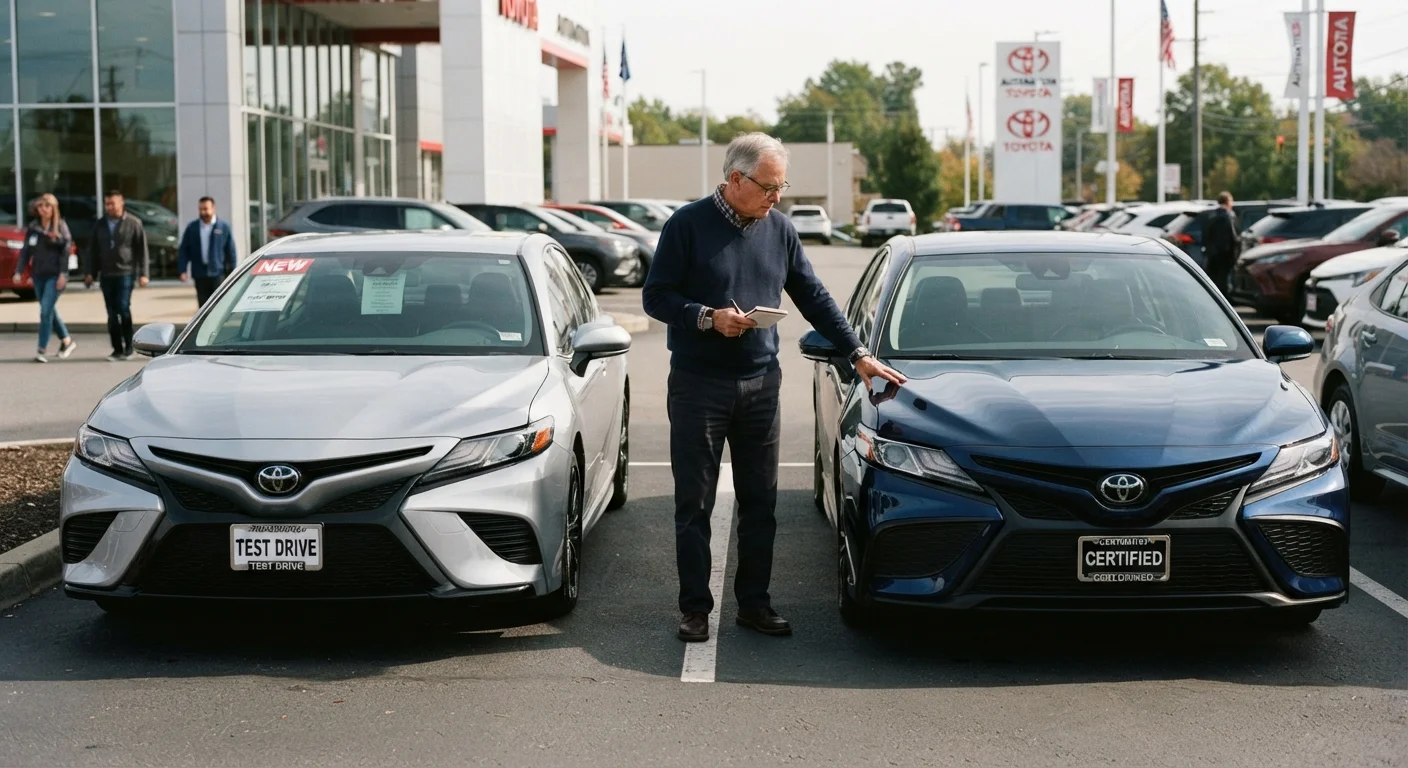
Start With Your Budget — Not the Showroom
Before stepping onto any lot, establish a clear, written budget that accounts for more than just monthly payments. Add up your fixed monthly income, subtract essential living expenses, and determine what you can realistically allocate to a car payment, insurance, fuel, and routine maintenance. Financial educators generally recommend keeping total vehicle costs — payment plus insurance plus fuel — below 15–20% of monthly take-home income.
For seniors managing retirement income or Social Security, this exercise is especially valuable. A vehicle that looks affordable at $350 per month may cost $600 or more once insurance and maintenance are factored in. See our guidance on the financing and budgeting strategies for senior buyers hub for a full breakdown of how to structure this calculation.
Get Pre-Approved Before You Shop
Securing pre-approval from your bank or credit union before visiting any dealership gives you a clear spending ceiling and removes financing pressure from the negotiation. Dealers may offer competitive financing, but having an outside offer in hand means you're never starting from zero. Compare the total interest paid — not just the monthly payment — across any loan offers you receive.
Once you have a monthly ceiling, work backward to estimate your maximum purchase price. At a 5% annual percentage rate (APR) over 48 months, roughly every $5,000 of vehicle price adds approximately $115 to your monthly payment — a useful rule of thumb when comparing options.
What New Cars Actually Offer Seniors
New vehicles carry three concrete advantages: full manufacturer warranty coverage (typically three years bumper-to-bumper, five years powertrain), the latest federally mandated safety technology, and zero unknown history. For older drivers, modern safety features — automatic emergency braking, lane-keeping assist, blind-spot monitoring, and large-format infotainment screens — can meaningfully reduce driving stress and risk.
For a thorough review of how today's new-car market is structured for older drivers, see The Complete Picture: Navigating New-Car Options as an Older Driver.
When comparing new versus used, request the out-the-door price in writing for both options — including taxes, title, registration fees, and dealer documentation fees — before making any comparison. Sticker prices rarely reflect true cost.
Dealerships sometimes offset a lower sticker price with higher fees, making a seemingly cheaper option cost more in total. Written out-the-door quotes are the only apples-to-apples comparison.
If you're leaning toward a used vehicle, target models that are two to three years old with under 35,000 miles — this range captures the deepest post-purchase depreciation while leaving substantial usable life remaining.
Industry depreciation data consistently shows the steepest value drop in the first 24–36 months of ownership, meaning a buyer entering at this point absorbs proportionally less depreciation per year going forward.
The trade-off is cost. New vehicles typically carry a higher sticker price and depreciate immediately — often losing 15–20% of value within the first year of ownership, according to widely cited automotive industry analyses. If you plan to drive a vehicle for ten or more years, spreading that depreciation over a long ownership period reduces its per-year impact. If you anticipate trading in within three to five years, however, you absorb the steepest portion of the depreciation curve.
The Real Case for Buying Used
A used vehicle — particularly one that is two to four years old — allows someone else to absorb the sharpest depreciation, while still leaving you with a modern, reliable car. Certified pre-owned (CPO) programs, offered through many franchised dealerships, add a layer of manufacturer-backed warranty and inspection standards that narrow the gap between new and used peace of mind.
For seniors who drive fewer miles annually — a common pattern in retirement — a lower-mileage used vehicle can represent exceptional value. Maintenance costs on a well-maintained three-year-old vehicle are generally comparable to those of a new one during the same ownership window.
Our guide From First Search to Test Drive walks through the full used-car search process step by step. For understanding where to source used vehicles, see The Landscape of Used Car Sources.
Private-Seller Purchases Carry More Risk
Buying from a private seller typically means no return policy, no warranty, and no certified inspection history. While prices can be lower, the burden of due diligence falls entirely on you. Always conduct a VIN history check and an independent pre-purchase inspection before completing any private-party transaction.
Depreciation, Financing, and Total Cost of Ownership
Depreciation is not just an abstract concept — it directly affects what you recover if you sell or trade in the vehicle later. New cars typically lose the most value in years one through three; used cars already past that window lose value more gradually. This means a used vehicle often has a lower total cost of ownership over a five-year period even if its financing rate is slightly higher.
~20%
Average new-car value lost in year one
Widely cited automotive industry analyses suggest new vehicles commonly depreciate 15–20% within the first 12 months of ownership.
$100–$200
Typical pre-purchase inspection cost
Independent mechanic inspections for used vehicles generally fall in this range and can identify costly hidden issues before purchase.
48–60 months
Common used-car loan terms for seniors
Consumer finance data suggests shorter loan terms reduce total interest paid, though monthly payments are higher; balance both factors against fixed income constraints.
Financing terms also differ. New vehicles frequently qualify for manufacturer-subsidized low-APR loans, while used vehicles are typically financed through banks or credit unions at market rates. However, because used vehicles carry a lower purchase price, total interest paid is often less even at a modestly higher rate. Seniors are encouraged to consult a licensed financial adviser before committing to any loan structure. Also consider whether leasing — a separate arrangement with its own set of trade-offs — warrants review: see Leasing vs. Buying: Which Arrangement Makes More Sense for Older Drivers?.
Insurance costs also shift between new and used. A newer, higher-value vehicle typically costs more to insure comprehensively. For guidance on choosing appropriate coverage, see A Senior's Roadmap to Selecting Car Insurance. Insurance terms, premiums, and coverage details vary by provider and by state; always read the full policy document and consult a licensed insurance agent for advice specific to your situation.
How to Inspect and Verify a Used Vehicle
Regardless of source, every used vehicle purchase should include three verification steps before money changes hands.
- Vehicle history report: Obtain a report using the vehicle identification number (VIN). Look for accident history, title problems (salvage, flood, lemon-law buyback), and the number of previous owners.
- Independent pre-purchase inspection (PPI): Hire a qualified, independent mechanic — not one affiliated with the seller — to inspect the vehicle on a lift. A PPI typically costs $100–$200 and can uncover hidden mechanical issues that are not visible during a test drive.
- Thorough test drive: Drive the vehicle in varied conditions: highway speeds, city stops, parking maneuvers. Listen for unfamiliar noises. Test all comfort and safety features personally.
For a practical search strategy tailored to seniors, see Finding a Used Car That Suits Seniors.
Never Skip the Independent Inspection
A vehicle history report alone does not reveal current mechanical condition. Hidden issues — worn brakes, oil leaks, transmission problems — may not appear in any database but will be visible to a qualified mechanic on a lift. Skipping this step to save $100–$200 can lead to repair bills many times that amount shortly after purchase. This applies equally to CPO vehicles; the CPO inspection is conducted by a dealer-affiliated technician, not an independent one.
Making the Final Call: A Decision Framework
Use the following questions to guide your decision rather than allowing urgency or emotion to drive it.
- How long do you plan to own the vehicle? Longer ownership (seven-plus years) reduces new-car depreciation's per-year cost and makes the warranty more valuable.
- How many miles do you drive annually? Lower annual mileage is generally a better fit for a used vehicle with existing mileage already logged.
- How important is warranty peace of mind? If the thought of unexpected repair bills creates significant stress, a new vehicle or CPO with extended coverage may be worth the premium.
- What is your financing picture? Seniors with strong credit who qualify for low-APR new-car promotions may find the cost gap narrower than expected.
- What safety features are non-negotiable? If specific features — such as automatic braking or large backup cameras — are essential, check whether they are available on the used vehicles in your price range before ruling out that path.
For a complete walkthrough covering the full purchase process — from research through registration — see Buying an Affordable Senior Car: A Complete Walkthrough. The Affordable Senior Cars hub also provides additional vetted resources for budget-conscious older drivers.
“The best car purchase is rarely the most exciting one — it's the one where the buyer fully understood what they were agreeing to before signing anything.”
— Car Buying Guide Editorial Team, Automotive consumer research and buyer education specialists
This article is for general informational and educational purposes only. It does not constitute personalised financial, insurance, or legal advice. Loan terms, insurance premiums, and vehicle values vary widely by provider, region, and individual circumstances. Consult a licensed financial adviser, insurance agent, or qualified mechanic before making decisions specific to your situation.
The content on this site is for informational purposes only and is not a substitute for professional advice. Always consult a qualified professional for guidance specific to your situation.