

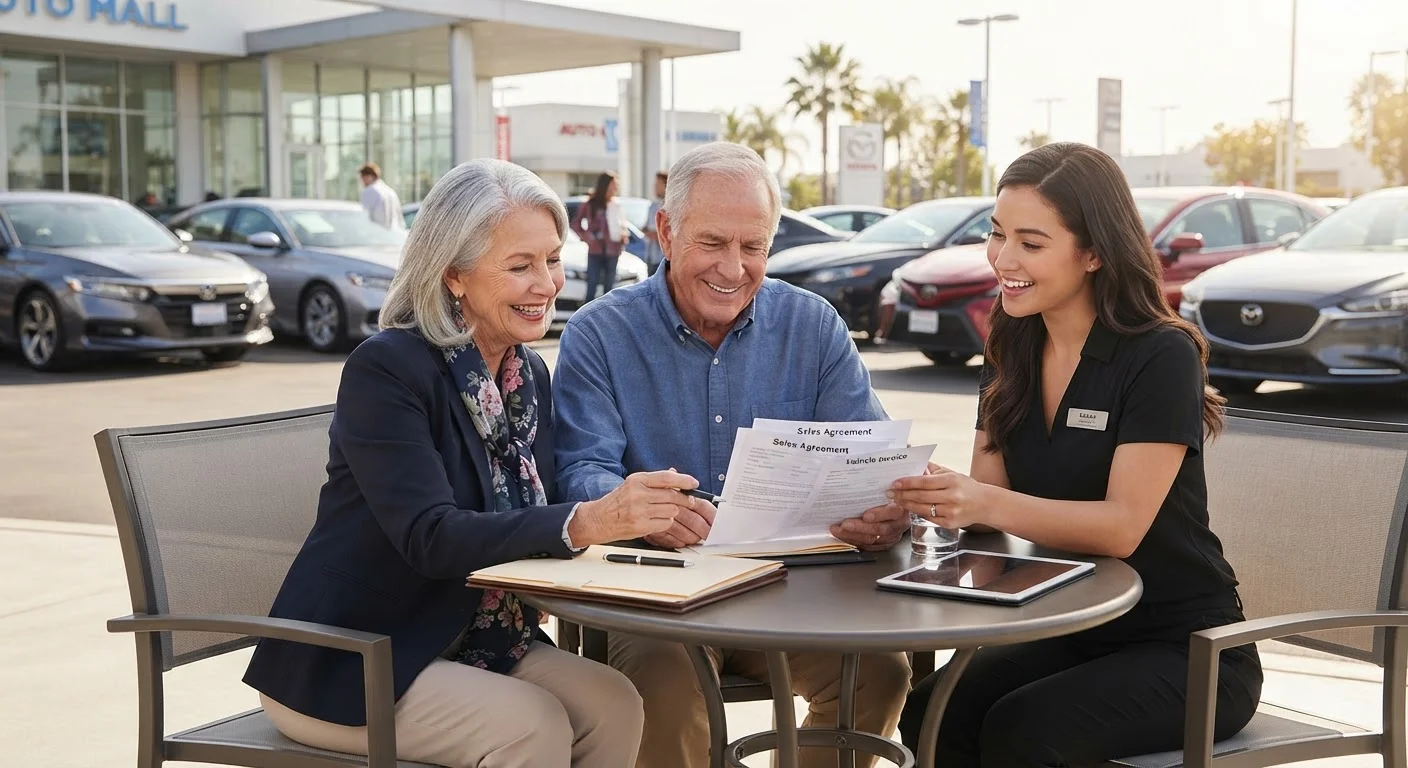
Setting a Realistic Budget
A sound budget is the foundation of every successful car purchase. Before researching specific vehicles, calculate what you can genuinely afford — not just the purchase price, but the full cost of ownership. This includes insurance premiums, registration fees, fuel, routine maintenance, and an emergency repair reserve.
Financial planners generally suggest keeping total vehicle costs — loan payment, insurance, and fuel — below 15–20% of monthly take-home income. If you plan to finance, consider the total interest paid over the loan term, not only the monthly payment. A longer loan can make payments feel manageable while significantly increasing the total you pay. See the Financing & Budgeting hub for a deeper look at loan structures and budgeting strategies suited to senior buyers.
Build a Repair Reserve Into Your Budget
Set aside $1,000–$2,000 beyond the purchase price when buying a used vehicle. Even well-maintained cars can need immediate attention after purchase — a pre-funded reserve means you won't face a difficult financial choice if something needs fixing right away. This simple step converts an unexpected cost into a planned one.
For used vehicles specifically, budget an additional $1,000–$2,000 as a contingency for repairs discovered after purchase — even well-maintained cars occasionally need immediate attention.
This article provides general information only and is not financial or legal advice. Consult a qualified professional regarding decisions specific to your situation.
Identifying the Right Features for Senior Drivers
Affordability should never come at the cost of safety or physical comfort. Seniors often benefit most from vehicles with low step-in height for easy entry and exit, adjustable pedals, a high seating position for clear sightlines, and large dashboard controls with legible font sizes.
Driver-assist technologies — automatic emergency braking, lane-keep assist, blind-spot monitoring, and rear cross-traffic alert — have become available on a growing range of modestly priced vehicles, including certified pre-owned models. These systems can meaningfully reduce collision risk, making them a worthwhile priority even when budgeting carefully.
During a test drive, bring any mobility aids you regularly use — a cane, walker, or cushion — and simulate your actual entry and exit routine. A car that feels accessible in the showroom may feel different with your real-world needs factored in.
Physical access is frequently overlooked during test drives but is one of the most important usability factors for seniors, particularly those managing joint pain or limited range of motion.
Request that the seller demonstrate every driver-assist feature — automatic braking, blind-spot alerts, and backup camera — before you drive. Confirm each system is functioning correctly, not just present on the spec sheet.
Safety systems can be disabled, malfunctioning, or damaged without obvious external signs. A working demonstration confirms you're receiving the technology you're paying for.
Comfort features such as heated seats, power-adjustable lumbar support, and keyless entry also reduce physical strain over time, particularly for drivers managing arthritis or limited mobility. Evaluate these not as luxuries but as practical supports for independent driving.
Researching and Sourcing Vehicles
Effective research narrows your options before you ever set foot on a lot. Start by identifying two or three vehicle types — sedan, small SUV, or hatchback — that meet your feature and budget criteria. Then consult reliability data published by consumer research organizations and owner forums to understand long-term maintenance patterns.
Sources worth exploring include franchised dealerships offering certified pre-owned programs, independent used car dealers, and private-party listings. Each has trade-offs in price, warranty coverage, and due-diligence requirements. Our guide on finding a used car that suits seniors covers each sourcing channel in detail, including how to search safely and what to prioritize.
38%
Of used car buyers who skip independent inspection
Consumer advocacy research consistently finds a significant share of used car buyers forgo professional inspection, increasing exposure to undisclosed mechanical issues.
$1,200+
Average annual car maintenance cost for seniors
AAA's annual Your Driving Costs study estimates average annual maintenance and repair costs for passenger vehicles, underscoring why a repair reserve matters.
If you're still weighing whether to buy new or used, the New vs Used Cars hub offers a structured comparison to guide that decision.
Inspection, History, and the Test Drive
Never skip the pre-purchase inspection. A vehicle history report (available through services like Carfax or AutoCheck using the vehicle identification number) reveals prior accidents, title issues, odometer discrepancies, and service records. However, a history report alone is not sufficient — have a trusted, independent mechanic perform a physical inspection before any money changes hands.
During the test drive, pay attention to entry and exit ease, visibility from the driver's seat, and how intuitively you can reach controls. Drive on highway and city roads. Listen for unusual noises over bumps. Check that all driver-assist systems activate as expected.
Our pre-purchase checklist for seniors provides a structured walkthrough of condition and value assessment before you commit.
Always Get an Independent Mechanic Inspection
A vehicle history report does not replace a hands-on mechanical inspection. Structural damage, worn components, and fluid leaks may not appear in any database. An independent mechanic — one with no relationship to the seller — can identify issues that affect both safety and value. The cost of an inspection (typically $100–$200) is small compared to a costly repair discovered after purchase.
Negotiating the Price
Knowledge is your strongest negotiating asset. Before any price discussion, research the fair market value of the specific vehicle — year, trim, mileage, and condition — using tools such as Kelley Blue Book or Edmunds. Arriving informed signals to a seller that you're a serious, prepared buyer and removes pressure to accept the asking price at face value.
Negotiate the out-the-door price, not only the monthly payment. Sellers sometimes adjust loan terms to keep monthly costs low while preserving or increasing the overall price. Ask for an itemized breakdown of all fees — documentation fees, dealer prep, and add-ons — before finalizing any figures. Separately, compare the new versus used decision roadmap if you're still evaluating both markets.
Watch for Add-Ons That Inflate the Price
Dealer add-ons such as paint protection packages, extended warranties sold at the point of sale, and documentation fees can add hundreds or thousands of dollars to the out-the-door price. Review each line item individually and ask which fees are mandatory versus optional. You are generally not required to purchase add-on products as a condition of buying the vehicle.
Financing, Insurance, and Final Paperwork
If financing, obtain pre-approval from your bank or credit union before visiting a dealer. This gives you a concrete rate benchmark and reduces reliance on dealer-arranged financing, which may carry higher interest. Compare the annual percentage rate (APR), total loan cost, and any prepayment penalties across offers.
Insurance costs should be confirmed before signing — contact your insurer with the vehicle's year, make, model, and VIN for an accurate quote. Coverage needs and premiums vary significantly based on vehicle type, driver history, and state. This is general guidance only; speak with a licensed insurance agent about options specific to your situation.
At signing, review every document carefully: the buyer's order, financing agreement, and any warranty paperwork. Registration requirements — title transfer, emissions testing, safety inspection — vary by state. Confirm local rules with your Department of Motor Vehicles. For a comprehensive end-to-end perspective on the used car search process, see From First Search to Test Drive.
Registration Rules Vary by State
Title transfer procedures, emissions testing requirements, and registration timelines differ from state to state. Some states require a safety inspection before registration; others do not. Contact your state's Department of Motor Vehicles — or visit its official website — early in the process so paperwork delays don't hold up your purchase.
This article is for general informational and educational purposes only. It does not constitute financial, legal, or insurance advice. Consult qualified professionals for guidance specific to your circumstances.
The content on this site is for informational purposes only and is not a substitute for professional advice. Always consult a qualified professional for guidance specific to your situation.