

Our Verdict
Steering wheel covers offer a low-commitment comfort upgrade suitable for most drivers, while spinner knobs provide meaningful functional assistance for those with limited arm or hand mobility. Grip aids occupy a practical middle ground — portable, affordable, and flexible. The right choice depends on a driver's specific physical needs and whether they have consulted a professional about adaptive equipment.
| Best for | Recommended |
|---|---|
| Drivers seeking improved grip and reduced vibration without modifying steering | Steering Wheel Cover |
| Those with limited hand strength, one-arm use, or coordination challenges | Spinner Knob |
| Drivers wanting a portable, tool-free supplemental aid | Grip Aid or Driving Glove |
Why Steering Aids Matter for Older Drivers
As drivers age, changes in grip strength, joint flexibility, and upper-body coordination can make steering feel more demanding — particularly during low-speed maneuvers like parking or three-point turns. Steering aids are a category of accessories designed to address these challenges by reducing the physical effort required to control the wheel.
The three most common options — steering wheel covers, spinner knobs, and grip aids — each work differently and suit different needs. Understanding the distinctions helps drivers and caregivers make informed decisions. For a broader overview of in-cabin mobility tools, see the adaptive car accessories quick-reference guide.
| Steering Wheel Cover | Spinner Knob | Grip Aid / Glove | |
|---|---|---|---|
| Primary benefit | Improved comfort and grip feel | One-handed steering capability | Increased hand-to-wheel friction |
| Ease of installation | Simple slip-on, no tools | Clamps to rim, some tools needed | No installation required |
| Addresses limited hand strength | Partially | Yes | Minimally |
| Suitable for one-arm use | No | Yes | No |
| Professional evaluation needed | Generally no | Often yes (state-dependent) | Generally no |
| Portability | Stays on vehicle | Stays on vehicle | Fully portable |
| Permanent vehicle modification | No | No | No |
Steering Wheel Covers: Comfort Without Complexity
A steering wheel cover wraps around the existing rim to improve tactile grip and cushioning. Materials range from foam and leather to textured rubber, each offering different levels of padding and friction. For drivers with mild arthritis or dry skin that reduces natural grip, a well-fitted cover can make sustained driving noticeably more comfortable.
Covers are simple to install and remove, require no permanent modification, and are generally inexpensive. Their limitation is that they do nothing to reduce the physical effort of steering — they only improve the feel of the wheel in your hands. Drivers with more significant strength or mobility limitations will likely need a more functional solution.
Getting the Right Fit
Steering wheel covers come in specific diameter sizes — measure your wheel's outer rim before purchasing. A cover that is too loose can shift during a turn, which is counterproductive. Most passenger vehicles fall within a standard range, but trucks and older models may differ. Check your vehicle's manual or measure the rim diameter directly.
Spinner Knobs: Functional Steering Assistance
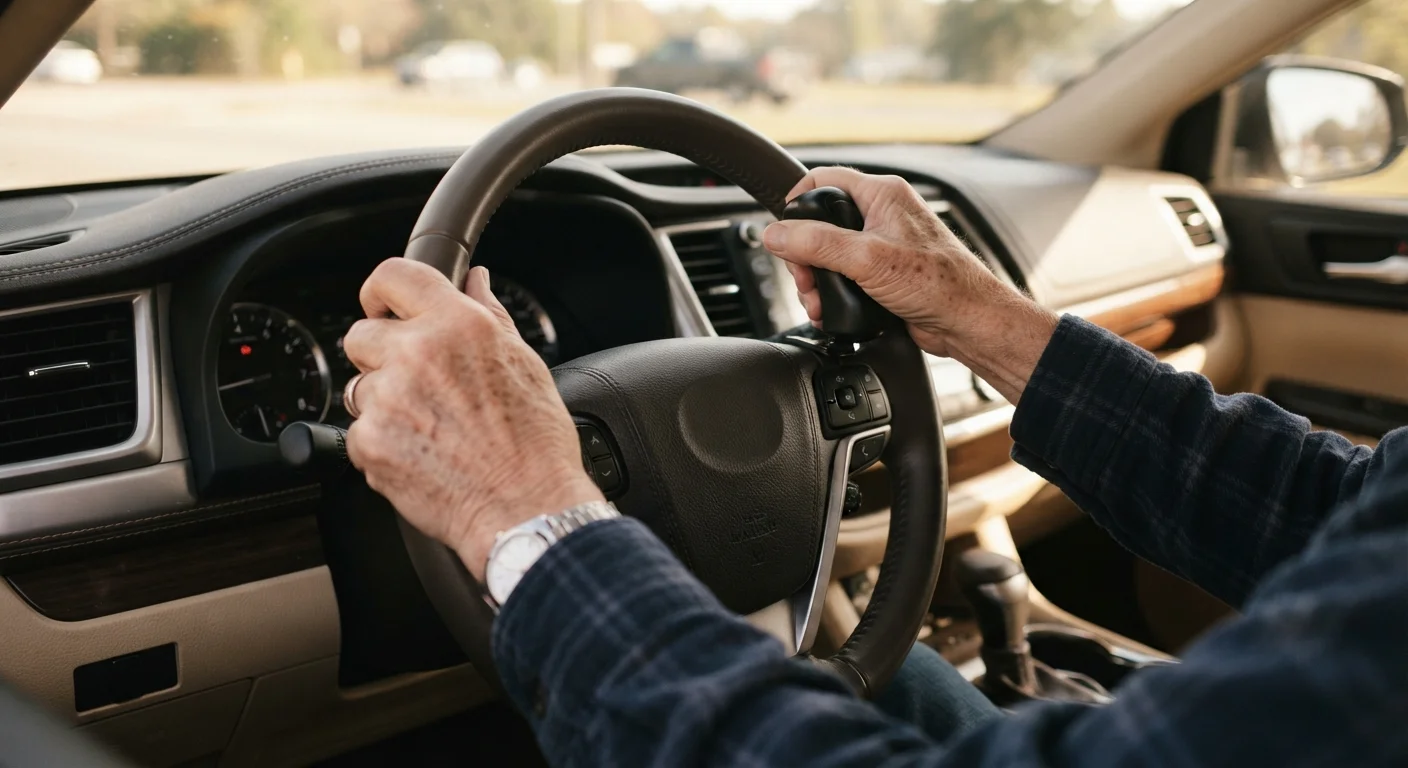
A spinner knob (also called a steering wheel knob or brodie knob) is a device that clamps to the steering wheel rim, allowing a driver to rotate the wheel with one hand using a pivoting grip. This is particularly useful for drivers who have limited use of one arm, reduced grip strength in both hands, or difficulty completing full-rotation turns.
Because spinner knobs change how steering control is exercised, they are considered adaptive driving equipment in many states and may require a professional driving evaluation before legal use. Occupational therapists who specialize in driver rehabilitation are typically the appropriate professionals to assess and recommend them. For more detail on how these devices work, the guide to adaptive steering aids for seniors offers a thorough explanation.
It is also worth noting that spinner knobs are not suitable for all vehicles or all drivers — particularly those with power steering systems that respond very quickly, where single-hand control can feel unpredictable at first.
Grip Aids and Driving Gloves: Portable Supplemental Options
Grip aids include products such as driving gloves with textured palms, anti-slip wraps, and hand-positioning guides. These are the least interventional option and require no installation. They work by increasing friction between the driver's hand and the wheel surface — helpful for those whose challenges stem primarily from reduced skin sensitivity or mild grip weakness.
Driving gloves designed for older adults often incorporate padding over bony prominences (such as knuckles) and open-finger designs to maintain tactile feedback. They do not assist with steering effort or one-handed control, but they complement other aids well.
Drivers who also experience difficulty with entry, exit, or pedal reach may benefit from reviewing grab handles and swivel cushion options and pedal extensions and adaptive controls as part of a broader comfort and safety review.
Choosing the Right Option: Key Factors to Consider
Selecting a steering aid should begin with an honest assessment of what is making driving difficult. The key questions to ask include:
- Is the issue grip texture or padding? A cover or glove may be sufficient.
- Is one arm or hand significantly weaker or less mobile? A spinner knob evaluation is worth pursuing.
- Is the challenge temporary or progressive? A progressive condition warrants professional guidance rather than a self-selected fix.
- Does the vehicle already have an adjustable column? Sometimes improving steering wheel position is the first step — the article on steering wheel adjustability explains how column position affects control and visibility.
Spinner Knobs May Have Legal Requirements
In some U.S. states, using a spinner knob on a public road without a medical or disability documentation may not be permitted. Regulations vary by state, and requirements can change. Before fitting a spinner knob, check your state's DMV regulations or speak with a driver rehabilitation specialist who understands local requirements.
Drivers uncertain about which category of aid is appropriate are encouraged to request a driver rehabilitation evaluation, typically offered through occupational therapy programs at hospitals or rehabilitation centers. These assessments are designed to match equipment to the individual safely.
The content on this site is for informational purposes only and is not a substitute for professional advice. Always consult a qualified professional for guidance specific to your situation.