

Why Entry and Exit Is Where Most Strain Happens
For many older drivers, the act of driving itself causes little discomfort — it's getting in and out of the car that taxes the body. The sequence of lowering into a seat, pivoting the hips, swinging both legs in, and then reversing the process to exit involves a coordinated demand on hip flexors, knee joints, lower back, and grip strength simultaneously. When any of those systems is limited by arthritis, reduced flexibility, or post-surgical recovery, the transfer becomes a genuine daily challenge.
The accessories designed to ease this process fall into a few distinct categories, each targeting a different part of the movement. Understanding what each one actually does — and the circumstances where it earns its place — matters more than accumulating a collection of aids that may not address your specific limitation. See our introduction to comfort and mobility aids for a broader overview of how these accessories fit into daily driving life.
Try Before You Buy When Possible
Vehicle entry-and-exit aids vary considerably in how well they fit specific car models and individual body mechanics. If possible, test a handle or cushion in your actual vehicle before committing — some occupational therapy departments and adaptive driving programs allow this. An aid that works well in one seat geometry may feel awkward in another.
The Aids Worth Knowing About
Doorframe Grab Handles
A doorframe grab handle — sometimes called a car cane or door-mounted support handle — clips into the U-shaped latch striker on the door frame. It creates a rigid vertical grip that a driver or passenger can hold while lowering into or rising from the seat. No drilling or permanent installation is required for most models; the handle simply slots in and locks under body weight.
This type of handle is particularly useful for people with knee or hip pain who need something to push against while rising, or who feel unsteady when the seat is low relative to the door opening. Because it's positioned near the door hinge line, it provides leverage at the moment when the body's center of gravity is most awkward — partially out of the seat but not yet fully upright.
The main limitation is load capacity: these handles are support aids, not full transfer devices. They're suited to people who can bear most of their own weight but need a stable reference point, not to those requiring full-body weight transfer assistance. Many models also include a small built-in LED torch and a seatbelt cutter, though those secondary features vary by product.
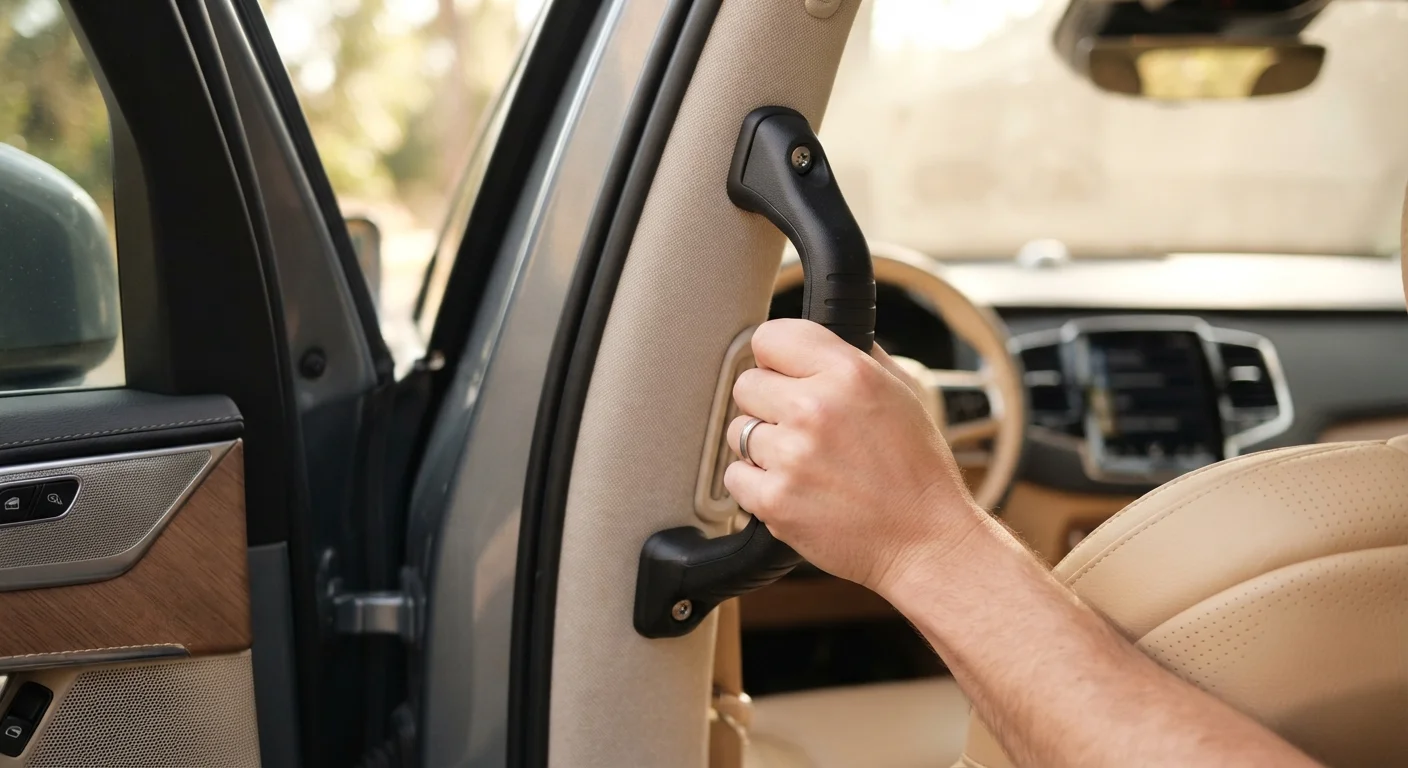
A doorframe grab handle creates a rigid grip exactly where leverage is needed most during the transfer.
Overhead Assist Grips
Overhead assist grips are the loops or handles mounted above the door, near the roofline, that most vehicles include as standard equipment. Many drivers overlook them for entry and exit because they're positioned for use once you're already seated — they're ideal for pulling the door shut, steadying yourself when repositioning in the seat, or bracing during sharp turns as a passenger.
For entry and exit specifically, the overhead grip is more useful on the way out: once upright and stepping toward the door, reaching back for the overhead handle can help maintain balance during that final rotational step. It's less useful during the initial lowering motion, where the angle and reach become awkward before the person is seated.
Aftermarket overhead assist handles can be added to vehicles whose stock grips feel too small or are poorly positioned. These typically install using existing bolts or specialized mounting brackets. The installation process for car grab handles varies by vehicle and handle type — professional fitting is worth considering when structural attachment points are involved.
Overhead assist grips are often most effective during the exit phase, once a person is upright and stepping out.
Swivel Seat Cushions
A swivel seat cushion sits on top of the existing vehicle seat and rotates — typically 360 degrees, though many users only need a 90-degree rotation — so that a person can sit down facing out of the vehicle and then turn to face forward without twisting at the hip or lumbar spine. On exit, the process reverses: rotate to face the door opening before standing.
This matters most for people with hip replacement history, spinal stenosis, or significant lower-back stiffness, where the standard pivot-and-swing motion of car entry is not just uncomfortable but mechanically risky. By eliminating the need to twist while partially weight-bearing, a swivel cushion meaningfully reduces joint stress at the moment of greatest vulnerability.
Swivel cushions come in two main types: passive (rotate freely under the user's own movement) and assisted (use a spring or disk mechanism to actively aid rotation). The choice between them depends on the user's upper-body strength and how much active participation they can contribute. For a direct comparison of swivel cushions against standard seat pads, the swivel vs. standard seat cushion guide covers the practical differences in detail.
A swivel cushion eliminates the need to twist at the hip while partially weight-bearing — the riskiest moment of car entry.
Leg Lifters and Transfer Boards
Leg lifters are simple fabric loops with a rigid footrest loop at one end and a hand grip at the other. They allow a person with limited hip flexor strength or leg mobility to manually lift their leg into the vehicle after the rest of the body is seated. The motion is entirely user-controlled, requiring only arm and shoulder strength rather than hip or thigh engagement.
Transfer boards are flat, low-friction boards that bridge the gap between a wheelchair or walker and the car seat, allowing a sliding transfer without a full standing pivot. They're less commonly used by drivers — who must be able to operate the vehicle independently — but are relevant for passengers with significant mobility limitations.
Both aids address the final stage of entry: the leg swing and seat positioning that follows the initial lowering motion. For people whose primary difficulty is not the lowering itself but getting both legs positioned correctly once seated, these tools fill a gap that grab handles and swivel cushions don't address. See the full guide to getting in and out of the car with less strain for additional context on the complete transfer sequence.
Leg lifters address the final stage of entry — positioning legs correctly once seated — which other aids don't cover.
Seat Edge Extenders and Running Board Steps
The height differential between the ground and the vehicle seat is one of the most direct predictors of transfer difficulty. A seat that's too low requires deep hip flexion to rise from; a step that's too high demands significant quad and hip flexor strength to climb. Seat edge extenders — firm foam or rigid panels that effectively raise the seating surface — reduce the depth of the required squat on both entry and exit.
Running board steps and aftermarket step bars lower the effective first step into the vehicle, reducing the height each foot must be lifted. On trucks, SUVs, and minivans where the floor height is considerable, a step bar can make the difference between a manageable entry and one that requires assistance.
Neither modification addresses rotation or lateral stability, so they're most effective for people whose primary challenge is the vertical component of the transfer — lifting the body's weight against gravity — rather than the pivot or the leg swing. When combined with a doorframe grab handle, a step bar plus grab handle can address both the height challenge and the stability challenge together, which is why these aids are often most effective when used as a coordinated pair rather than in isolation.
Reducing the height differential between ground and seat directly lowers the muscular demand of every entry and exit.
These Aids Are Not Medical Devices
The majority of grab handles, swivel cushions, and assist grips sold for vehicle use are consumer mobility accessories, not regulated medical devices. This means quality, load ratings, and durability vary significantly between products. If you have a specific post-surgical or medical condition, consult your physical therapist or physician before selecting an aid — they can advise on weight-bearing limits and positioning that a product description alone won't address.
Choosing What's Right for You
No single aid works for every person, and several work best in combination. A swivel cushion addresses hip rotation; a doorframe handle supports the lowering and rising motion; an overhead assist grip helps once you're seated and need to pull the door closed or reposition. Someone managing both knee pain and limited grip strength may benefit from two or three of these used together rather than searching for one product that does everything.
Before purchasing any mobility aid, consulting a certified driver rehabilitation specialist (CDRS) is a practical step that's often overlooked. These professionals can assess your physical range of motion, identify which specific transfers are causing difficulty, and recommend aids that match the actual mechanics of your vehicle and your body — rather than relying on general descriptions. For a fuller breakdown of the categories covered here and others, the adaptive car accessories quick-reference guide is a useful companion resource. If you're also weighing whether a clip-on solution suits your needs or whether a more permanent modification makes sense, this comparison of clip-on vs. permanent mobility aids walks through the practical trade-offs.
The content on this site is for informational purposes only and is not a substitute for professional advice. Always consult a qualified professional for guidance specific to your situation.