

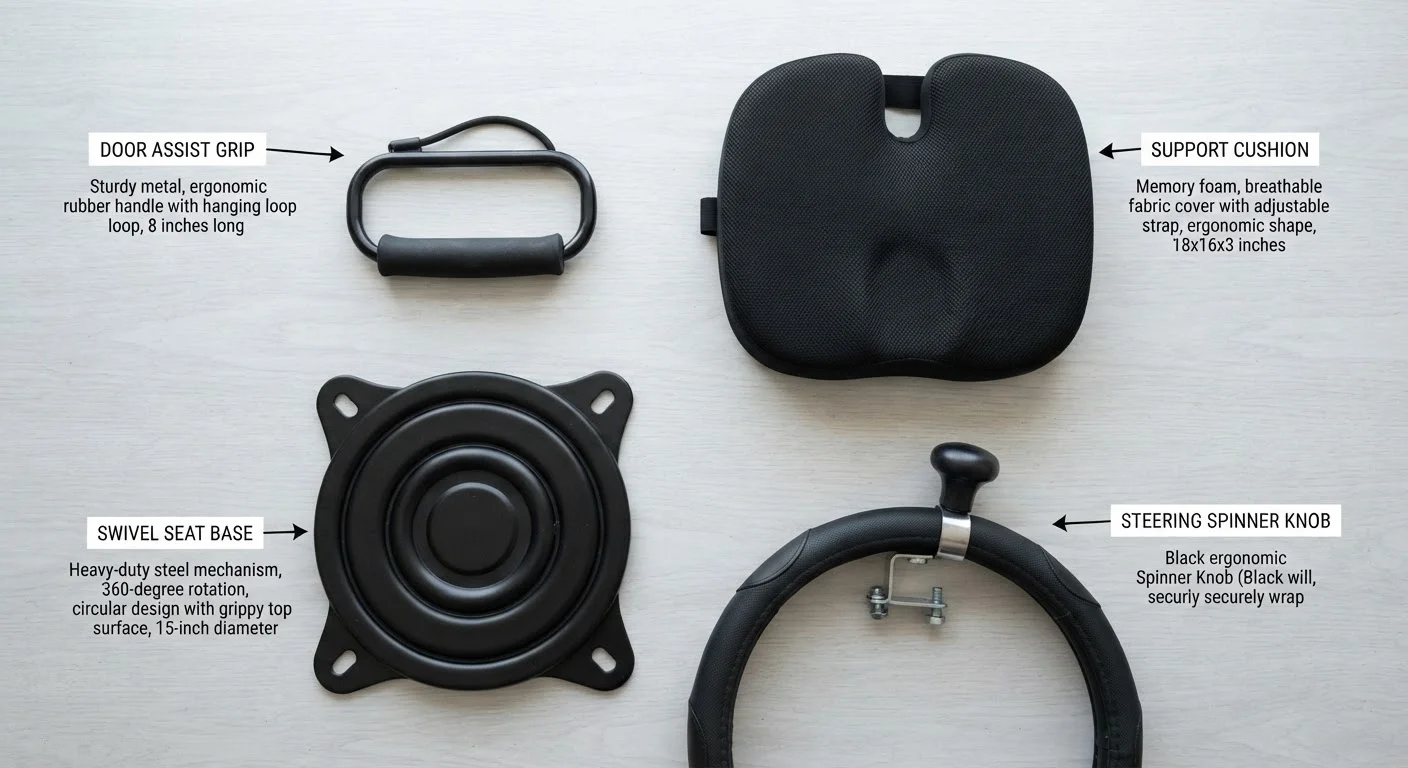
How Adaptive Accessories Are Categorized
Adaptive car accessories are in-cabin devices and modifications designed to help people with reduced strength, flexibility, or mobility drive or ride more safely and comfortably. They are organized into functional categories based on the physical challenge each one addresses — entry and exit, seating, steering and pedal control, and visibility.
This guide serves as a quick reference for seniors and caregivers who want to understand what options exist before consulting a specialist. For a broader introduction to why these tools matter, see Comfort & Mobility Aids for Senior Drivers.
Adaptive accessory
A device or modification designed to help a person with a physical limitation perform a driving-related task they would otherwise find difficult or impossible. These range from simple cushions to professionally installed control modifications.
Certified Mobility Equipment Dealer (CMED)
A professional retailer and installer who has met training and certification standards for fitting adaptive driving equipment. They work with clients, often alongside driver rehabilitation specialists, to match equipment to individual needs.
Swivel seat cushion
A rotating disc placed on a car seat that allows the user to turn their entire body toward the door before standing, reducing the need to twist the hips or spine during entry and exit.
Spinner knob
A knob clamped to the steering wheel rim that enables one-handed steering with reduced grip and wrist rotation. Also called a steering knob or driving knob.
Hand controls
Mechanical devices that let a driver operate the brake and accelerator using hand movements rather than foot pressure. Installation and use typically require assessment by a driver rehabilitation specialist.
Driver rehabilitation specialist
An occupational therapist with advanced training in evaluating a person's ability to drive safely and recommending appropriate adaptive equipment or driving techniques.
This article is for general informational purposes only and does not constitute medical, legal, or professional mobility advice. Consult a certified mobility equipment dealer or occupational therapist before making modifications to a vehicle.
Entry and Exit Aids
Getting in and out of a vehicle is one of the most physically demanding tasks for older adults with joint stiffness, hip replacements, or limited lower-body strength. Several accessory types address this challenge:
- Door handle assist grips: Portable handles that attach to the door latch or window frame, giving the occupant a stable surface to push or pull against. Look for a non-slip grip surface and a weight rating appropriate to the user.
- Swivel seat cushions: A rotating disc placed on the seat that allows the user to swing legs in and out as a unit rather than twisting the spine. Some versions include a locking mechanism to prevent unwanted rotation while seated.
- Transfer boards: Rigid panels that bridge the gap between a wheelchair and the car seat, enabling a sliding transfer. They are typically used alongside caregiver assistance.
- Rooftop grab handles: Portable handles that hook onto the door frame to stabilize a person as they lower into or rise from the seat.
Key features to compare: weight capacity, portability (for use across multiple vehicles), and whether installation requires tools or professional fitting.
| Primary entry/exit challenge addressed | Hip and knee stiffness, reduced grip strength |
| Most portable entry aid | Door handle assist grip (no installation needed) |
| Swivel cushion rotation range | Typically 360 degrees |
| Professional installation required? | Yes, for hand controls and left-foot accelerators |
| Who assesses need for major modifications | Driver rehabilitation specialist (often an OT) |
| Spinner knob legal status | Varies by state — check local motor vehicle regulations |
Seating and Posture Supports
Once inside the vehicle, proper posture reduces fatigue and discomfort during longer drives. Seating supports serve both drivers and passengers:
- Lumbar support cushions: Wedge or contoured inserts placed against the lower back. They help maintain the spine's natural curve, which can reduce strain on the lower back during extended periods of sitting.
- Seat raisers: Firm cushions that elevate the seating position, improving sightlines over the dashboard and making it easier to stand up when exiting.
- Coccyx (tailbone) relief cushions: Designed with a cutout at the rear edge to relieve pressure for people with tailbone sensitivity or post-surgical discomfort.
- Head and neck supports: Supplemental pillows that wrap around or attach to the headrest to reduce neck fatigue on longer trips.
For more on how vehicle seat geometry affects comfort, see the complete overview of comfort and easy-access features.
Steering, Pedal, and Control Aids
These accessories are more specialized and often require professional installation or evaluation by a certified mobility equipment dealer (CMED). They modify how a driver interacts with the vehicle's primary controls.
- Spinner knobs (steering knobs): A knob attached to the steering wheel rim that allows one-handed steering with less wrist rotation. Useful for drivers with limited grip strength or upper-limb mobility. In most states, installation requires no permit for personal use, but rules vary — check your state's motor vehicle regulations.
- Left-foot accelerator pedals: A secondary accelerator mounted to the left of the brake, for drivers whose right-side function is impaired. This type of modification should always be installed by a CMED and evaluated by a driver rehabilitation specialist.
- Hand controls: Levers or push-pull devices that allow braking and acceleration without using the feet. These are significant adaptive modifications requiring professional assessment and installation.
- Turn signal and wiper extensions: Lever extensions that bring controls closer and reduce the reach or force needed to operate standard column stalks.
Working with a certified mobility equipment dealer explains how to find a qualified professional and what to expect from that process.
Some Modifications Require Professional Assessment
Hand controls, left-foot accelerators, and similar primary control modifications are not off-the-shelf purchases. They require evaluation by a driver rehabilitation specialist to ensure the equipment matches the user's specific capabilities. Installing these without proper assessment can create safety risks. Your state's motor vehicle department may also require documentation of the modification.
Visibility and Awareness Accessories
Reduced range of motion in the neck and shoulders can limit a driver's ability to check blind spots. Visibility aids compensate for this without requiring physical modification to the vehicle:
- Wide-angle mirror attachments: Convex clip-on panels added to existing mirrors to expand the field of view. They do not replace standard mirrors but supplement them.
- Blind-spot mirrors: Small, stick-on convex mirrors applied to the outer corners of side mirrors to help detect vehicles in adjacent lanes.
- Parking sensors and rear-view camera add-ons: Aftermarket units for vehicles that lack factory-installed systems. These provide auditory or visual alerts when the vehicle approaches an obstacle while reversing.
For a fuller picture of safety-focused accessories, Safety Accessories Every Older Driver Should Know About covers visibility, awareness, and protective tools in one place. You can also browse the full Safety Accessories hub for additional resources.
40+
Recognized categories of adaptive driving equipment
According to the Association for Driver Rehabilitation Specialists (ADED), there are more than 40 recognized categories of adaptive driving equipment available to assist individuals with disabilities.
1 in 5
U.S. adults aged 65+ report a mobility limitation
U.S. Census Bureau data indicates approximately one in five adults aged 65 and older reports some form of mobility difficulty that can affect daily activities including driving.
The content on this site is for informational purposes only and is not a substitute for professional advice. Always consult a qualified professional for guidance specific to your situation.