

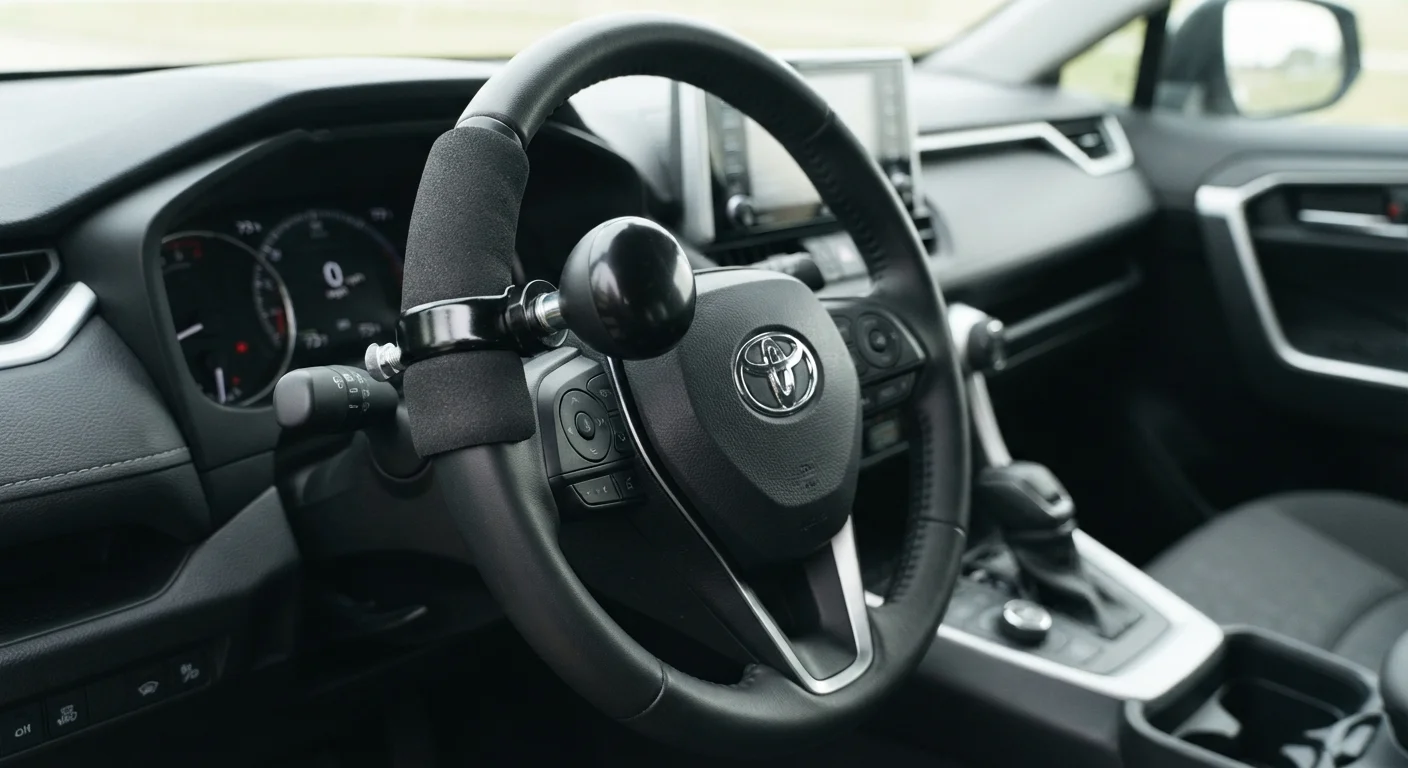
What Are Adaptive Steering Aids?
Adaptive steering aids are devices attached to — or wrapped around — a vehicle's steering wheel to make turning and maneuvering easier for drivers who face physical challenges. For many older adults, reduced grip strength, arthritis, shoulder limitations, or one-sided weakness can make standard steering wheels uncomfortable or difficult to control safely.
These aids do not replace a vehicle's power steering system — they work alongside it. For a primer on how power steering itself supports easier driving, see our guide on power steering fluid and what it does.
| Main device types | Steering knobs, grip covers, spinner controls (tri-pin, V-pin) |
| Who typically recommends them | Certified Driver Rehabilitation Specialists (CDRS) and occupational therapists (Association for Driver Rehabilitation Specialists (ADED)) |
| Common conditions addressed | Arthritis, stroke-related hemiplegia, Parkinson's disease, rotator cuff injury, neuropathy |
| Installation guidance | Professional installation strongly recommended; some devices require a prescription |
| Regulatory note | U.S. state rules on adaptive controls vary; verify requirements with a licensed specialist |
The three main categories most commonly recommended by occupational therapists (OTs) are steering wheel knobs, grip aids or covers, and spinner controls. Each addresses a distinct physical need, and understanding the difference helps drivers and caregivers make more informed decisions.
Knobs, Grips, and Spinner Controls: How Each Works
Steering Wheel Knobs
A steering wheel knob — sometimes called a palm knob or driving knob — is a rounded device that clamps onto the rim of the steering wheel. The driver grips and rolls the knob to turn the wheel rather than sliding both hands around the rim. This is especially helpful for drivers who can only steer with one hand due to hemiplegia, stroke recovery, or significant arm weakness.
Grip Aids and Covers
Grip aids are foam, rubber, or textured wraps applied to the steering wheel rim to increase friction and reduce the force needed to maintain a hold. They benefit drivers with arthritis, tremors, or generally diminished grip strength who can still steer with both hands but find a standard smooth wheel fatiguing or painful. Unlike knobs, grip covers do not change steering mechanics — they simply make holding the wheel easier.
Spinner Controls (Tri-Pin and V-Pin Devices)
Spinner controls — also called hand controls or steering spinners — go a step beyond the basic knob. A tri-pin device consists of three padded prongs that the driver's hand slots between, allowing them to push or pull the wheel without needing a firm grip at all. A V-pin variant offers two prongs in a fork configuration. These are particularly suited to drivers with significant hand weakness, paralysis, or prosthetic limb use.
Professional Assessment Before Purchase
Adaptive steering aids are not one-size-fits-all products. What helps one driver may be unsafe or unnecessary for another. A certified driver rehabilitation specialist can evaluate your specific physical profile and recommend the most appropriate device. Installing an aid without a professional assessment may create new risks rather than reduce them.
For a side-by-side look at how these options compare with each other and with general steering accessories, see steering wheel covers, spinner knobs, and grip aids compared.
When Are These Aids Typically Recommended?
Occupational therapists who specialize in driver rehabilitation are the primary professionals who assess whether — and which — adaptive steering aids are appropriate. A formal driver rehabilitation evaluation typically includes a clinical assessment of hand strength, range of motion, and coordination, followed by an in-vehicle assessment.
Common physical conditions that may lead an OT to recommend steering aids include:
- Arthritis — particularly affecting the wrists, fingers, or shoulders
- Post-stroke hemiplegia — where one-handed steering becomes necessary
- Parkinson's disease — where tremor or rigidity reduces reliable grip
- Rotator cuff injury or shoulder impingement — limiting the range of arm movement needed for full-circle steering
- Peripheral neuropathy — reducing sensation and grip confidence in the hands
It is important to note that many U.S. states require a prescription or documentation from a licensed driver rehabilitation specialist before certain adaptive controls can be legally used on public roads. Seniors and caregivers should check applicable state regulations and consult a certified driver rehabilitation specialist (CDRS) before installing and using these devices.
For context on other adaptive devices that may be recommended alongside steering aids, the guide on pedal extensions and adaptive controls covers how a full adaptive driving assessment typically works.
Steering Wheel Knob
A rounded device clamped to the rim of a steering wheel that allows a driver to turn the wheel using one hand with a rolling motion, rather than sliding both hands around the rim.
Spinner Control
An adaptive steering device — such as a tri-pin or V-pin — that allows the driver to guide the steering wheel without requiring a conventional grip, suitable for those with significant hand weakness or paralysis.
Certified Driver Rehabilitation Specialist (CDRS)
A licensed professional trained to assess driving ability and recommend adaptive equipment for people with physical, cognitive, or sensory impairments. In the U.S., they are credentialed through the Association for Driver Rehabilitation Specialists (ADED).
Grip Aid
A textured foam or rubber wrap applied to a steering wheel rim to increase friction and reduce the effort needed to maintain a handhold, benefiting drivers with arthritis or reduced grip strength.
Tri-Pin Device
A type of spinner control featuring three padded prongs that the driver's hand slots between, enabling steering without needing to close the hand into a grip.
Driver Rehabilitation Specialist
A healthcare or mobility professional — often an occupational therapist with specialist training — who evaluates driving ability and prescribes adaptive equipment or modified techniques.
Fitting, Safety, and What to Know Before Installing
Adaptive steering aids must be correctly fitted to the steering wheel to be safe. Improperly attached knobs or spinner devices can slip during a turn, which creates a serious safety hazard. Professional installation by a qualified mobility equipment dealer or a certified driver rehabilitation specialist is strongly recommended — and in some cases required.
Drivers should also be aware that some adaptive steering aids may affect airbag deployment geometry or interfere with steering wheel controls (such as audio or cruise control buttons). A qualified installer will assess compatibility with the specific vehicle before fitting.
Once installed, any new steering aid requires a period of familiarization. Most OTs will schedule supervised practice sessions before clearing a patient to drive independently with the new equipment.
The broader context of vehicle design — including adjustable steering columns — also plays a role in how effective these aids can be. Our article on steering wheel adjustability and why it matters explains why column position interacts with both comfort and safety.
For a broader view of adaptive in-cabin accessories available to seniors, the types of adaptive car accessories quick-reference guide covers the full range of categories worth knowing about.
This article is for general informational purposes only and does not constitute medical, legal, or professional driving advice. Suitability of any adaptive driving aid depends on individual health conditions, vehicle type, and applicable state regulations. Consult a certified driver rehabilitation specialist before selecting or installing adaptive steering equipment.
The content on this site is for informational purposes only and is not a substitute for professional advice. Always consult a qualified professional for guidance specific to your situation.