

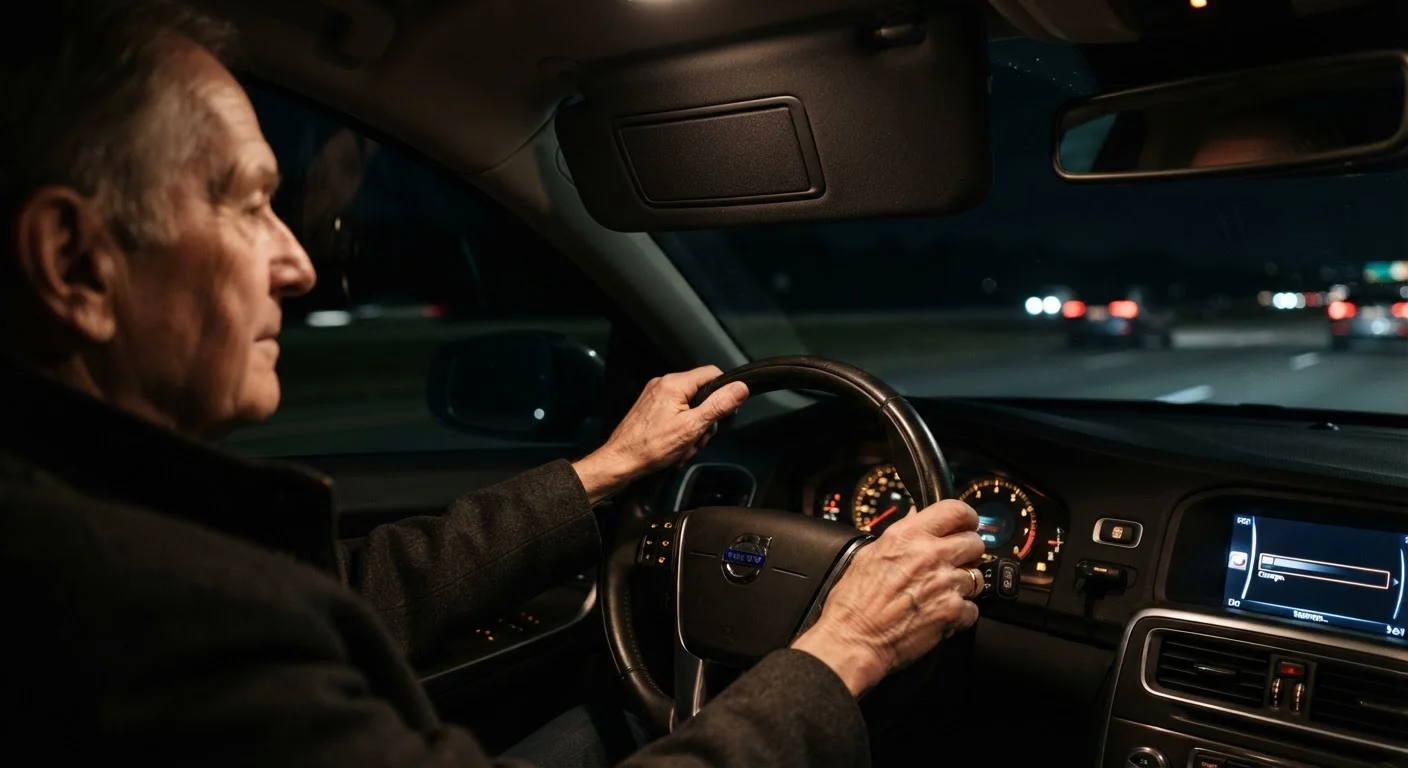
Why Older Eyes Struggle with Glare and Low Light
Vision changes with age in ways that directly affect driving safety. The eye's crystalline lens gradually becomes denser and less flexible, reducing the amount of light that reaches the retina. Pupil size also decreases over time, limiting the eye's ability to adapt quickly when moving from bright to dark environments — for example, entering a tunnel or facing an oncoming vehicle's headlights at night.
Research consistently shows that older drivers experience significantly greater disability glare than younger drivers. In practical terms, this means a brief exposure to a bright light source can temporarily impair the ability to see clearly for longer after the light passes. On a dark road, that recovery delay represents real risk.
Dashboard reflections are another underappreciated hazard. Shiny dashboard surfaces, particularly those in lighter colours, can cast a faint image onto the inside of the windshield — especially during daytime driving against a dark treeline or at dusk. This "secondary glare" interferes with contrast perception without drivers always recognising its source.
Glare vs. Low Light: Two Different Problems
Glare sensitivity and reduced night vision are related but distinct issues. Glare sensitivity refers to impairment caused by a bright light source in an otherwise dark field. Reduced night vision refers to difficulty seeing clearly in uniformly dim conditions. Many accessories address one more effectively than the other, so it helps to identify which challenge is most limiting for you before selecting a solution.
Understanding the specific visual changes involved is the first step in choosing accessories that address the right problem. See our guide to accessories for age-related driving challenges for a broader look at how physical changes affect driving.
Eyewear Accessories: The First Line of Defence
Because glare sensitivity originates in the eye, accessories worn on the face often address the problem most directly. The two most relevant categories are anti-reflective lens coatings and contrast-enhancing tinted lenses.
Anti-reflective (AR) coatings are applied to prescription or non-prescription lenses to reduce internal lens reflections — the secondary bouncing of light within the lens material itself. This scatter is a significant contributor to the halo effect older drivers often experience around streetlights and oncoming headlights. AR coatings are widely available from opticians and can be added to existing prescriptions.
Yellow or amber-tinted lenses are marketed as contrast enhancers for low-light driving. They work by filtering out short-wavelength blue light, which scatters more inside ageing eye tissue. The result is increased perceived sharpness in overcast or twilight conditions, though they are not suitable as a substitute for proper headlight use at night.
Consult Your Optometrist First
Before investing in glare-reduction accessories, have your vision checked by a licensed optometrist. Conditions such as cataracts, which are highly treatable, can cause glare sensitivity far more severe than typical age-related changes. An updated prescription and appropriate lens coatings may address more of the problem than any aftermarket accessory.
For those already using prescription eyewear, polarised clip-on visors or fitover sunglasses can add an external glare-reduction layer without replacing existing glasses. These are available in a range of frame sizes to fit over prescription frames.
Vehicle-Based Accessories for Glare Reduction
Several accessories attach to or modify the vehicle interior to reduce the sources of glare reaching the driver's eyes.
Extended sun visors and clip-on visor extenders address the gap between the factory visor edge and the windshield top — a common entry point for low-angle sun glare during morning or afternoon drives. Aftermarket visor extenders attach to the existing visor and fold down to cover the additional area, without blocking the driver's primary field of view.
Dashboard mats in dark, non-reflective materials placed over the top of the instrument panel absorb rather than reflect light, eliminating one of the most common sources of windshield glare. These are simple, low-cost, and do not require installation.
Anti-glare rearview mirrors use a dimming coating or an electrochromic (automatically dimming) layer that reduces the brightness of headlight reflections from vehicles behind. Many newer vehicles include auto-dimming mirrors as standard, but aftermarket versions are available for older models. This is one of the more directly impactful accessories for night driving comfort.
For a broader overview of how vehicle safety technologies complement these accessories, our article on night vision and enhanced headlight systems explores built-in options available in newer vehicles.
~10x
Increase in glare recovery time with age
Vision science research indicates older adults may take up to ten times longer than younger adults to recover vision after exposure to bright light sources — a factor with direct implications for night driving safety.
1 in 3
Older adults report reduced night driving confidence
Surveys of drivers aged 65 and over consistently find that a significant proportion have voluntarily reduced or eliminated night driving due to vision-related discomfort, according to studies published in journals of gerontology and traffic safety.
50%
Less light reaching retina by age 60
Optical research has documented that by age 60, the ageing eye may admit roughly half as much light as it did at age 20, primarily due to pupil contraction and lens yellowing — underlying causes of both glare sensitivity and reduced night vision.
Putting It Together: A Layered Approach
No single accessory resolves all the visual challenges associated with ageing. The most effective strategy addresses multiple sources of glare and low-light difficulty simultaneously — eyewear for internal lens scatter, dashboard and visor accessories for reflected and ambient light, and rearview mirror solutions for following headlights.
Before purchasing any accessory, a current eye examination is advisable. An optometrist can identify whether specific visual changes — such as early cataracts, which substantially worsen glare — might benefit more from a medical or optical intervention than from a vehicle accessory alone.
Practical steps worth taking in parallel include dimming dashboard and instrument panel brightness using the vehicle's built-in controls, keeping the windshield clean on both sides (interior film significantly worsens glare), and avoiding driving during the most challenging light transitions at dawn and dusk when possible.
For a comprehensive overview of accessories relevant to older drivers across all safety categories, see our end-to-end resource on senior driving safety accessories. Additional safety feature considerations are covered in our article on safety features that make the biggest difference for older drivers.
Frequently Asked Questions
Older eyes admit less light because pupils shrink with age and the eye's lens becomes less transparent. This means less visual information reaches the retina in dim conditions. Combined with slower pupil response and increased glare from oncoming headlights, night driving becomes genuinely more demanding — not a matter of confidence, but of physiology.
Glasses with anti-reflective (AR) coatings on the lenses reduce the amount of light scattered inside the lens itself, which is a real and measurable cause of glare. Yellow-tinted lenses increase perceived contrast in low-light conditions, though they do not improve overall light transmission. Both options can help, but an optometrist can advise on which is appropriate for your specific vision prescription.
Windshield tint regulations vary by state. Most US states prohibit any tint on the main driving area of the windshield, though a narrow strip along the top edge (the 'AS-1 line') is often permitted. Anti-reflective films that do not reduce visible light transmission may be permitted, but you should check your state's motor vehicle regulations before applying any film to your windshield.
Polarised lenses and visors block horizontally reflected light — particularly useful for road surface glare and water reflections. Anti-reflective coatings reduce light scatter caused by lens surfaces themselves. Both target glare, but through different mechanisms, and they work best in different situations.
Yes. A bright dashboard creates a reflection on the windshield and causes the eyes to adjust to a lighter overall environment, which can make it harder to perceive dark objects on the road ahead. Dimming dashboard and instrument lighting using existing vehicle controls is a simple, free adjustment that many drivers overlook.
The content on this site is for informational purposes only and is not a substitute for professional advice. Always consult a qualified professional for guidance specific to your situation.