

Why Accessory Choices Matter for Older Drivers
Physical changes that accompany aging — stiffening joints, reduced peripheral vision, slower processing speed — don't happen overnight, and they don't all happen at once. What they share is a gradual effect on driving confidence and safety. The encouraging reality is that well-chosen accessories can meaningfully offset many of these changes without requiring a new vehicle or complex adaptations.
This list focuses on accessories that correspond to specific, documented age-related challenges. For a broader overview of how built-in vehicle features can also help, see our guide to vehicle features that reduce physical strain. And for a comprehensive catalog of accessory categories, the Senior Driving Safety Accessories end-to-end resource covers the full landscape in depth.
When to Consult a Specialist
Certified Driver Rehabilitation Specialists (CDRS) are trained to evaluate how physical, cognitive, and sensory changes affect driving ability and to recommend appropriate adaptive equipment. If you're unsure which accessories are appropriate for your situation, or if a physician has raised concerns about your driving, a professional assessment provides far more tailored guidance than any general article can. The Association for Driver Rehabilitation Specialists (ADED) maintains a directory of certified professionals in the US.
Accessories That Target Specific Age-Related Challenges
Blind-Spot Mirrors for Reduced Neck Rotation
One of the most common physical changes older drivers experience is reduced cervical spine flexibility — meaning it becomes harder to turn the head far enough to check blind spots. Convex blind-spot mirrors, which attach to the corners of existing side mirrors, widen the visible field without requiring additional head movement. They are inexpensive, easy to position, and require no installation tools. The key is angling them to fill the gap between the standard mirror view and the vehicle's rear quarter panel.
Convex blind-spot mirrors extend your field of view without requiring additional neck rotation.
Wide-Angle Rearview Mirror Overlays for Limited Torso Mobility
Standard rearview mirrors show a relatively narrow band of what's behind the vehicle. Wide-angle or panoramic mirror overlays clip over the existing mirror and expand the horizontal view significantly. For drivers with limited torso rotation or shoulder stiffness, this means more of the road behind them is visible without repositioning the body. Look for overlays with minimal distortion at the edges, as heavy curvature can make distance judgment harder.
Panoramic mirror overlays compensate for limited torso mobility by widening the rearview field.
Anti-Glare Visors and Clip-On Shields for Light Sensitivity
The lens of the eye becomes less effective at filtering light with age, making glare from oncoming headlights or low sun a more significant issue. Anti-glare visors extend further than standard sun visors and can be repositioned to block light that comes from below or at angles standard visors miss. Polarized clip-on shields for the windshield can also reduce daytime glare without noticeably darkening the field of view. For a detailed look at nighttime visibility challenges, see our article on how night vision and enhanced headlight systems help older eyes.
Anti-glare visors address a specific age-related increase in sensitivity to bright and oncoming light.
Seat Cushions and Wedge Supports for Posture and Visibility
Sitting height affects how much of the road ahead is visible, particularly at intersections. Drivers who have lost height due to spinal compression or who simply sit low in their seat can benefit from a firm foam wedge cushion that raises seated height by a few inches. Beyond visibility, the right cushion also supports the lumbar region and reduces fatigue on longer drives. Look for non-slip bases to prevent the cushion from shifting during braking or turns.
A firm seat wedge can improve both road visibility and lumbar support for seniors who sit low.
Steering Wheel Covers for Grip Strength and Arthritis
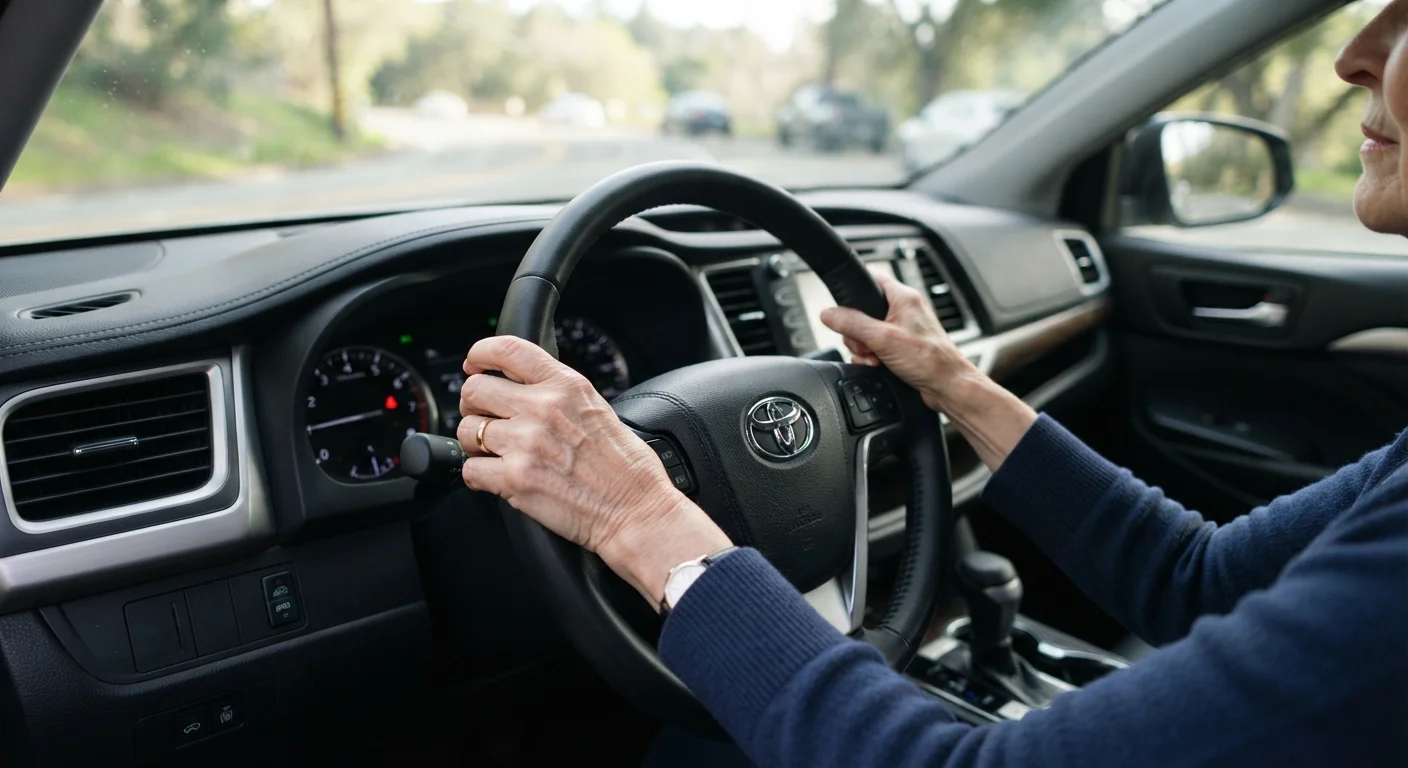
Arthritis in the hands and fingers is common among older adults and can make maintaining a firm grip on a smooth steering wheel more effortful, particularly during long drives or in cold weather. Textured or padded steering wheel covers improve tactile grip without requiring increased hand strength. Those with a softer inner padding also absorb some vibration from the road. Ensure the cover fits snugly — a loose cover that shifts during steering is a safety hazard rather than an aid.
Textured steering wheel covers reduce grip effort, which matters when arthritis affects hand strength.
Parking Sensors and Backup Alert Systems for Spatial Awareness
Maneuvering in tight spaces becomes more demanding as reaction time slows and spatial judgment becomes less precise. Aftermarket parking sensors — both front and rear — emit audible tones that increase in frequency as the vehicle approaches an obstacle, giving the driver a clear, real-time cue without requiring visual scanning. Some systems include a small display screen. These are particularly useful in parking lots and driveways where obstacles like bollards or low walls are easily missed. For context on how these technologies compare to built-in vehicle systems, the safety features that make the biggest difference for older drivers article is a useful reference.
Audible parking sensors give real-time proximity cues that compensate for slower spatial processing.
Grab Handles and Swivel Seat Cushions for Getting In and Out Safely
While not active driving accessories, portable grab handles that hook onto the door latch or window frame assist with lowering into and rising from the seat safely. Swivel seat cushions rotate to face the door opening, reducing the need to pivot the hips — a movement that can be painful or unstable for those with hip or knee problems. Both accessories reduce the physical strain around the act of getting in and out, which is a meaningful source of minor falls and injury for older adults.
Swivel cushions and grab handles reduce hip strain and fall risk when entering and exiting the vehicle.
Start With Your Most Pressing Challenge
Rather than purchasing multiple accessories at once, identify the single driving task that feels most effortful or uncertain — whether that's checking blind spots, managing glare, or parking — and address that first. A focused approach makes it easier to evaluate whether an accessory is genuinely helping. Your primary care physician or an occupational therapist with driving expertise can also help you identify which physical changes are most relevant to your driving needs.
Putting It All Together
No single accessory transforms driving safety on its own. The value comes from matching the right tool to a real, personal challenge. If neck stiffness limits mirror checks, a blind-spot mirror addresses that gap directly. If glare causes momentary vision loss on evening drives, an anti-glare visor is a small investment with a tangible payoff.
For context on how modern vehicle technology works alongside these accessories, the article on safety technologies addressing common senior driving challenges is a useful companion. Likewise, safety accessories every older driver should know about offers a broader practical overview for those earlier in the process of evaluating options.
This article is for general informational purposes only. Consult a qualified occupational therapist or certified driver rehabilitation specialist for guidance tailored to your individual needs and health circumstances.
The content on this site is for informational purposes only and is not a substitute for professional advice. Always consult a qualified professional for guidance specific to your situation.