

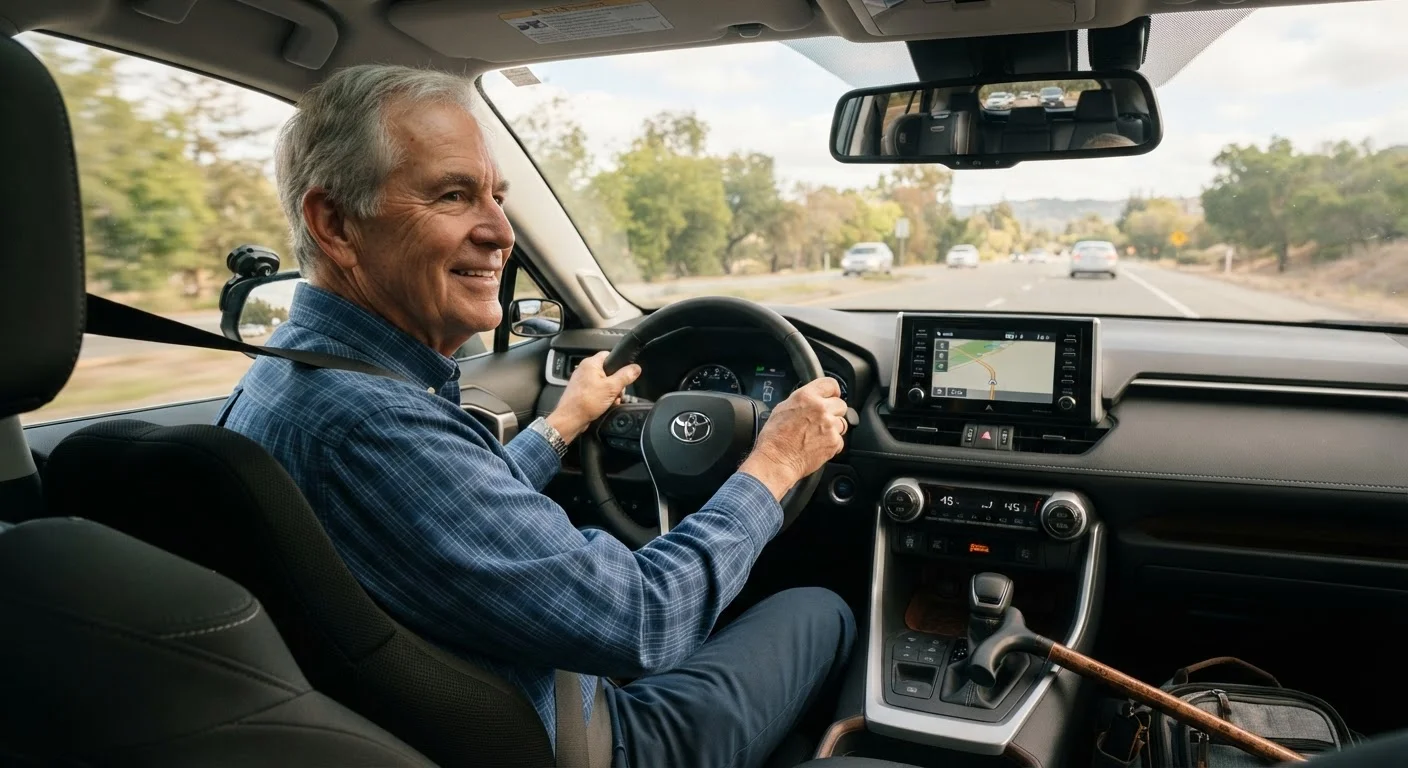
Why Safety Accessories Matter for Older Drivers
As drivers age, a range of gradual physical changes — reduced peripheral vision, slower reaction times, decreased joint flexibility, and diminished grip strength — can quietly affect driving performance. These changes do not necessarily disqualify someone from driving, but they do create genuine risks that well-chosen accessories can help manage.
Safety accessories are add-on tools, devices, and adaptive aids installed in or around a vehicle to compensate for specific physical limitations. Unlike built-in vehicle safety features (covered in detail in our complete overview of senior safety features), aftermarket accessories can be added to vehicles a driver already owns, making them a practical and often affordable option.
This guide walks through every major accessory category, explains who each type is designed for, and provides guidance on how to evaluate options thoughtfully.
Always Involve a Medical Professional
This guide provides general educational information, not personalized medical or driving advice. If you have concerns about how a health condition is affecting your driving, consult your physician and consider a formal evaluation by a Certified Driver Rehabilitation Specialist. Decisions about fitness to drive should always involve qualified professionals familiar with your individual circumstances.
Visibility and Awareness Tools
Reduced visual range is among the most common age-related challenges for drivers. Wide-angle convex mirrors, blind-spot mirrors, and panoramic rearview mirrors are among the most widely used accessories in this category. They attach to or replace existing mirrors to extend the driver's field of view without requiring significant physical movement.
Backup cameras — if not already built into the vehicle — can also be added as aftermarket kits. These small cameras mount at the rear and display a live feed on a dashboard screen, eliminating the need to twist to see behind the vehicle.
1 in 6
Older drivers involved in US traffic fatalities
The CDC reports that adults aged 65 and older account for roughly 1 in 6 traffic fatalities in the United States.
40°
Reduction in peripheral vision field possible with age
Research on aging and vision suggests peripheral visual field can narrow noticeably by the time adults reach their 70s, affecting hazard detection while driving.
Glare is a separate but related concern. Anti-glare screen shades and tinted sun visors reduce the intensity of oncoming headlights and direct sunlight, which are particularly disorienting for older eyes. For a detailed look at how these tools address specific physical changes, see our companion article on practical safety accessories for age-related driving challenges.
Mobility and Entry/Exit Aids
Getting in and out of a vehicle safely is a challenge many older drivers face before they even start the engine. Grab handles that hook onto the door frame, swivel seat cushions that rotate outward, and step assists that attach below the door sill are all designed to make this transition easier and reduce fall risk.
For drivers with more significant mobility limitations, transfer boards, leg lifters, and portable handrails provide additional support. These items are especially relevant for those managing arthritis, hip replacements, or general lower-body weakness.
Start with the Biggest Pain Point
Rather than purchasing multiple accessories at once, identify the single biggest challenge — whether that's getting out of the car, seeing behind the vehicle, or gripping the wheel — and address that first. Adding too many new aids at once can itself become disorienting. A phased approach makes adoption easier and helps you assess what's genuinely useful.
Our introductory guide on comfort and mobility aids for senior drivers covers these categories with more depth, and our quick-reference guide to adaptive car accessories is a useful lookup resource for caregivers.
Adaptive Controls and Ergonomic Supports
Drivers who find standard controls increasingly difficult to operate have several adaptive options. Steering wheel covers with textured or padded grips reduce the effort required to maintain control. Spinner knobs (also called steering aids) allow one-handed steering with less wrist torque — these are particularly useful for drivers with limited arm mobility, though some require a prescription from a certified driver rehabilitation specialist depending on the state.
Pedal extenders bring accelerator and brake pedals closer to shorter drivers, reducing the strain of reaching. Seat wedge cushions and lumbar supports improve posture and reduce fatigue on longer drives, keeping the driver alert and comfortable.
Before purchasing any adaptive control, verify whether your state requires a medical or specialist prescription for installation — some devices, like spinner knobs, carry legal requirements in certain jurisdictions.
Using an adaptive control without proper evaluation can create liability issues and may not actually address the underlying driving challenge safely.
Test ergonomic supports — such as seat wedges and lumbar cushions — during a short drive before committing, as the right thickness and firmness varies significantly between individuals.
An ill-fitted cushion can shift the seated position in ways that reduce visibility over the steering wheel or affect pedal reach, introducing new risks.
Navigation and Emergency Tech Aids
Getting lost, encountering unexpected detours, or managing an emergency while driving alone are real concerns for many senior drivers. Simple, large-display GPS devices with audible turn-by-turn directions reduce the need to read small text or glance at a phone. Voice-activated navigation reduces distraction further.
Personal emergency response devices designed for vehicles — including in-car alert buttons that connect to emergency services or family members — provide a meaningful safety net. Some connect via cellular networks; others use Bluetooth to pair with a smartphone.
Explore the broader category of navigation and tech aids for seniors to understand the full range of options available in this space.
Smartphone Apps Are Not a Substitute
While navigation apps on smartphones are widely used, they are generally less suitable for senior drivers as a primary tool — small text, frequent update prompts, and battery dependency make them less reliable in a driving context. Dedicated GPS devices with simplified interfaces are generally a more consistent solution.
How to Evaluate and Choose the Right Accessories
No single set of accessories suits every driver. The most effective approach is to start with an honest assessment of specific challenges — whether those are related to vision, mobility, strength, or confidence — and then match accessories to those needs.
Working with a Certified Driver Rehabilitation Specialist (CDRS) is strongly recommended for drivers with significant physical changes. These professionals conduct formal driving evaluations and can recommend or prescribe adaptive equipment tailored to the individual. The Association for Driver Rehabilitation Specialists (ADED) maintains a directory of certified practitioners in the US.
For family members or caregivers helping a senior driver make decisions, prioritizing safety and ease of use over cost is generally the right framing. An accessory that goes unused because it is too complicated provides no benefit. Always verify that any installed accessory does not obstruct sightlines, interfere with airbag deployment, or compromise any factory safety system.
Do Not Block Airbag Deployment Zones
Some aftermarket accessories — including certain seat cushions, covers, and add-on devices mounted to steering wheels or dashboards — can interfere with airbag deployment in a crash. Always check the accessory manufacturer's guidance and, if in doubt, consult a qualified mechanic or the vehicle manufacturer before installation.
Finally, reassess regularly. Driving needs evolve, and an accessory that was sufficient two years ago may no longer fully address current limitations. Annual check-ins — ideally coinciding with a medical or vision appointment — help ensure the right tools remain in place.
The content on this site is for informational purposes only and is not a substitute for professional advice. Always consult a qualified professional for guidance specific to your situation.