

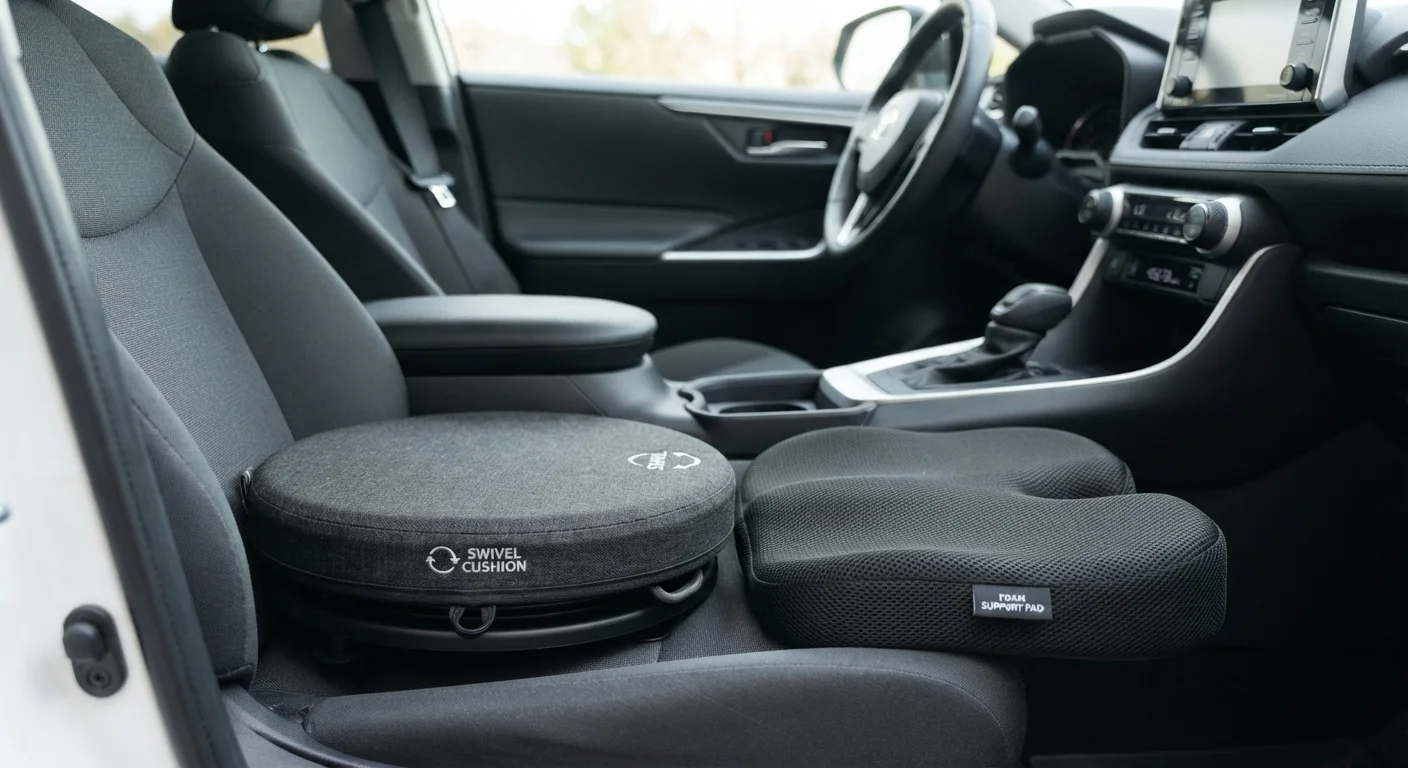
Option A
Swivel Seat Cushion
The mobility-first solution for easier getting in and out.
Best for: Seniors who find twisting their hips or pivoting their legs when entering or exiting a vehicle painful or difficult.
Option B
Standard Seat Cushion
The everyday comfort and support upgrade for seated driving.
Best for: Seniors seeking pressure relief, posture improvement, or extra padding during regular drives without mobility transfer concerns.
What Each Cushion Type Actually Does
The names sound similar, but swivel cushions and standard seat cushions serve meaningfully different purposes. Understanding that distinction is the starting point for choosing wisely.
A swivel seat cushion sits on top of the driver's seat and contains a rotating mechanism — typically ball bearings or a turntable layer — that allows the cushion surface to spin horizontally. When a driver sits down outside the car and then rotates toward the steering wheel, the cushion turns with them, reducing the sideways twisting motion at the hip and lower back. The primary job is to ease the physical transfer into and out of the vehicle. For more on how these tools fit into a broader set of entry aids, see getting in and out of the car with less strain.
A standard seat cushion, by contrast, stays firmly in place and is engineered for what happens once you are seated. Materials such as memory foam, gel, or high-density foam are chosen to redistribute body weight, ease pressure on the tailbone and sit bones, and support the lumbar curve. Some are wedge-shaped to tilt the pelvis forward slightly, which can improve overall posture during a drive.
| Criterion | Swivel Seat Cushion | Standard Seat Cushion |
|---|---|---|
| Primary purpose | Easier vehicle entry and exit | In-seat comfort and pressure relief |
| Rotation mechanism | Yes — rotates horizontally | No — fixed in place |
| Cushioning depth | Generally thin to allow rotation | Varies; often deeper foam or gel |
| Lumbar support | Typically none | Available in many designs |
| Best for hip/joint mobility issues | Yes — reduces transfer strain | Limited benefit for transfers |
| Best for long-drive comfort | Limited | Yes — designed for this |
| Complexity of use | Slightly higher — rotation must be managed | Simple — place and sit |
| Typical price range | Moderate to higher | Wide range; many affordable options |
Where Swivel Cushions Excel — and Where They Fall Short
For seniors with reduced hip flexibility, arthritis in the lower body, or recovering from joint surgery, the transfer in and out of a vehicle is often the most physically taxing part of any journey. A swivel cushion directly addresses this by allowing a seated pivot rather than a step-and-twist motion. Grab handles, assist grips, and swivel cushions can work well together as a combined entry-exit system.
However, swivel cushions are generally not designed for driving comfort. Most are relatively thin and firm so the rotation mechanism functions correctly. They typically offer minimal cushioning for long drives and may not provide the lumbar contouring that many older drivers need. If you're already familiar with the broader category of adaptive accessories, the comfort and mobility aids overview for senior drivers explains how these products fit together.
A Note on Swivel Cushion Stability While Driving
Most swivel cushions include a locking mechanism or friction base to prevent unwanted rotation once you are seated and ready to drive. It is important to confirm that any cushion you consider has a reliable locking feature and that it does not raise your seated height to the point where headroom or seatbelt positioning is compromised. If in doubt, consult a mobility specialist or occupational therapist before purchasing.
What Standard Cushions Do Well — and Where They Have Limits
Standard seat cushions shine during the drive itself. A well-chosen cushion can meaningfully reduce pressure on sensitive areas, help maintain a healthier seated posture, and reduce fatigue on longer journeys. This matters for seniors who spend significant time in the car or whose vehicles have factory seats that are too firm, too flat, or too low. Our article on lumbar support and posture on long drives goes deeper on how the right cushion can change the experience for drivers with lower-back concerns.
The limitation is clear: a standard cushion adds no rotational assist. If the challenge is the act of sitting down into the car or swinging your legs out at the end of a journey, a flat foam pad will not help with that movement. Understanding what seat ergonomics actually mean can help you evaluate whether a standard cushion addresses your specific discomfort.
~30%
Seniors reporting difficulty with vehicle entry or exit
Studies on older driver mobility consistently find that entering and exiting a vehicle is among the most commonly reported physical challenges for adults over 70.
2 in 3
Older adults with musculoskeletal discomfort while driving
Research in driver ergonomics suggests that a significant proportion of older drivers experience some form of back, hip, or joint discomfort during regular vehicle use.
Choosing the Right Option for Your Situation
The practical question is not which cushion is objectively better, but which one addresses your specific challenge. Ask yourself: where in the driving experience does discomfort or difficulty occur?
- Difficulty getting in or out: A swivel cushion is the more targeted solution. Pair it with a grab handle or door-mounted assist grip for best results.
- Back or hip discomfort while seated and driving: A standard cushion with appropriate contouring or lumbar support is the more relevant choice.
- Both challenges present: Some seniors use a swivel cushion for entry and exit, then remove or adjust it for driving, or consult an occupational therapist for a combined setup.
It is also worth noting that seat height affects both transfer difficulty and seated comfort. If your vehicle's seat is very low, even a quality cushion may not fully compensate. Exploring vehicle comfort and easy access features at the car-selection stage can reduce the need for accessories later. If seatbelt comfort is also a concern alongside seating, seatbelt extenders and shoulder pad covers are worth exploring as a complementary adjustment.
This article provides general information about car accessories for educational purposes and is not a substitute for personalised advice from a healthcare provider, occupational therapist, or qualified mobility specialist. Suitability of any accessory depends on individual health conditions and vehicle type.
The content on this site is for informational purposes only and is not a substitute for professional advice. Always consult a qualified professional for guidance specific to your situation.