

When Technology Meets the Reality of Aging Behind the Wheel
Driving is deeply tied to independence for many older Americans. But aging brings well-documented physical changes — slower reaction times, reduced peripheral vision, decreased neck flexibility, and greater difficulty processing multiple inputs simultaneously — that can make certain driving situations more demanding than they once were.
Modern vehicle safety technologies weren't designed exclusively for seniors, but many of them directly address these exact challenges. Understanding which systems help with which challenges is far more useful than a general list of features. The technologies below are matched to the specific age-related driving difficulties they're best positioned to support. For a broader overview of how these systems work together, see our guide on driver-assist technology in modern cars.
Automatic Emergency Braking (AEB) — For Slower Reaction Times
Reaction time typically increases with age, and the gap between perceiving a hazard and applying the brakes can widen meaningfully. Automatic Emergency Braking (AEB) monitors the road ahead using radar, cameras, or both. When the system detects an imminent collision and the driver hasn't responded in time, it applies the brakes automatically — or at minimum, pre-charges them to reduce stopping distance.
AEB is now standard on a broad range of new vehicles and has been shown in research to reduce rear-end crashes at lower speeds. For seniors whose braking response may be slower than it once was, this system functions as a direct physical backup.
AEB acts as a direct physical backup when reaction time creates a gap between perceiving a hazard and braking.
Blind-Spot Monitoring (BSM) — For Reduced Neck and Shoulder Mobility
Checking blind spots requires rotating the head and upper body — a movement that becomes more restricted for many people as they age due to arthritis, cervical spine stiffness, or general reduced flexibility. Blind-Spot Monitoring (BSM) uses rear-facing sensors to detect vehicles in adjacent lanes and delivers a warning — typically a light in or near the side mirror — when a lane change would be unsafe.
Some systems also add steering wheel vibration or audible alerts if the driver activates a turn signal while a vehicle occupies the blind spot. For drivers who struggle to turn their heads fully, BSM provides meaningful situational awareness that the mirror arrangement alone cannot.
BSM provides situational awareness in adjacent lanes when physical mobility limits a full head-turn check.
Rear-View and Surround-View Cameras — For Backing and Spatial Judgment
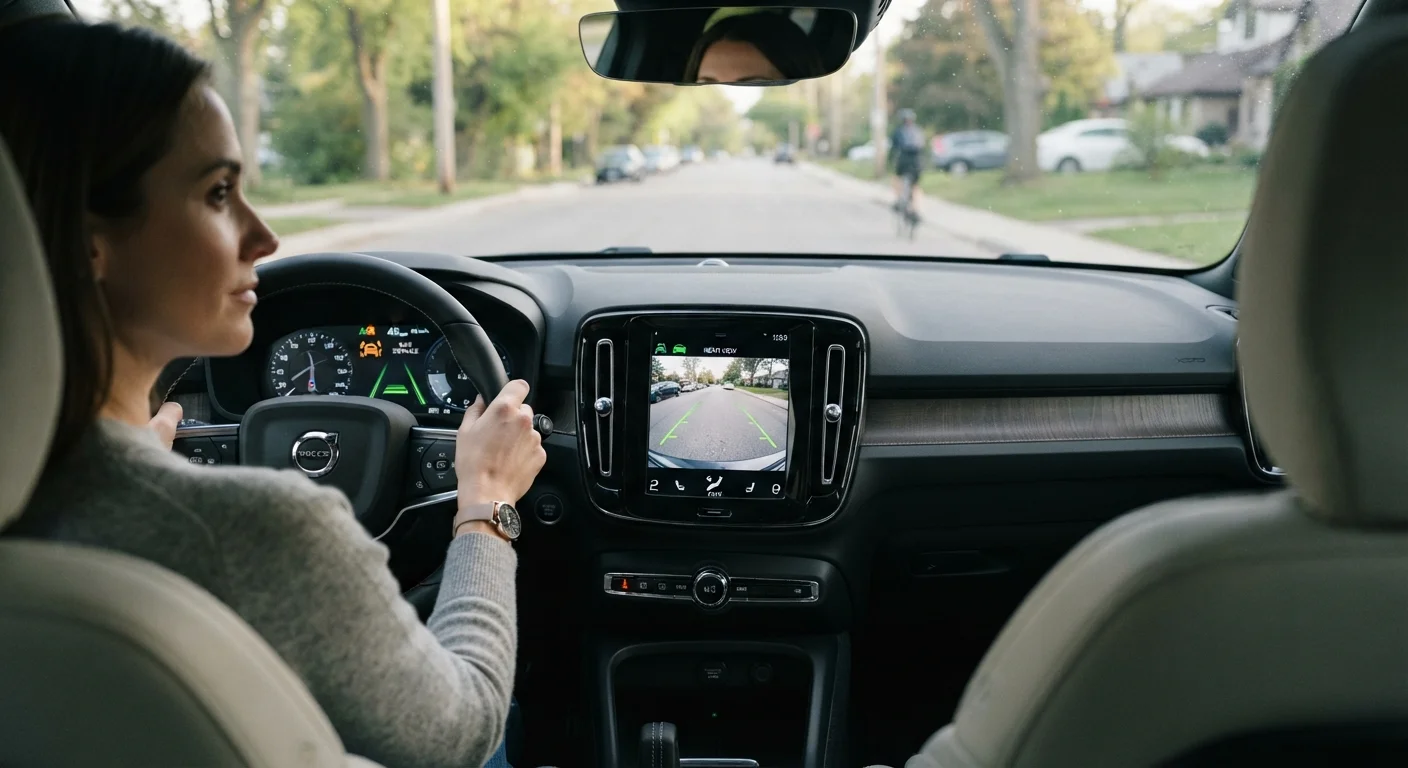
Reversing requires looking backward while managing steering — a task that demands flexibility and spatial processing simultaneously. Rear-view cameras, now federally mandated on all new passenger vehicles sold in the U.S., display a live video feed of the area directly behind the car when reverse is engaged. Many systems overlay dynamic guidelines that adjust as the steering wheel turns.
More advanced surround-view (360-degree) camera systems stitch together feeds from multiple cameras, giving a bird's-eye view of the vehicle and its immediate surroundings. For older drivers who find parking, maneuvering in tight spaces, or gauging distance behind the vehicle more difficult, these systems reduce reliance on physical flexibility and spatial estimation alone.
Rear-view cameras reduce dependence on physical flexibility and spatial estimation when reversing.
Lane-Keeping Assist (LKA) — For Attention Lapses and Fatigue
Sustained concentration over longer drives becomes more demanding with age, and minor lane drifts — particularly on highways — can occur without the driver being fully aware. Lane-Keeping Assist (LKA) uses forward-facing cameras to monitor lane markings. When the vehicle begins to drift without a turn signal being activated, the system provides gentle steering corrections or audible and haptic warnings.
It's important to distinguish LKA from Lane Centering Assist, which continuously steers the vehicle toward the center of the lane — a more active intervention. LKA is a reactive safety net; Lane Centering is an active aid. Both address attention-related drift, but drivers should understand which their vehicle uses and how each responds.
Lane-Keeping Assist provides a safety net for minor inattentive drift without replacing driver control.
Adaptive Cruise Control (ACC) — For Highway Following Distance Management
Maintaining a safe following distance requires continuous monitoring of the vehicle ahead and rapid adjustment of speed — a task that combines perception, judgment, and throttle/brake control. Adaptive Cruise Control (ACC) automates this on highways by using radar or cameras to measure the gap to the vehicle ahead and automatically adjusting vehicle speed to maintain a set following distance.
When traffic slows, ACC slows the vehicle. When it clears, ACC accelerates back toward the set speed. For seniors who find highway driving mentally taxing — particularly managing sudden speed changes in traffic — ACC meaningfully reduces moment-to-moment cognitive load. It does not replace the need for driver alertness, but it does reduce the physical and attentional demands of cruise-controlled highway travel.
ACC reduces the continuous cognitive and physical effort of managing following distance on the highway.
Rear Cross-Traffic Alert — For Backing Out of Parking Spaces
One of the more dangerous low-speed maneuvers for older drivers is reversing out of a parking space into traffic or pedestrian flow. The challenge combines limited rearward visibility, compressed time to react, and difficulty tracking moving objects from multiple directions simultaneously. Rear Cross-Traffic Alert (RCTA) systems use rear-facing radar sensors to detect approaching vehicles or pedestrians crossing behind the car while reversing, then alert the driver — and in some vehicles, apply the brakes.
This is particularly valuable in busy parking lots where the view is obstructed by adjacent vehicles. RCTA works alongside the rear-view camera rather than replacing it, giving drivers both a visual feed and an active hazard alert. For a practical comparison of built-in systems and aftermarket options, see practical safety accessories that address age-related driving challenges.
RCTA adds an active hazard alert layer to the rear-view camera when backing into traffic or pedestrian flow.
Making Informed Decisions About Safety Features
These systems work best as supplements to attentive driving — not replacements for it. Most driver-assist technologies can be adjusted or temporarily disabled, so it's worth spending time with a vehicle's owner's manual or asking a dealer to walk through each system's settings before relying on it. Sensitivity levels, alert styles, and intervention thresholds all vary by manufacturer and model.
Test Systems Before You Rely on Them
When evaluating a vehicle with driver-assist features, ask for a demonstration in a controlled setting — a quiet parking lot works well. Understanding how each system alerts you, and how intrusive or subtle those alerts are, matters as much as knowing the feature exists. Some drivers find certain alert styles distracting; others find them essential. Familiarity before real-world reliance is always worthwhile.
Seniors and their families evaluating vehicles should also look beyond built-in technologies. Aftermarket accessories can complement factory systems — our overview of safety accessories for older drivers covers practical additions worth considering. For a more detailed look at how specific features rank in real-world usefulness for seniors, safety features that make the biggest difference for older drivers provides additional context.
This article is for general informational and educational purposes only. Vehicle safety system performance varies by make, model, and driving conditions. Consult your vehicle's owner's manual and a qualified automotive professional for guidance specific to your situation.
The content on this site is for informational purposes only and is not a substitute for professional advice. Always consult a qualified professional for guidance specific to your situation.