

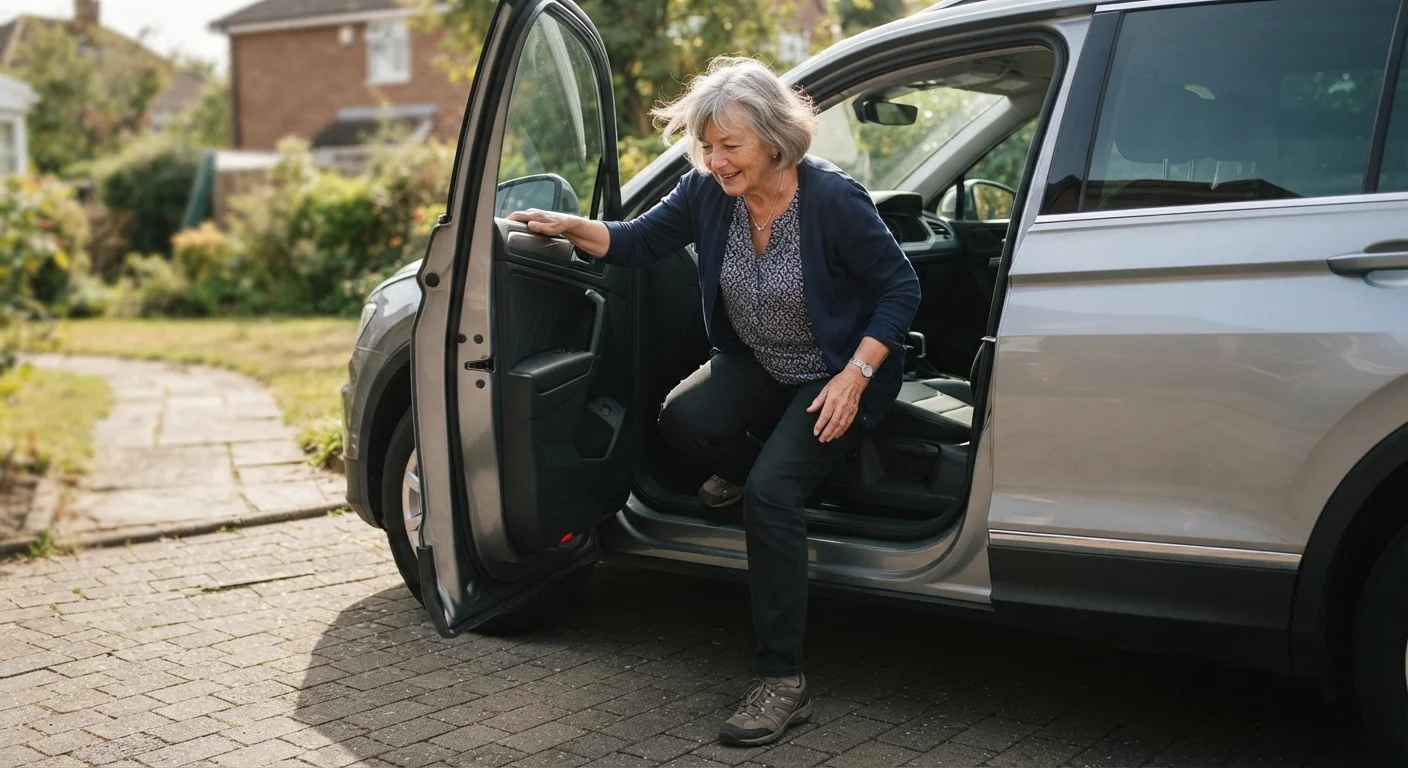
Why This Dimension Gets Overlooked at the Showroom
When people evaluate a vehicle, they typically focus on fuel economy, cargo space, technology features, or price. Door opening width rarely appears on a spec sheet, and showroom lighting is rarely designed to help buyers think critically about ingress and egress. Yet for older drivers — and particularly those managing arthritis, reduced hip flexibility, lower back issues, or balance concerns — the aperture of a door can become one of the most consequential dimensions in daily life.
The challenge compounds because the impact of a narrow opening is often not felt immediately. A buyer tests the vehicle briefly, manages fine, and only later — when stiffness increases or a condition progresses — discovers that getting in and out has quietly become the hardest part of owning the car. Understanding what door opening width actually involves, and why it matters more as the body changes, puts buyers in a far stronger position.
For a broader look at how vehicle geometry affects physical comfort, see our complete overview of comfort and easy access for older drivers.
The Mechanics of Getting In and Out
Entering a vehicle involves a sequence of movements that healthy younger adults perform without conscious thought: approach, grip, rotate the torso, lower the body, swing the legs, and settle into the seat. Each of those steps requires a specific range of motion. A narrow door opening compresses that sequence, forcing lateral bending at the hip or torso to clear the frame. A low roofline adds a requirement to flex the neck and upper spine.
As people age, joint flexibility naturally decreases. The range of motion in the hips, knees, and lumbar spine tends to narrow. Balance control also changes, meaning the brief moment of single-leg weight-bearing during entry carries more fall risk. In this context, even a few extra inches of door aperture — or a few extra inches of vertical clearance — meaningfully reduce both the physical demand and the injury exposure of a routine act performed multiple times every day.
~30%
Reduction in hip flexibility reported with aging
Research in geriatric biomechanics consistently documents meaningful reductions in hip range of motion across the adult lifespan, affecting vehicle entry mechanics.
1 in 4
Older adults who fall each year in the U.S.
According to the U.S. Centers for Disease Control and Prevention, falls are a leading cause of injury among adults aged 65 and older, underscoring the importance of stable, low-strain vehicle entry.
Seat height interacts closely with door opening. A seat that sits at roughly knee height means a person lowers themselves through a controlled, short arc. A seat that sits very low — common in sporty sedans — requires a deep descent through a small opening, combining two difficulties simultaneously. Elevated seating, paired with a wide aperture, is what makes certain vehicle categories genuinely more accessible.
Vehicle Types and What Their Apertures Typically Offer
Not all body styles are created equal from an accessibility standpoint. Traditional sedans tend to have lower rooflines, which limit vertical clearance even when horizontal width is adequate. Coupes and two-door models often provide wider individual door panels, but their low, swept rooflines negate much of that advantage for people with limited spinal flexibility.
Crossover SUVs and traditional SUVs generally offer a more favorable combination: elevated seating, a taller door opening, and a step-in height that avoids the deep-drop problem of sedans. The tradeoff is that if the vehicle sits very high, a short step or running board may be needed. Minivans with sliding rear doors offer some of the most user-friendly rear-entry geometry available in any mainstream vehicle category — the sliding mechanism eliminates the rotational swing of a hinged door entirely, and the opening width is typically generous.
Vehicle features that reduce physical strain for older drivers covers how door design sits alongside other ergonomic elements worth evaluating together.
How to Evaluate Door Aperture Before You Buy
Because door opening width is rarely published in a standardized, comparable format, the most reliable evaluation is physical. When visiting a dealership or private seller, go through the full entry and exit sequence deliberately — not just a quick sit-and-stand. Bring any mobility aid you use regularly, such as a cane, to test whether it can be managed within the space available. Check that the door opens wide enough to stay clear of your body without needing to be held.
Pay attention to the door's maximum opening angle. Some vehicles have door stops that limit how far the door can swing — a door that stops at 60 degrees versus one that opens to 90 degrees makes a significant practical difference when you need room to maneuver. Also note whether the door frame or sill requires stepping over a high threshold, which is a separate but related challenge.
Bring Your Own Test Routine to the Dealership
Rather than a quick sit-down, perform the full sequence you use at home: approach with any mobility aid, open the door fully, rotate, lower, swing legs, and settle. Then reverse the process. Do this on both the driver and passenger sides, since apertures can differ. This real-world test reveals far more than any specification sheet.
For additional techniques and adaptive aids that make entry and exit less physically demanding, getting in and out of the car with less strain walks through practical options in detail. If door-mounted assist handles are of interest, car door handle assist grabs and who benefits most explains how they work and who benefits from them.
Frequently Asked Questions
There is no single universal standard, but a wider aperture generally means easier entry and exit. Many ergonomics specialists suggest that an opening allowing a person to step through without significant lateral bending is the practical benchmark. Testing the vehicle in person remains the most reliable approach.
Not always. Two-door vehicles often have longer, wider front doors to compensate for the absent rear door. However, their low rooflines frequently reduce vertical clearance, which can make ducking in difficult for people with neck or back limitations.
Minivans with sliding rear doors and crossover SUVs with elevated seating tend to offer generous apertures combined with a comfortable seat height. These body styles reduce both lateral contortion and the distance a person must lower or raise themselves to reach the seat.
Yes, to a degree. Assist grab handles that attach to the door frame or roof line can improve stability during entry and exit. Swivel seat cushions can reduce rotational strain. However, accessories address technique rather than the fundamental size of the opening itself.
Yes. The B-pillar is the vertical support between the front and rear doors. In vehicles without a B-pillar — sometimes called pillarless designs — the combined front and rear opening is significantly wider, though these vehicles are relatively rare in mainstream models.
The content on this site is for informational purposes only and is not a substitute for professional advice. Always consult a qualified professional for guidance specific to your situation.