

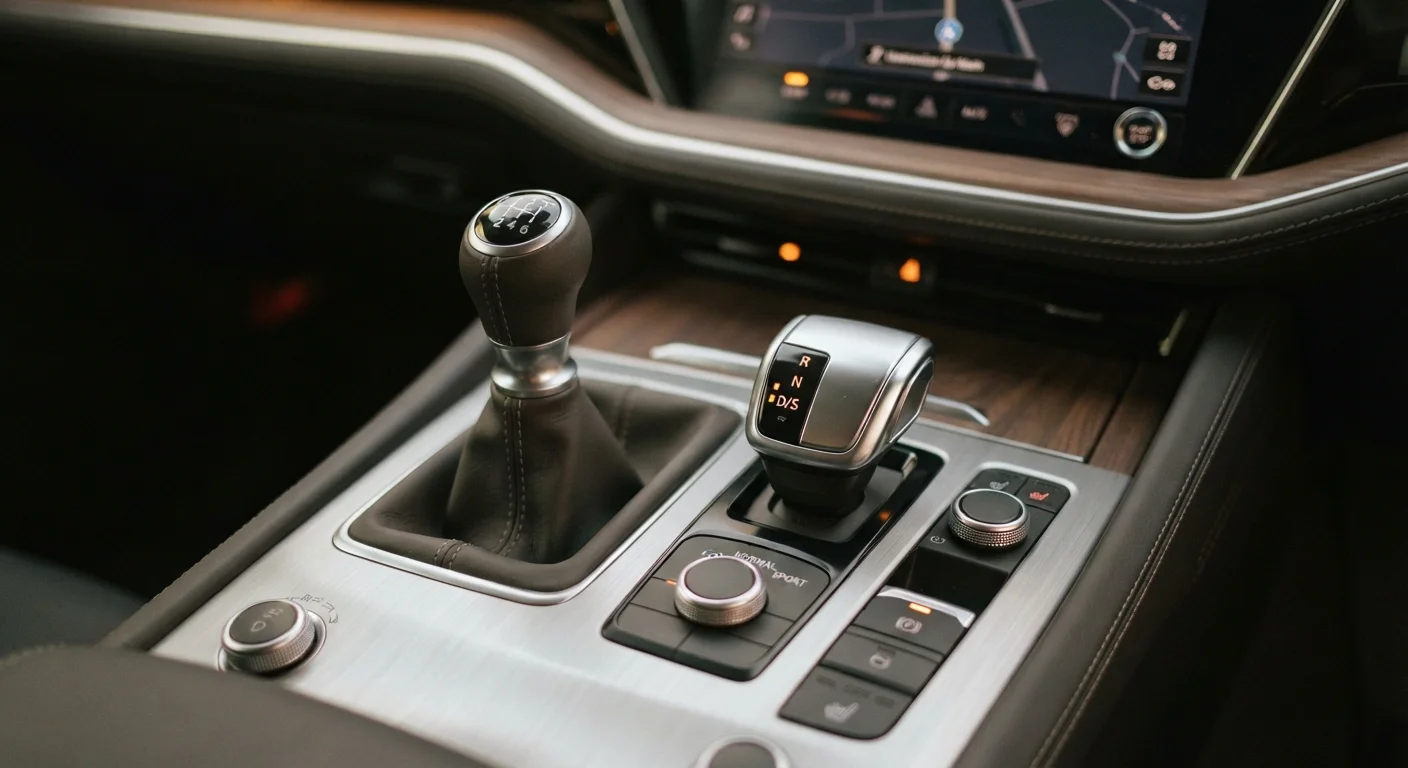
Option A
Manual Transmission
The traditional, hands-on driving experience.
Best for: Drivers who prefer direct vehicle control and are comfortable operating a clutch pedal without joint or mobility constraints.
Option B
Automatic Transmission
The streamlined, low-effort everyday choice.
Best for: Seniors seeking reduced physical demand, easier stop-and-go driving, and broad availability across modern vehicle segments.
The Physical Demands of Each Transmission Type
For many older drivers, the most immediate consideration is physical comfort. Operating a manual transmission requires simultaneously coordinating the clutch pedal with the left foot, the gear lever with the right hand, and the accelerator with the right foot — a sequence that becomes second nature over years of driving, but one that can strain joints under certain health conditions.
The clutch pedal typically requires 20–40 pounds of force per depression, and in stop-and-go city driving, that motion may be repeated hundreds of times in a single commute. Drivers managing arthritis, hip replacements, or reduced leg strength may find this repetitive load genuinely problematic. Automatic transmissions, by contrast, require only the right foot to operate the brake and accelerator — a significant reduction in physical demand.
It is worth noting that individual health varies widely. A 70-year-old who is physically active and free of joint issues may find clutch operation entirely comfortable, while a 60-year-old managing a chronic condition may not. Consulting a physician or occupational therapist about driving ergonomics is a sensible step for anyone uncertain about their physical tolerance for a particular control setup. For a broader look at seat and ergonomic features relevant to seniors, see our guide to power-adjustable versus manual seats.
Side-by-Side: How the Two Transmissions Compare
Beyond comfort, several practical factors differentiate manual and automatic transmissions for everyday ownership. The table below summarizes the key dimensions older drivers typically weigh.
| Criterion | Manual Transmission | Automatic Transmission |
|---|---|---|
| Physical demand | High — clutch pedal required | Low — right foot only |
| U.S. market availability | Very limited — under 3% of new sales | Dominant — over 97% of new vehicles |
| Fuel economy (modern vehicles) | Comparable or slightly lower | Comparable or slightly higher |
| Typical purchase price | Marginally lower in some models | Standard pricing across segments |
| Clutch wear/replacement cost | Required; varies by driving style | Not applicable |
| Fluid service required | Gear oil changes recommended | ATF or CVT fluid changes recommended |
| Resale buyer pool (U.S.) | Narrow — fewer trained manual drivers | Broad — accessible to most buyers |
| Stop-and-go driving ease | Tiring; requires constant engagement | Effortless; managed automatically |
One area where the gap has narrowed significantly is fuel economy. Early automatic transmissions were measurably less efficient than manuals, but modern eight-, nine-, and ten-speed automatics — as well as continuously variable transmissions (CVTs) — now match or exceed manual efficiency in most real-world conditions. The U.S. Environmental Protection Agency's fuel economy estimates confirm this shift across many current vehicle segments.
Cost, Availability, and the U.S. Market Reality
Manual transmissions were once meaningfully cheaper to purchase. That price gap has narrowed in recent years, and in many segments it has effectively disappeared — partly because demand for manuals in the U.S. has declined sharply, reducing the incentive for automakers to price them as budget options. According to industry tracking data, manual transmissions now account for a small single-digit percentage of new vehicles sold in the United States, down from roughly one-third of the market in the 1980s.
< 3%
Manual transmission share of U.S. new car sales
Industry sales tracking data consistently shows manual transmissions representing a low single-digit percentage of the U.S. new vehicle market.
60,000–100,000 mi
Typical clutch replacement interval
Clutch lifespan varies significantly with driving habits; city driving and hilly terrain tend to accelerate wear.
This market shift has real consequences for used-car shoppers. Finding a specific used model with a manual transmission can require a longer search, fewer local options, and in some cases a willingness to travel farther. Automatics dominate inventory at most dealerships and private sellers, providing more choice across price points. Seniors evaluating used vehicles should factor availability into their decision, particularly if they have a preferred body style or safety package in mind. Our guide on new versus used car decisions for seniors explores this inventory question in more depth.
Maintenance costs are another consideration. Manual transmissions have traditionally been seen as simpler and less expensive to service, but their clutches are wear items that typically require replacement between 60,000 and 100,000 miles depending on driving style. Automatic transmission fluid service, meanwhile, is a routine maintenance item that, when kept current, supports long-term reliability. If you are unsure about your vehicle's fluid status, our article on transmission fluid warning signs and maintenance outlines what to watch for.
Making the Right Choice for Your Driving Life
The right transmission type ultimately depends on the intersection of your health, your typical driving environment, and your vehicle budget. For most senior drivers in the U.S., automatic transmissions represent the more practical default — not because manuals are inferior, but because the market, the infrastructure, and the physical demands of daily driving increasingly favor them.
Drivers considering a vehicle purchase as part of a broader evaluation of affordability and long-term ownership costs may also find our comparison of leasing versus buying for older drivers useful, since transmission type can influence both resale value and lease-return flexibility. And if you are still deciding on the overall body style that suits your needs, see our sedan, hatchback, or small SUV comparison for seniors.
When test-driving any vehicle, take time to assess the physical feel of all controls — not just the transmission — under conditions that resemble your normal routine. A short highway test drive tells you very little about stop-and-go usability. Drive the routes you actually take, and bring any mobility aids or adjustments you routinely use so the evaluation reflects your real-world experience.
This article is for general informational purposes only and does not constitute professional medical, financial, or mechanical advice. Consult a qualified professional for guidance specific to your health or financial situation.
The content on this site is for informational purposes only and is not a substitute for professional advice. Always consult a qualified professional for guidance specific to your situation.