

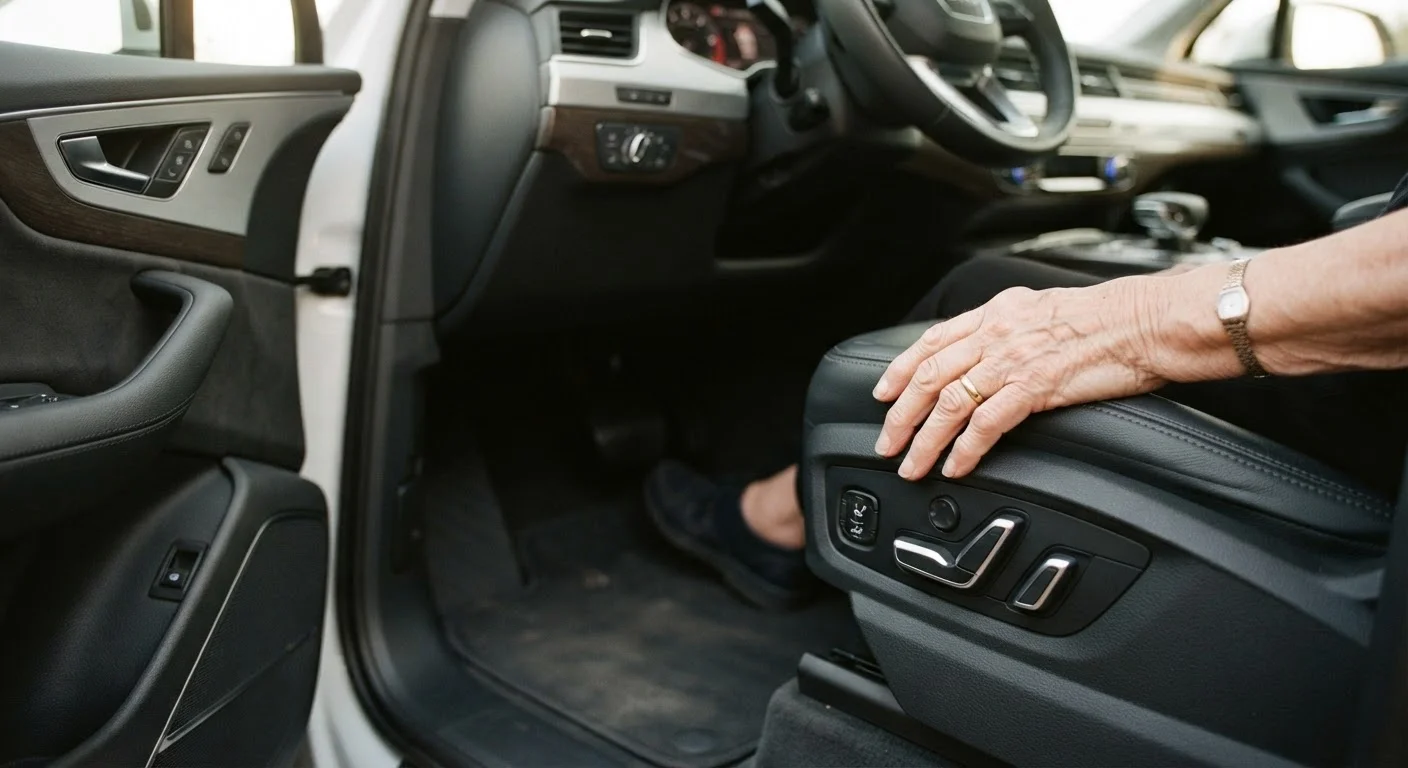
Option A
Power-Adjustable Seats
The precision-controlled, effortless option for reduced physical strain.
Best for: Seniors with limited grip strength, joint stiffness, or arthritis who need fine-tuned positioning without physical effort.
Option B
Manual Seats
The straightforward, mechanical option with no electrical dependency.
Best for: Seniors who retain adequate hand and upper-body strength and prefer simpler, lower-maintenance seat mechanics.
Why Seat Adjustability Matters More as We Age
The ability to position a car seat correctly is not merely about comfort — it is a foundational element of safe driving. For older adults, achieving the right seat position affects pedal reach, steering wheel clearance, seatbelt fit, and forward sightlines. As flexibility, muscle strength, and joint mobility often change with age, the mechanism used to make those adjustments becomes increasingly relevant.
Two broad categories define what most drivers encounter: power-adjustable seats, which use electric motors controlled by buttons or switches, and manual seats, which rely on physical levers, handles, or sliders. Understanding how each system works — and where each may fall short for older drivers — is essential when evaluating a vehicle's suitability. For a broader look at ergonomic vehicle design, see Comfort and Easy Access in Cars: A Complete Overview for Older Drivers.
How Each System Works
Power-adjustable seats use small electric motors — often multiple — to move the seat forward and back, raise or lower the seat cushion, tilt the seatback, and in many cases adjust lumbar support independently. The driver operates these with rocker switches or touch panels, typically located on the outboard side of the seat. High-trim vehicles may also include memory functions that store a driver's preferred configuration and restore it at the push of a button.
Manual seats use a primary slide lever, usually positioned underneath the front of the seat, to unlock and reposition the seat along a track. Seatback recline is typically controlled by a separate lever or knob on the side. Adjustments require the driver to apply body weight or grip strength to shift the seat while simultaneously operating the release mechanism — a two-handed task that can be physically demanding.
| Criterion | Power-Adjustable Seats | Manual Seats |
|---|---|---|
| Physical effort to adjust | Minimal — button press only | Moderate — lever and body weight required |
| Number of adjustment axes | Up to 8 or more (height, tilt, lumbar, etc.) | Typically 2 (fore-aft, recline) |
| Memory preset capability | Often available | Not available |
| Suitability for arthritis / limited grip | High | Low to moderate |
| Mechanical complexity | Higher (motors, wiring) | Lower (levers, tracks) |
| Common in used / affordable vehicles | Less common | Very common |
| Lumbar support control | Frequently included | Rarely included |
The Ergonomic Case for Power Seats
For seniors experiencing arthritis, reduced grip strength, or shoulder and hip stiffness, the physical demands of a manual seat mechanism can range from inconvenient to genuinely painful. Gripping a floor-level lever, shifting body weight, and sliding the seat simultaneously puts strain on wrists, shoulders, and the lower back — the very areas most commonly affected by age-related joint changes.
Power seats eliminate that effort entirely. A light press of a button — requiring only a fingertip — moves the seat incrementally and with precision. This matters not just for initial setup but for the micro-adjustments many drivers make over the course of a longer journey. The availability of lumbar support controls in many power seat systems also addresses lower back fatigue, which is a common complaint among older drivers on extended trips.
54 million+
Americans aged 65 and older
According to the U.S. Census Bureau, this population is projected to grow significantly, increasing the importance of age-appropriate vehicle ergonomics.
~30%
Adults 65+ reporting arthritis
The Centers for Disease Control and Prevention (CDC) report that arthritis is among the most common chronic conditions in older American adults, directly affecting hand and joint function.
Memory seat presets are a particularly valuable feature for senior households where two drivers share a vehicle. Rather than re-adjusting the seat each time, a memorized position can be recalled instantly — reducing both effort and the risk of driving with an improperly configured seat. For related adaptive control considerations, see Pedal Extensions and Adaptive Controls: What Older Drivers Should Understand.
Where Manual Seats Still Hold Up
Manual seats are not without merit. Their mechanical simplicity means fewer components that can fail or require specialist repair. There are no motors, wiring harnesses, or control modules involved — a stuck manual seat track can often be addressed more straightforwardly than an electrical fault in a power system.
For seniors with sufficient physical capability, manual seats present no meaningful barrier. They are also more prevalent in the used vehicle market and in entry-level new vehicles, which may be relevant for those prioritising affordability. If a senior driver has already settled into a vehicle and rarely needs to reposition the seat, the day-to-day impact of manual versus power controls may be minimal.
That said, it is worth noting that manual seat systems typically offer fewer adjustment axes. Most provide only fore-aft sliding and seatback recline, with no independent height or lumbar control. For drivers who need a higher seating position due to hip stiffness or reduced flexibility, a manual-only seat may not deliver adequate positioning options. Aftermarket seat cushions can supplement, and our guide to Swivel Seat Cushions vs. Standard Seat Cushions explores supportive additions worth considering.
Seniors evaluating vehicles holistically should also consult Comfort and Mobility Aids for Senior Drivers for a wider view of accessible vehicle features.
Consider a Certified Driver Rehabilitation Specialist
If seat adjustment is a persistent concern, a Certified Driver Rehabilitation Specialist (CDRS) can conduct a professional assessment of your seating needs in relation to your specific physical profile and vehicle. These specialists are trained to recommend adaptive equipment and vehicle modifications that go beyond what standard seat options provide. Your physician or occupational therapist may be able to provide a referral.
The content on this site is for informational purposes only and is not a substitute for professional advice. Always consult a qualified professional for guidance specific to your situation.