

Our Verdict
Rotation, balancing, and alignment each solve a different problem and should not be treated as interchangeable. Rotation extends tyre life by evening out wear; balancing eliminates vibration caused by weight distribution; alignment corrects the angle of your wheels to protect steering and safety. Knowing the difference helps you prioritize the right service at the right time.
| Best for | Recommended |
|---|---|
| Drivers who want to maximize tyre lifespan on a budget | Regular tyre rotation |
| Drivers experiencing steering wheel vibration at highway speeds | Wheel balancing |
| Drivers noticing pulling to one side or uneven tyre wear | Wheel alignment |
Why These Three Services Are Often Confused
At a tyre shop, you may hear rotation, balancing, and alignment mentioned in the same breath — sometimes bundled into a single service offer. This creates the impression that they're variations of the same job. They are not. Each service addresses a separate mechanical issue, uses different equipment, and is needed at different intervals.
Confusing them can lead to paying for something you don't need, or — more importantly — delaying a service that directly affects your safety. As part of a senior driver's complete tyre and brake maintenance routine, understanding these distinctions is one of the most practical things you can learn.
| Tyre Rotation | Wheel Balancing | Wheel Alignment | |
|---|---|---|---|
| What it addresses | Uneven tyre wear across positions | Vibration from weight imbalances | Incorrect tyre angles to the road |
| Typical interval | Every 5,000–7,500 miles | When vibration occurs or new tyres fitted | Annually or after significant impact |
| Key symptom it fixes | Faster wear on certain tyres | Steering wheel vibration at speed | Vehicle pulling; edge tyre wear |
| Equipment used | Lift and basic tools | Computerized balancing machine | Precision alignment rack and sensors |
| Effect on tyre life | Extends life by distributing wear | Reduces wear from vibration | Prevents edge wear from bad angles |
| Safety impact | Maintains consistent grip across tyres | Reduces handling instability | Critical for straight-line control |
Tyre Rotation: Spreading the Wear Evenly
Tyres wear at different rates depending on their position on the vehicle. Front tyres typically wear faster because they handle steering forces and, on front-wheel-drive vehicles, also deliver engine power. Rotation involves moving each tyre to a different wheel position — for example, moving the front tyres to the rear — so that wear is distributed more evenly over time.
Most vehicle manufacturers recommend rotation every 5,000 to 7,500 miles, though your owner's manual is the definitive guide. Many drivers time it with an oil change for convenience. Rotation does not fix an existing problem like vibration or pulling; it is a preventive measure that extends the usable life of your tyres and can save money by delaying replacement.
Pair Rotation With Oil Changes
Scheduling tyre rotation at every oil change is a simple habit that keeps intervals consistent without requiring you to track mileage separately. Ask your service provider whether rotation is included or available as an add-on during your next visit. Keeping a simple service log in your glove compartment makes it easy to confirm when each service was last completed.
Wheel Balancing: Eliminating Vibration
Every tyre and wheel assembly has small variations in weight around its circumference. When a wheel spins, these imbalances create vibration — most noticeable in the steering wheel at highway speeds. Balancing involves a technician placing the wheel on a specialized machine that identifies where the weight is uneven, then attaching small counterweights to the rim to compensate.
Balancing is typically recommended when you notice a persistent vibration, after hitting a significant pothole or curb, or whenever new tyres are installed. It is also worth checking after rotation if vibration develops. Unaddressed imbalance accelerates tyre wear and can strain suspension components over time.
To understand the language your mechanic uses when describing these issues, see our guide on talking to a mechanic about tyres and brakes.
Wheel Alignment: Correcting the Angle of Your Tyres
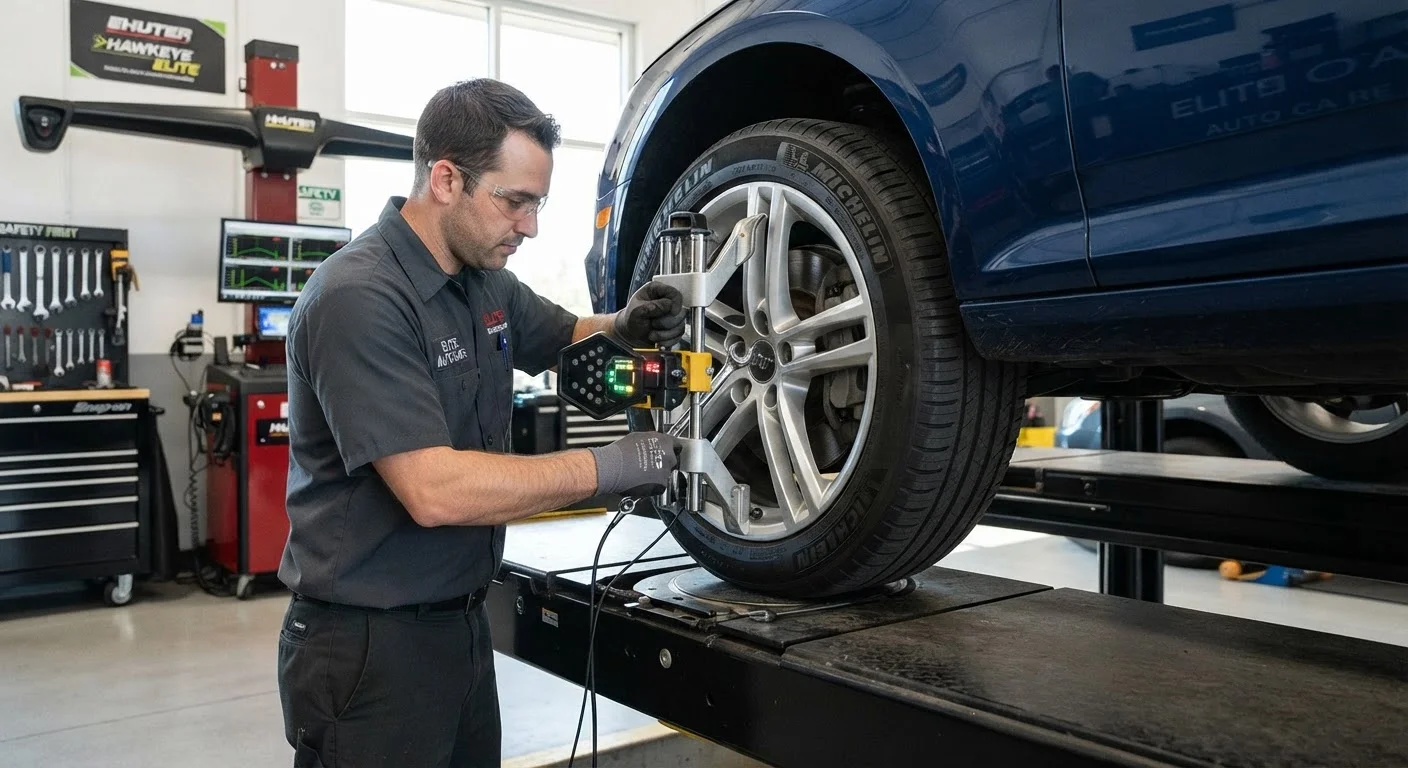
Alignment refers to the angles at which your tyres contact the road. Over time — through normal driving, minor curb strikes, or road imperfections — these angles shift. When they do, your vehicle may pull to one side, your steering wheel may sit off-center, or you may notice tyre wear concentrated on one edge. Alignment uses precision measuring equipment to adjust the suspension components that control tyre angle, returning them to manufacturer specifications.
Alignment does not have a fixed mileage interval in the same way rotation does. Most mechanics recommend checking it annually or after any significant impact. It is also advisable when installing new tyres, since misalignment will cause them to wear unevenly from the start. Unusual wear patterns visible on your current tyres are often a sign that alignment has been off for some time — a point explored further in our article on what tyre condition reveals about a car's history.
Don't Ignore Pulling or One-Sided Wear
A vehicle that consistently pulls to one side or shows tyre wear concentrated on a single edge may have an alignment problem that has been developing for some time. Continuing to drive without correcting it will wear through new tyres prematurely and may affect your ability to steer safely in an emergency. Have a mechanic inspect the alignment before or when you install replacement tyres.
When to Schedule Each Service
These services do not need to happen simultaneously. A straightforward way to think about timing is this: rotate regularly on a mileage schedule, balance when you feel vibration or install new tyres, and check alignment annually or after any jarring road event. Your routine car check schedule is a good place to log and track each of these.
If you notice your vehicle pulling to one side, a steering wheel vibration, or tyres wearing faster on one edge than the other, those are signals worth reporting to a mechanic promptly. Catching misalignment or imbalance early is nearly always less expensive than replacing tyres prematurely. For common misconceptions that can delay this kind of action, see our piece on tyre and brake myths that put drivers at risk.
This article provides general automotive information for educational purposes and is not a substitute for advice from a qualified mechanic. Service intervals and recommendations vary by vehicle — always consult your owner's manual and a licensed technician for guidance specific to your car.
The content on this site is for informational purposes only and is not a substitute for professional advice. Always consult a qualified professional for guidance specific to your situation.