

Two Phases, One Critical Number
Many drivers assume that stopping a car is simply a matter of pressing the brake pedal hard enough. In reality, stopping distance is the sum of two distinct phases, and the brakes only govern one of them.
The first phase is reaction distance — the road covered between the moment you recognize a hazard and the moment your foot actually engages the brake. At 60 mph, a vehicle travels roughly 66 feet per second. Even a reaction time of 1.5 seconds means nearly 100 feet of travel before braking even begins.
The second phase is braking distance — how far the car moves from the point the brakes engage to a full stop. This depends on vehicle speed, tyre grip, road surface, and the condition of the brake system itself.
Together, these two distances determine how much space you genuinely need to stop — and in many emergencies, the gap between available space and required space is measured in just a few feet.
Why Speed Changes Everything
Speed is the single most powerful factor in stopping distance, and its effect is often underestimated. Braking distance does not double when speed doubles — it quadruples. This is because kinetic energy (the energy of a moving vehicle) increases with the square of speed. The brakes must dissipate all of that energy as heat to bring the car to a stop.
4×
Braking distance increase when speed doubles
Because kinetic energy scales with the square of speed, doubling velocity roughly quadruples the distance required to stop — a basic principle of physics applied to vehicle dynamics.
~2×
Braking distance increase on wet roads
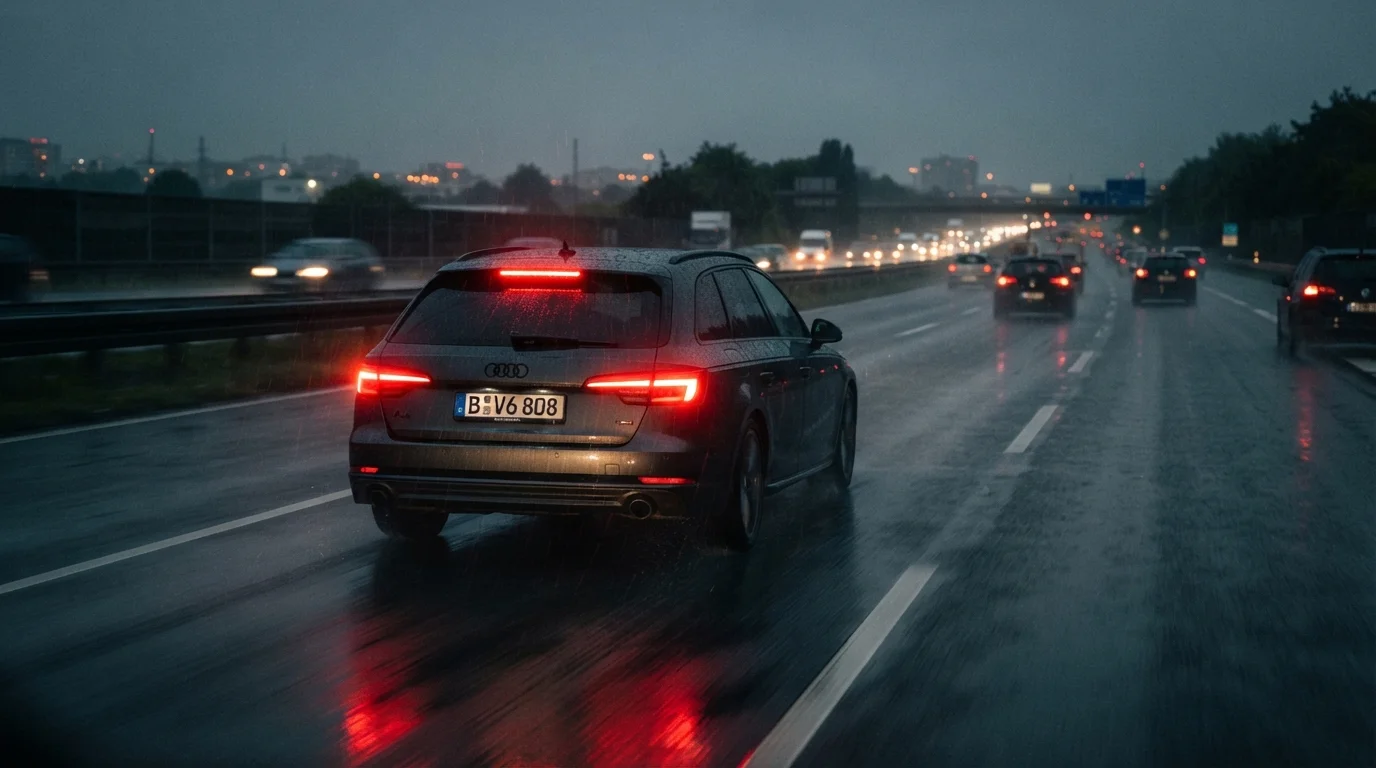
General driver safety guidance notes that wet road conditions can approximately double stopping distance compared to dry pavement, depending on tyre tread and vehicle speed.
1.5 sec
Average driver reaction time
Transportation safety research commonly cites an average reaction time of 1.5 seconds; at 60 mph this corresponds to roughly 132 feet of travel before braking begins.
Practically speaking, this means that reducing your speed even slightly — from 45 mph to 35 mph, for example — meaningfully shortens the distance needed to stop. Speed choice is one of the most direct safety decisions a driver makes.
The Role of Tyres and Road Surface
Even perfectly functioning brakes cannot overcome poor tyre grip or a slippery road. Tyres are the only part of the car that actually contacts the road, and braking distance is largely determined by how well that contact translates into friction.
Worn tread reduces a tyre's ability to channel water and maintain grip, particularly in rain. Under-inflated tyres deform under load and reduce the contact patch with the road. Either condition extends braking distance — sometimes dramatically. See our guide to common tyre and brake myths for misconceptions that put drivers at risk.
Road surface matters just as much. Dry asphalt provides the best grip. Wet roads can roughly double braking distance. Gravel, leaves, and ice reduce friction further still. Adjusting speed to match road conditions is not timid driving — it is sound physics applied to safety.
Check Tyre Tread Before Winter Driving
A quick way to assess tread depth is to insert a quarter into the tread groove with Washington's head pointing down. If the top of his head is visible, the tread is likely too worn for safe wet-weather stopping. Have tyres inspected by a tyre professional if you are uncertain about their condition.
Reaction Time and the Older Driver
Reaction time — the gap between seeing a hazard and beginning to brake — is influenced by age, fatigue, distraction, and medication. Research in driver physiology consistently finds that reaction time tends to lengthen gradually as people age, even among healthy, experienced drivers.
This does not mean older drivers are unsafe. It means that maintaining a larger following distance is an especially practical habit. A gap of three to four seconds between your car and the vehicle ahead gives more total stopping room, directly compensating for any increase in reaction time.
“The most dangerous thing on the road is not the hazard ahead — it is the gap between when you see it and when your foot reaches the brake. That gap is where crashes happen.”
— Traffic Safety Education Perspective, General principle cited in driver safety education curricula
Staying aware of distractions, keeping prescription glasses current, and scheduling regular vision and hearing checks all support faster, more accurate hazard perception — the foundation of the reaction phase.
How Brake Condition Affects the Equation
Once you have reacted and pressed the pedal, the braking system takes over. Worn brake pads, degraded rotors, or compromised brake fluid all reduce the force the system can apply — which directly extends braking distance.
Brake fluid is a commonly overlooked factor. Over time it absorbs moisture, which lowers its boiling point and can cause a soft, spongy pedal feel — meaning less braking force reaches the wheels. Our article on brake fluid and stopping power explains what to check and when to have it replaced.
Similarly, understanding your car's brake type matters. Drum and disc brakes behave differently in heat and wet conditions, and knowing which system your car uses can inform your maintenance schedule. If a recent brake service felt incomplete or you notice pulling, vibration, or extended stopping distances, our guide on when a brake job involves more than just pads outlines what else may need attention.
Regular brake inspections — typically every 12,000 miles or annually, though your owner's manual gives the best guidance — help catch wear before it affects stopping performance. A qualified mechanic should handle any brake component replacement or fluid flush.
This article is for general informational purposes only and does not constitute professional mechanical or safety advice. Always consult a qualified mechanic for diagnosis and repair of your vehicle's brake system.
Frequently Asked Questions
Stopping distance is made up of reaction distance — how far the car travels while you perceive a hazard and move your foot — and braking distance, which is the distance covered once the brakes are applied. Both add together to give total stopping distance.
Yes — the relationship is not linear. Because braking distance increases with the square of speed, driving at 60 mph requires roughly four times the braking distance of driving at 30 mph. Even modest speed reductions meaningfully shorten total stopping distance.
Wet roads can roughly double braking distance compared to dry conditions, and icy roads can increase it tenfold or more. Reduced friction between tyres and road surface means the tyres cannot grip as effectively, so the car takes far longer to slow down.
Yes. Tyres are the only contact point between the car and the road. Worn or under-inflated tyres reduce grip, which extends braking distance significantly — sometimes as much as degraded brakes would. Maintaining proper tread depth is a critical safety habit.
Increasing following distance is the most practical strategy — it gives more total stopping distance before a collision occurs. Reducing speed in unfamiliar or adverse conditions and keeping tyres and brakes in good condition also help maintain a safety margin.
Brake fluid transfers the force of your foot pedal to the brake components. If the fluid has absorbed moisture over time, it can cause a soft or spongy pedal and reduce braking force, which extends stopping distance. Regular fluid checks help keep the system responsive.
The content on this site is for informational purposes only and is not a substitute for professional advice. Always consult a qualified professional for guidance specific to your situation.