

Option A
Disc Brakes
The modern standard for consistent, powerful stopping.
Best for: Drivers who prioritize confident stopping performance, especially in wet conditions or on hilly terrain.
Option B
Drum Brakes
The durable, low-cost design still common on rear axles.
Best for: Everyday city and suburban driving where rear braking demands are moderate and cost-effective maintenance matters.
How Each System Actually Works
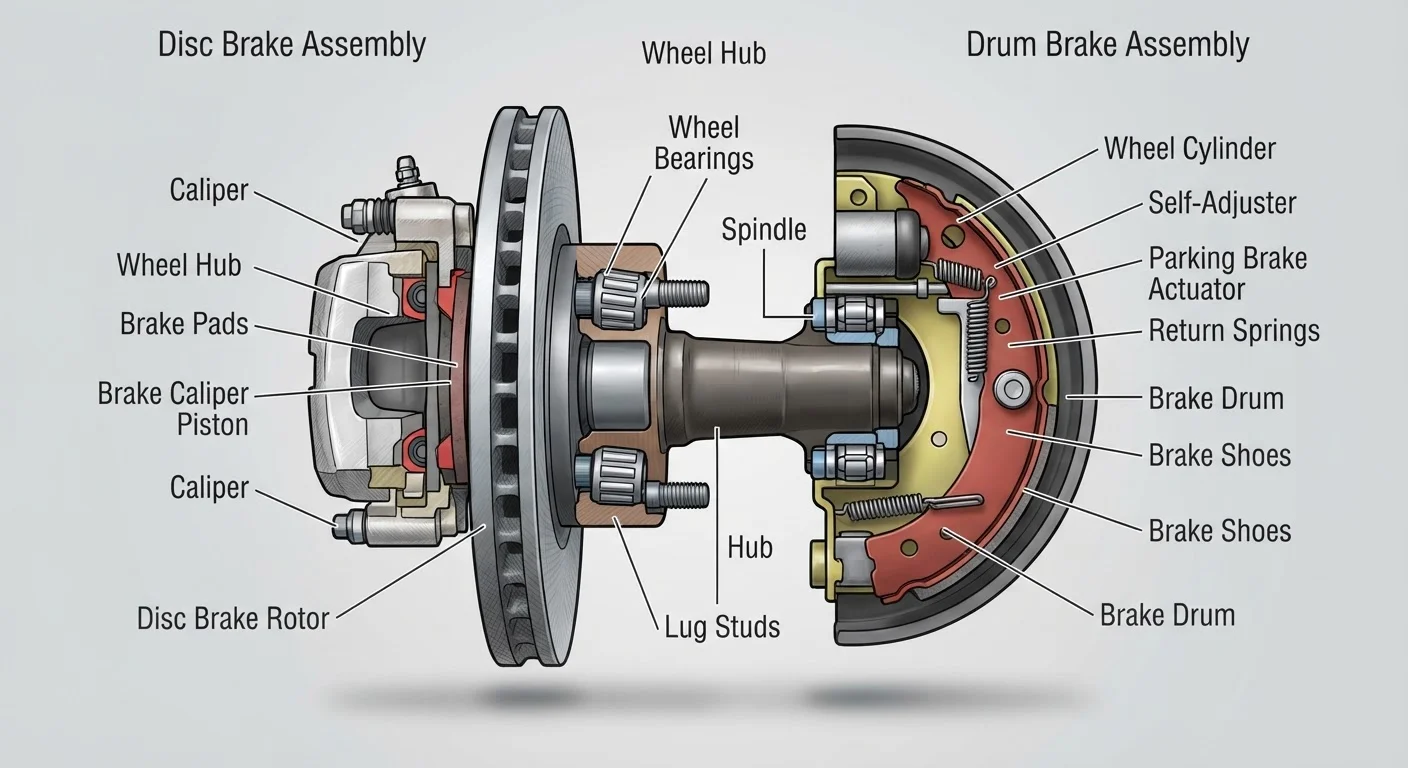
A disc brake clamps a flat metal rotor — the disc — using a caliper that squeezes brake pads against each side when you press the pedal. Because the rotor spins in open air, heat escapes quickly and performance stays consistent even under repeated use.
A drum brake works differently. A hollow metal drum rotates with the wheel, and curved friction linings called brake shoes press outward against the drum's inner surface to create stopping force. The enclosed design traps heat more readily, which is one reason drum brakes are rarely used where braking demands are highest — the front axle.
Before going further, it helps to know a few key terms. If words like brake fade, rotor runout, or ABS are unfamiliar, the braking terms glossary breaks each one down in plain language.
| Criterion | Disc Brakes | Drum Brakes |
|---|---|---|
| Design | Rotor clamped by caliper and pads | Shoes press outward inside a drum |
| Heat dissipation | Excellent — open-air cooling | Limited — enclosed design traps heat |
| Typical location | Front axle (always); rear axle (common on newer cars) | Rear axle on many older and economy vehicles |
| Wet-weather performance | Consistent — water flung off quickly | Brief lag — moisture can be trapped inside |
| Visual inspection ease | Often visible through wheel spokes | Requires wheel removal to access |
| Parts and service cost | Moderate — rotors add to cost | Generally lower — shoes last longer |
| Parking brake integration | Requires separate mechanism | Shoes serve dual purpose naturally |
Performance, Heat, and Daily Driving
Heat is the biggest factor separating these two designs in real-world use. When you brake repeatedly — descending a long hill, slowing for stop-and-go traffic, or making a sudden emergency stop — friction generates significant heat. Disc brakes vent that heat into the surrounding air almost immediately. Drum brakes hold heat inside the drum, which can cause brake fade (reduced stopping power as components overheat) under sustained use.
For most seniors driving in typical suburban or city conditions, rear drum brakes perform adequately — the front brakes, which are almost always discs, handle roughly 70% of stopping force during a normal stop. However, if your driving regularly involves long downhill stretches or heavily loaded vehicles, a vehicle equipped with four-wheel disc brakes offers a measurable safety advantage.
~70%
Braking force handled by front brakes
Weight shifts forward under braking, placing the majority of stopping demand on the front axle — one reason front discs are universal.
2–3 years
Typical brake fluid change interval
Many vehicle manufacturers recommend replacing brake fluid every two to three years regardless of mileage, as moisture absorption degrades performance over time.
Wet-weather performance also favors disc brakes. Because the rotor is exposed, water is flung off with each rotation. Drum brakes can trap moisture inside, briefly reducing friction until heat dries the surfaces. This usually corrects itself within a few applications of the pedal, but it is worth knowing about on rainy mornings.
Maintenance: What Each System Needs
Both systems require periodic inspection of friction material — pads on disc brakes, shoes on drum brakes — and replacement before metal-on-metal contact occurs. That grinding or persistent squealing noise is a signal that inspection is overdue.
Disc brakes are relatively straightforward to check. Many wheel designs let you see pad thickness through the spokes without lifting the car. Rotors should be examined for deep grooves or uneven wear, and a mechanic can measure rotor thickness to confirm it remains within safe operating limits. The full scope of a brake job covers when rotors, calipers, and fluid also need attention — not just pads.
Drum brakes require removing the wheel to access the shoes, springs, and adjusters. Springs and self-adjusting hardware can weaken or seize over time, causing uneven braking or a parking brake that no longer holds firmly. Ask your mechanic to inspect these components at each brake service.
Regardless of brake type, the hydraulic fluid that transfers pedal force through the system deserves attention. Brake fluid absorbs moisture over time, which lowers its boiling point and can soften pedal feel — a safety concern that is easy and inexpensive to address on a routine schedule.
Which Setup Is on Your Vehicle — and Does It Matter?
Check your owner's manual or ask a mechanic at your next oil change. Many sedans and smaller SUVs built after 2010 use four-wheel disc brakes. Older vehicles, and some newer economy models, retain rear drum brakes as a cost-saving measure. Neither arrangement is inherently unsafe for normal daily use when properly maintained.
What matters most is not which type you have, but whether your brake system is in good working order. Warning signs that apply to both types include: a soft or spongy pedal, pulling to one side during braking, vibration through the steering wheel or pedal, and any grinding or persistent squealing. Do not delay having these symptoms evaluated by a qualified mechanic — brakes are a safety-critical system.
Also remember that brakes are only part of the stopping equation. Tire condition, road surface, and reaction time all affect how quickly your vehicle can stop. The physics of stopping distance explains why a well-maintained vehicle with worn tires can still take far longer to stop than expected.
This article provides general automotive education and is not a substitute for professional mechanical inspection. Always consult a qualified mechanic for brake diagnosis, repair, or safety concerns specific to your vehicle.
The content on this site is for informational purposes only and is not a substitute for professional advice. Always consult a qualified professional for guidance specific to your situation.