

Why Tyre Pressure Isn't a Set-and-Forget Number
Many drivers assume that once a tyre is inflated correctly, the pressure stays put indefinitely. In practice, it doesn't. Tyre pressure changes continuously in response to temperature, time, and the physical demands of driving — often without any puncture or visible damage.
Understanding why this happens helps you treat tyre checks as a normal part of vehicle care rather than a response to something going wrong. For seniors who rely on their vehicles for independence, that shift in mindset can prevent a minor pressure drop from becoming a roadside emergency.
Dashboard Warning Lights Are a Last Resort
Most modern vehicles have a Tyre Pressure Monitoring System (TPMS) that illuminates a warning light when pressure drops significantly below the safe range. However, the light typically activates only after a meaningful shortfall has already occurred. Relying on the warning light alone means your tyres may have been running under-inflated for some time. Regular manual checks catch problems earlier.
See our monthly tyre and brake safety checklist for a simple routine you can do at home.
Temperature: The Biggest Driver of Pressure Changes
Air expands when it warms and contracts when it cools. Because the air inside a tyre follows the same rule, pressure rises as the rubber heats up from driving or from a hot day, and drops when temperatures fall. As a general guideline, tyre pressure changes by roughly 1 PSI for every 10°F (about 5.5°C) change in ambient temperature.
That means a tyre correctly inflated on a warm afternoon may read noticeably low on a cold morning — not because air has escaped, but simply because the air inside has contracted. This effect is especially pronounced during seasonal transitions.
1–2 PSI
Monthly pressure loss through normal permeation
Tyre manufacturers and vehicle safety organizations consistently cite this as the expected natural rate of air loss through rubber.
1 PSI
Pressure change per 10°F temperature shift
This widely referenced guideline reflects the physical behavior of air (an ideal gas) expanding and contracting with heat and cold.
~25%
Vehicles on the road with at least one under-inflated tyre
Multiple roadside surveys by tyre safety organizations have found roughly one in four vehicles has at least one tyre below the recommended pressure.
For a closer look at how seasonal swings affect your readings throughout the year, the article Tire Pressure and Why It Shifts With the Seasons covers the cold-weather and summer patterns in detail.
Natural Air Loss and Tyre Age
Even a perfectly sealed tyre loses air gradually. Gas molecules are small enough to permeate through rubber over time, resulting in a natural pressure loss of approximately 1–2 PSI per month. This is normal and expected — it isn't a sign of a problem. But it does mean that a tyre left unchecked for several months can be meaningfully under-inflated.
Older tyres compound this effect. As rubber ages, it becomes more porous and less flexible, allowing air to escape more readily. This is one reason why tyre age matters even when the tread still looks acceptable — the internal structure may no longer hold pressure as reliably as it once did.
Keep a Gauge in Your Glove Box
A small tyre pressure gauge costs only a few dollars and means you never have to rely solely on a petrol station pump's built-in reader, which may not be calibrated regularly. Check all four tyres — and your spare — at least once a month and whenever the weather changes significantly. Early morning, before your first drive of the day, gives the most accurate cold reading.
How to Check Tyre Pressure Correctly
The most important rule: check pressure when the tyres are cold — before the vehicle has been driven more than about one mile. Driving heats the air inside and temporarily raises pressure, which gives a misleading reading.
- Find your recommended PSI. Look for a sticker on the inside edge of the driver's door frame, or check the owner's manual. Do not use the number moulded on the tyre sidewall — that is the maximum structural limit, not the target pressure.
- Remove the valve cap from the tyre's air valve stem (the small rubber or metal nub).
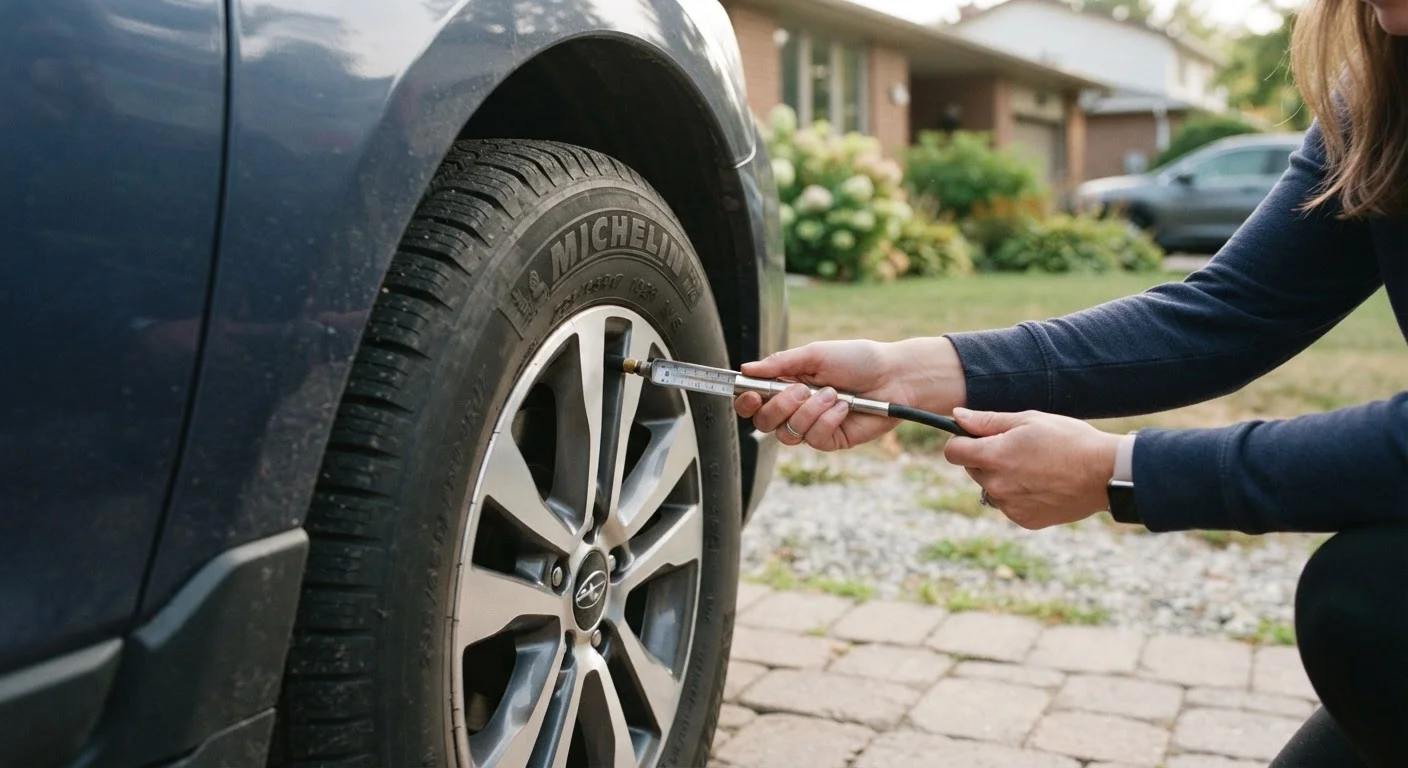
- Press your gauge firmly onto the valve. A digital or dial gauge available at most auto-supply stores gives a clear reading. Pencil-style gauges work too, though they can be harder to read.
- Compare to your recommended PSI and add or release air as needed. Most petrol station air pumps allow both inflation and deflation.
- Replace the valve cap after checking each tyre, including the spare.
If you notice one tyre consistently losing pressure faster than the others, have a qualified mechanic inspect it for a slow leak — a small nail or damaged valve stem may be the cause.
You may also find it helpful to review how tread depth is measured and what worn tyres look like, since pressure and tread condition go hand in hand.
Frequently Asked Questions
A monthly check is a reasonable habit for most drivers. Additionally, check before any long trip or when outdoor temperatures shift dramatically. It takes only a few minutes with an inexpensive gauge kept in the glove box.
Air molecules slowly migrate through rubber over time, causing a gradual natural pressure loss of roughly 1–2 PSI per month. Cooler overnight temperatures also cause the air inside the tyre to contract, which registers as a pressure drop by morning.
The correct PSI is specific to your vehicle, not your tyre brand or size. Check the sticker inside the driver's door frame or your owner's manual. Never use the maximum PSI printed on the tyre sidewall — that is the tyre's structural limit, not the recommended operating pressure.
Even a modest shortfall of 5–6 PSI below the recommended level can reduce fuel efficiency, accelerate tread wear, and affect handling. Driving significantly under-inflated tyres — especially at highway speeds — raises the risk of a dangerous blowout. Top up as soon as possible.
Yes, most petrol stations have an air pump with a built-in gauge. Arrive before driving far if possible, so the tyres are still relatively cool. If the station gauge reads differently from your own gauge, trust the one you've verified against a known standard.
The content on this site is for informational purposes only and is not a substitute for professional advice. Always consult a qualified professional for guidance specific to your situation.