

Why Knowing Your Car's Fluids Matters
Your car depends on at least six different fluids to run safely. Each one does a specific job — lubricating, cooling, pressurizing, or cleaning — and each one can quietly cause expensive damage when it runs low or degrades. The good news is that checking most fluids takes only a few minutes and requires no special tools.
This guide is a plain-language lookup reference. Use it to identify what each fluid looks like when healthy, where it lives in a typical vehicle, and what warning signs to watch for. For a deeper look at reading your engine oil specifically, see our engine oil dipstick guide.
| Number of major vehicle fluids | 6 (oil, coolant, brake, transmission, power steering, washer fluid) |
| Most frequently checked fluid | Engine oil — recommended monthly for most drivers |
| Brake fluid check frequency | At least once a year, or per owner's manual |
| Coolant color variation | Green, orange, pink, or blue — varies by formulation |
| Transmission fluid appearance (healthy) | Bright red to pink; dark or burned fluid needs evaluation |
| Best reference for change intervals | Your vehicle's owner's manual |
The Six Fluids Every Driver Should Know
Use the descriptions below as a quick reference. If a fluid looks or smells different from its healthy state, that's a signal worth investigating — either by checking your owner's manual or consulting a qualified mechanic.
Coolant
A liquid mixture — usually water and antifreeze — that circulates through the engine to regulate temperature. It prevents overheating in summer and freezing in winter.
Brake Fluid
A hydraulic fluid that transfers the force of your foot on the brake pedal to the brakes at each wheel. It absorbs moisture over time, which reduces its effectiveness.
Transmission Fluid
A lubricating fluid that keeps the gears and components inside your transmission running smoothly. It also helps cool the transmission and enables smooth gear changes.
Dipstick
A long, thin metal rod inserted into a fluid reservoir that lets you check the fluid level and condition without opening or draining the system.
Power Steering Fluid
A hydraulic fluid used in vehicles with traditional (non-electric) power steering systems. It helps make turning the steering wheel easier at low speeds.
Firewall
The metal barrier between the engine compartment and the passenger cabin. Several fluid reservoirs — including the brake fluid reservoir — are typically mounted against it.
Engine Oil
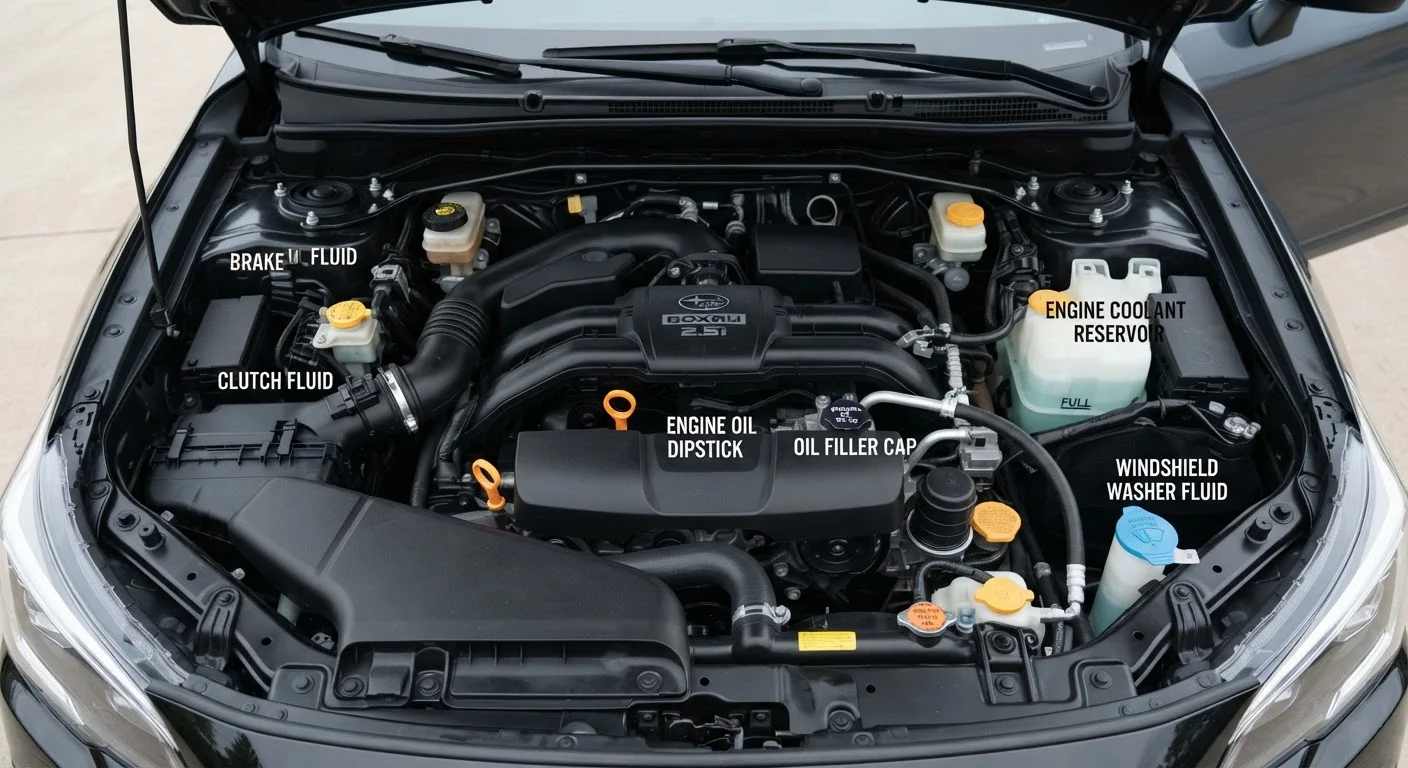
Where it lives: Dipstick and oil filler cap, usually near the front of the engine.
Healthy color: Amber to light brown. Dark brown or black oil is aged; a milky or foamy appearance may signal coolant contamination.
Low or degraded: Engine knocking noises, oil pressure warning light, or visible smoke from the hood.
Coolant (Antifreeze)
Where it lives: A translucent plastic reservoir near the radiator, usually with a MIN/MAX line.
Healthy color: Bright green, orange, pink, or blue depending on the type — always check your owner's manual for the correct specification.
Low or degraded: Temperature gauge climbing toward the red zone, sweet smell from the engine area, or visible steam.
Brake Fluid
Where it lives: A small reservoir under the hood, usually near the firewall on the driver's side.
Healthy color: Clear to pale yellow. Dark brown fluid has absorbed moisture and should be evaluated by a mechanic.
Low or degraded: A spongy or soft brake pedal, or the brake warning light illuminating on the dashboard. If your brakes feel unusual in any way, have the vehicle inspected before driving further.
Power Steering Fluid
Where it lives: A small reservoir with a dipstick or MIN/MAX markings, usually toward the front of the engine bay. Note that many newer vehicles use electric power steering and do not have this fluid at all.
Healthy color: Clear, amber, or light pink.
Low or degraded: Whining or groaning sound when turning the steering wheel, or steering that feels stiff or heavy.
Transmission Fluid
Where it lives: Accessed via a dipstick (automatic transmissions) or a fill plug (many manual and some newer automatic transmissions).
Healthy color: Bright red to pink. Dark red or brown fluid, or fluid with a burned smell, suggests it needs attention. For more on what degraded transmission fluid looks like, see our transmission fluid guide.
Low or degraded: Delayed or rough gear shifts, slipping, or an unusual smell while driving.
Windshield Washer Fluid
Where it lives: A plastic reservoir with a washer-symbol cap, typically blue.
Healthy appearance: Usually blue or tinted. Plain water is not a substitute — it can freeze in winter and does not clean effectively.
Low: No fluid sprays when the washer lever is used.
Some vehicles also use a separate fluid for the rear differential or transfer case. These are typically checked and serviced by a mechanic during scheduled maintenance. If you notice a puddle beneath your car, our leak color and location guide can help you make sense of it before calling for service.
Building a Habit Around Fluid Checks
You do not need to check every fluid every week. A practical approach is to inspect engine oil and coolant monthly, and to glance at the other reservoirs every three months or when you schedule any service visit. Your owner's manual lists the manufacturer's recommended change intervals, which is the most reliable reference for your specific vehicle.
Weather changes can affect fluid performance more than many drivers realize. Seasonal fluid checks are a smart way to stay ahead of temperature-related problems. And if you want to turn these checks into a consistent routine, building a simple maintenance routine offers a practical framework any driver can follow.
Electric Vehicles Have Fewer Fluids
If you drive a fully electric vehicle (EV), you will not have engine oil or transmission fluid in the traditional sense. EVs still use brake fluid, coolant (for battery and electronics), and windshield washer fluid. Always consult your EV's owner's manual for the correct maintenance schedule, as it differs meaningfully from a conventional gasoline vehicle.
If you are ever unsure whether a fluid level or color is acceptable, the safest step is to ask a licensed mechanic. A quick inspection is far less costly than waiting until a warning light appears.
The content on this site is for informational purposes only and is not a substitute for professional advice. Always consult a qualified professional for guidance specific to your situation.