

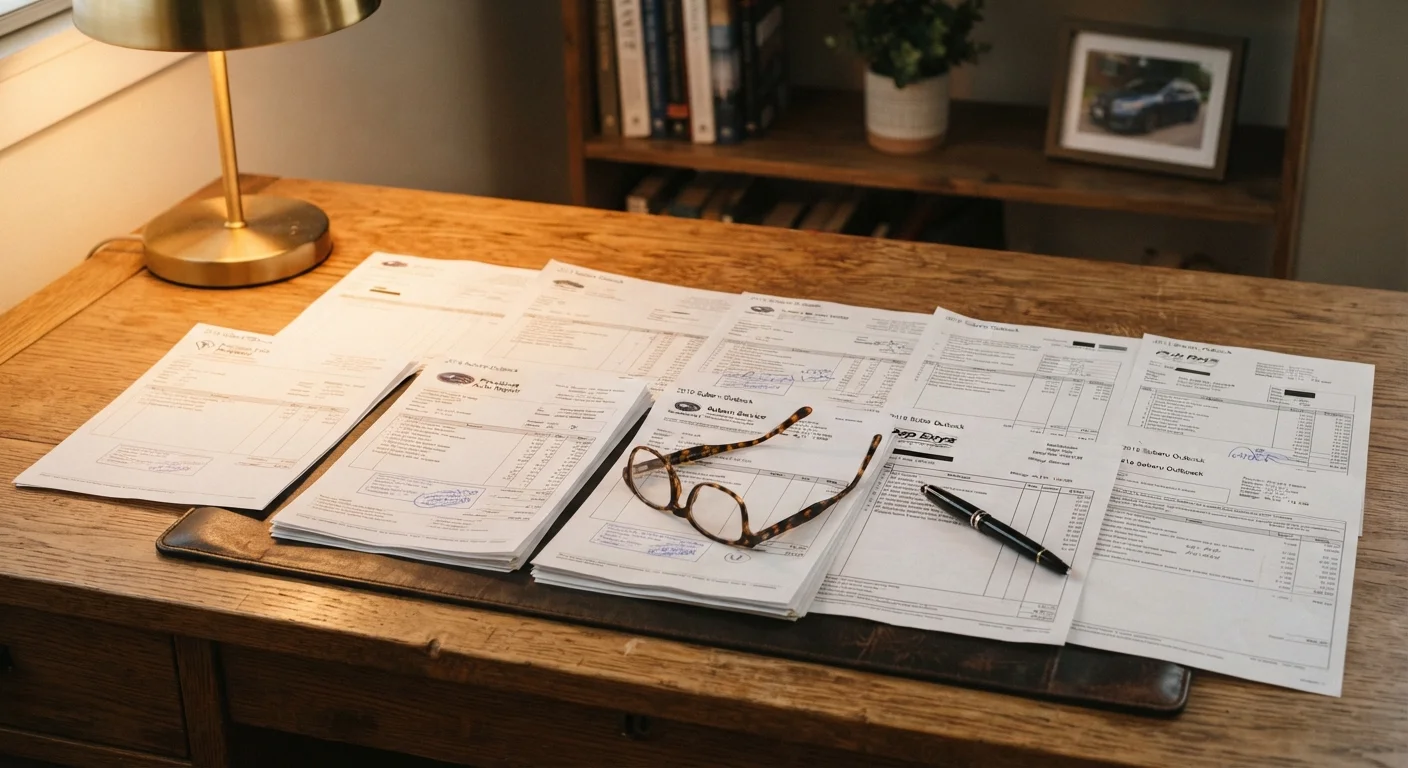
What Service History Documents Actually Show
A service history is a running record of the maintenance and repairs performed on a vehicle throughout its life. The documents themselves take several forms: printed receipts from a franchise dealership or independent repair shop, a handwritten owner's log, or digital records stored against the car's VIN — the unique 17-character code assigned to every vehicle sold in the U.S.
What you're looking for is evidence of scheduled upkeep: oil and filter changes, tire rotations, brake inspections, coolant and transmission fluid replacements, and any major work such as timing belt replacement or suspension repairs. A consistent paper trail signals that previous owners took routine care seriously — and that the car is less likely to be hiding deferred maintenance that will surface as a costly repair after purchase.
For more on how a car's documented past shapes what it's actually worth, see our guide on using vehicle history reports to assess fair pricing.
How to Read the Records You're Given
When a seller hands you maintenance paperwork, look for three things: timing, consistency, and scope.
Timing means services were performed at reasonable intervals. Oil changes every 5,000 to 7,500 miles is typical for many modern vehicles, though your owner's manual is the authoritative source for any specific car — intervals vary by engine type and manufacturer. Consistency means the vehicle went to the same shop or mechanic over time, or was clearly logged by one careful owner throughout. Scope means the records go beyond basic oil changes to cover larger milestone services: air filters, spark plugs, brake pads, belts, and hoses.
Watch for long gaps between service dates or mileage jumps that skip multiple recommended intervals. That's not a dealbreaker on its own, but it's worth asking about directly. You can find guidance on questions worth asking a seller before you commit.
Use the Owner's Manual as a Benchmark
If the car still has its original owner's manual, compare the seller's receipts against the manufacturer's recommended maintenance schedule. Most manuals list service intervals by mileage and time for each major item. Gaps become much easier to spot when you have the schedule right in front of you, rather than relying on memory or general rules of thumb.
What Gaps and Missing Records Actually Mean
Incomplete or absent service records are very common in the used-car market. Some owners maintained their vehicles themselves and simply kept no paperwork. Others bought the car second- or third-hand and received nothing at the point of sale. Records also get lost during moves or after many years of ownership.
Missing documentation doesn't automatically mean a car was neglected — but it does mean you're making a decision with less information, and that warrants extra scrutiny on other fronts.
One practical first step: look for dealership or shop stickers inside the car — often on the windshield, door frame, or under the hood — then contact those businesses directly. Many franchise dealerships and established independent shops retain records by VIN and can print a service history going back several years. A vehicle history report may also surface some maintenance events that were reported to the database.
History Reports Don't Capture Every Service
Third-party vehicle history reports pull data from sources that participate in their reporting network — including some dealerships, insurers, and state agencies. Many independent shops do not report routine service events to these databases. A missing oil change entry in a history report does not prove the work was skipped; it may simply mean the shop that performed it wasn't part of the network.
Steps to Take When Documentation Is Thin
Sparse records call for more legwork — not necessarily a different car. Work through these steps before committing to any purchase.
- Ask the seller directly. Request specifics: what maintenance was done, when, and by whom. Consistent, detailed answers are reassuring; vague or shifting ones are not.
- Do a VIN lookup. Contact the franchise dealership for the car's brand and any shops whose stickers you spot in the vehicle. Give them the VIN and ask what service history they have on file.
- Pull a vehicle history report. These reports can reveal some service events alongside accident records, ownership changes, and title issues. See our article on reading vehicle history reports before you commit for what to look for.
- Arrange a pre-purchase inspection. A licensed mechanic with no connection to the seller can assess fluid conditions, brake wear, tire health, and signs of deferred maintenance — information no paper trail can fully replace.
If you go ahead with the purchase, starting your own maintenance log right away protects your safety and the car's resale value. Our guide on keeping a vehicle maintenance log explains how to build that habit from day one.
This article provides general educational information about used car buying and is not a substitute for professional mechanical inspection or personalised advice from a qualified automotive technician.
Frequently Asked Questions
Start by asking the seller what maintenance was done and when, and listen for specific, consistent answers. Try contacting the franchise dealership for the car's brand using the VIN — many retain electronic records. A vehicle history report can surface some service events, but a pre-purchase inspection by a licensed mechanic is your most reliable way to assess the car's actual condition.
Many franchise dealerships do retain electronic service records linked to a vehicle's VIN and will share them on request. Coverage depends on whether the previous owner used that dealership for service and how long records are kept. Independent shops maintain their own records but typically do not participate in a shared database.
Well-documented maintenance is a positive indicator, but it is not a guarantee of reliability. A car can have thorough records and still have underlying mechanical issues. Service records are one part of the picture — a pre-purchase inspection by a licensed mechanic provides the hands-on assessment that paper alone cannot replace.
Oil and filter changes at regular intervals are the baseline indicator of care. Look also for brake inspections, transmission fluid changes, coolant flushes, timing belt or chain service where applicable, and any manufacturer recall repairs that were completed. These items have the most direct bearing on long-term reliability and safety.
Not automatically. Gaps are common and often have innocent explanations, such as owner-performed maintenance or paperwork lost during a move. The better approach is to ask direct questions, do a VIN lookup, and arrange a pre-purchase inspection rather than walking away solely on the basis of missing paperwork.
The content on this site is for informational purposes only and is not a substitute for professional advice. Always consult a qualified professional for guidance specific to your situation.