

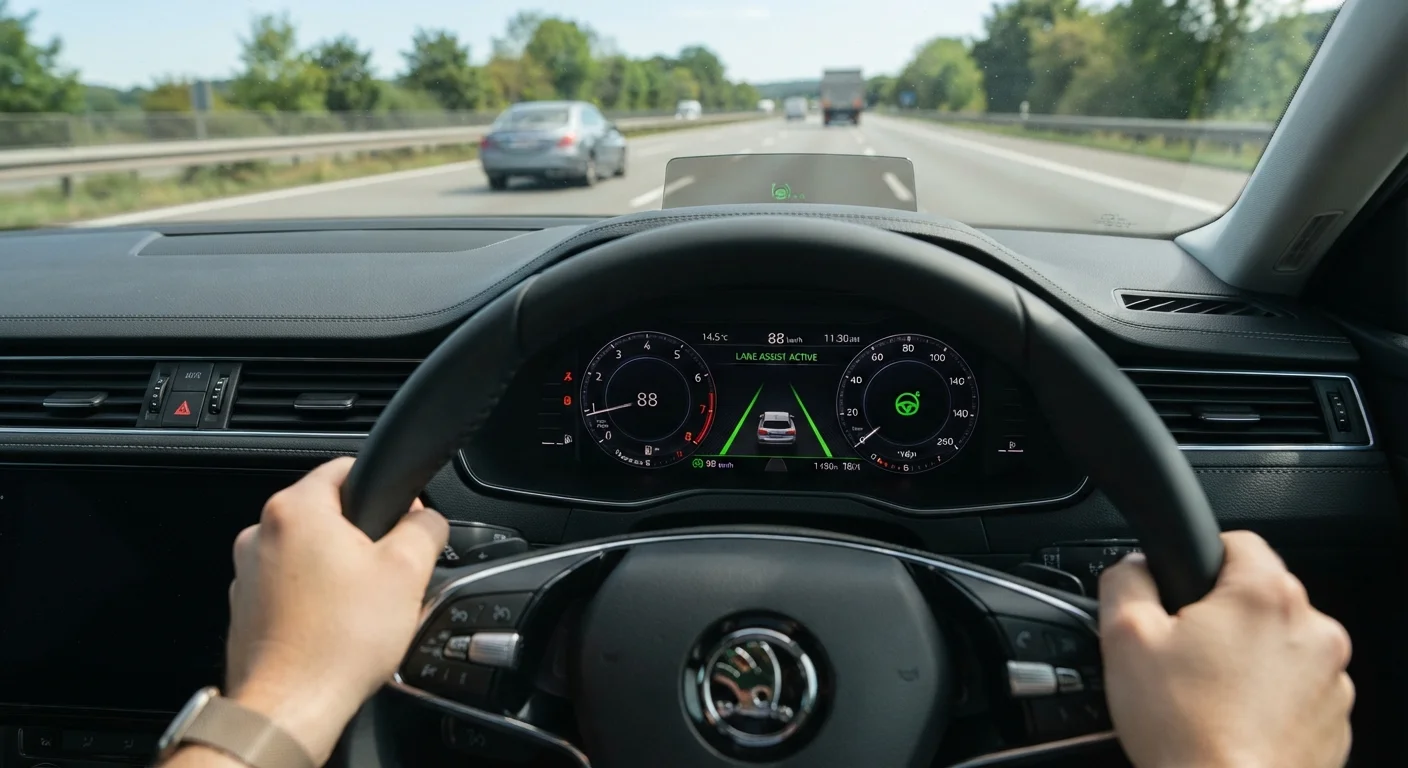
Option A
Lane Departure Warning (LDW)
The alert-only system that tells you when you're drifting.
Best for: Drivers who want a heads-up about lane drift while keeping full control of the steering.
Option B
Lane-Keeping Assist (LKA)
The active system that gently steers you back into your lane.
Best for: Drivers who want the car to take corrective action automatically when unintentional lane drift is detected.
What Each System Actually Does
The names sound similar, but these two systems have fundamentally different jobs. Lane Departure Warning (LDW) is a passive alert system. Using a forward-facing camera to track painted lane markings, it detects when the vehicle crosses or approaches a lane boundary without the turn signal activated. When that happens, it notifies the driver — typically through a beep, a vibration in the seat or steering wheel, or a dashboard icon. That's where its involvement ends. The driver is entirely responsible for any corrective action.
Lane-Keeping Assist (LKA), by contrast, takes the next step. It uses the same camera technology but goes beyond alerting — it applies a gentle steering torque or, in some implementations, a light brake input on one side of the vehicle to guide the car back toward the center of the lane. The correction is typically subtle, designed to feel like a nudge rather than a jerk. The driver can override it at any moment simply by steering normally.
Understanding this distinction matters because it changes how you interact with each system. With LDW, you're the responder. With LKA, the car is a co-pilot making small adjustments on your behalf. For a deeper look at how these and similar technologies fit together, see the plain-language guide to driver-assist technology covering today's new cars.
Head-to-Head: How the Two Systems Compare
The table below captures the most practical differences between Lane Departure Warning and Lane-Keeping Assist across the criteria that matter most to everyday drivers.
| Criterion | Lane Departure Warning | Lane-Keeping Assist |
|---|---|---|
| Primary function | Alerts the driver to lane drift | Actively steers or brakes to correct drift |
| Driver intervention required | Yes — driver must respond | No — system acts automatically |
| Type of output | Beep, vibration, or visual warning | Gentle steering torque or brake input |
| Can driver override it | N/A — no physical input to override | Yes — normal steering overrides immediately |
| Technology used | Forward-facing camera reads lane markings | Same camera; adds steering/brake control |
| Effectiveness in poor visibility | Reduced when markings are unclear | Reduced when markings are unclear |
| Classification | Passive driver-support system | Active driver-support system |
One important nuance: many automakers bundle both systems into a single package — sometimes labeling the combined feature simply as "Lane Keeping" or under a brand-specific name. When evaluating a vehicle, it's worth asking whether the system alerts only, steers actively, or does both, since marketing names don't always make this clear.
Shared Limitations Both Systems Have
Neither system is infallible, and understanding their shared limitations helps set realistic expectations.
These Systems Require Clear Lane Markings
Both Lane Departure Warning and Lane-Keeping Assist rely on a camera reading painted lines on the road surface. In conditions where those markings are faded, covered by snow, or obscured by glare, either system may disengage or provide unreliable feedback. It's advisable to check your vehicle's display or indicator to confirm when a lane-safety system is active — most vehicles show a visual status indicator on the dashboard or instrument cluster.
- Lane markings must be visible. Both systems depend on the camera clearly reading painted lines. Faded markings, snow, heavy rain, or nighttime glare can cause either system to disengage or perform inconsistently.
- Intentional lane changes can confuse them. Both systems are typically designed to deactivate when the turn signal is on, but this interaction varies by vehicle.
- They don't prevent all drifting. A slow, gradual drift can still occur if lane markings are ambiguous or the road curves sharply.
- Neither replaces driver attention. These systems are categorized as driver-support features, not autonomous driving. Regulations and automaker guidelines make clear that the driver remains responsible at all times.
This alert-vs.-action distinction mirrors a pattern seen across other safety technologies. The comparison of Forward Collision Warning and Automatic Emergency Braking covers the same alert-vs.-action divide for front-end crash prevention.
Why This Distinction Matters for Senior Drivers
For older drivers, the choice between an alert system and an active one isn't just technical — it's personal. Some seniors appreciate the reassurance of a car that makes a small corrective move when attention wavers for a moment, particularly on long highway trips. Others find unexpected steering inputs startling or intrusive, preferring to stay fully in command.
There's no universally correct preference. What matters is being aware of which system a vehicle has before you drive it, so that its behavior isn't surprising. If a car you're test-driving gently steers itself back into the lane, that's LKA at work — not a malfunction. If it simply beeps and does nothing more, that's LDW doing its job correctly.
The driver-assist technologies every senior should know about provides broader context on how these and other systems support safer driving as you age. And if you're thinking about the wider framework of how safety features are classified, the active vs. passive safety features guide explains where lane-safety systems fit within the full picture.
This article is for general informational purposes only. Vehicle feature availability, behavior, and naming conventions vary by make, model, and trim level. Consult the vehicle's owner's manual or a qualified automotive professional for guidance specific to your vehicle.
The content on this site is for informational purposes only and is not a substitute for professional advice. Always consult a qualified professional for guidance specific to your situation.