

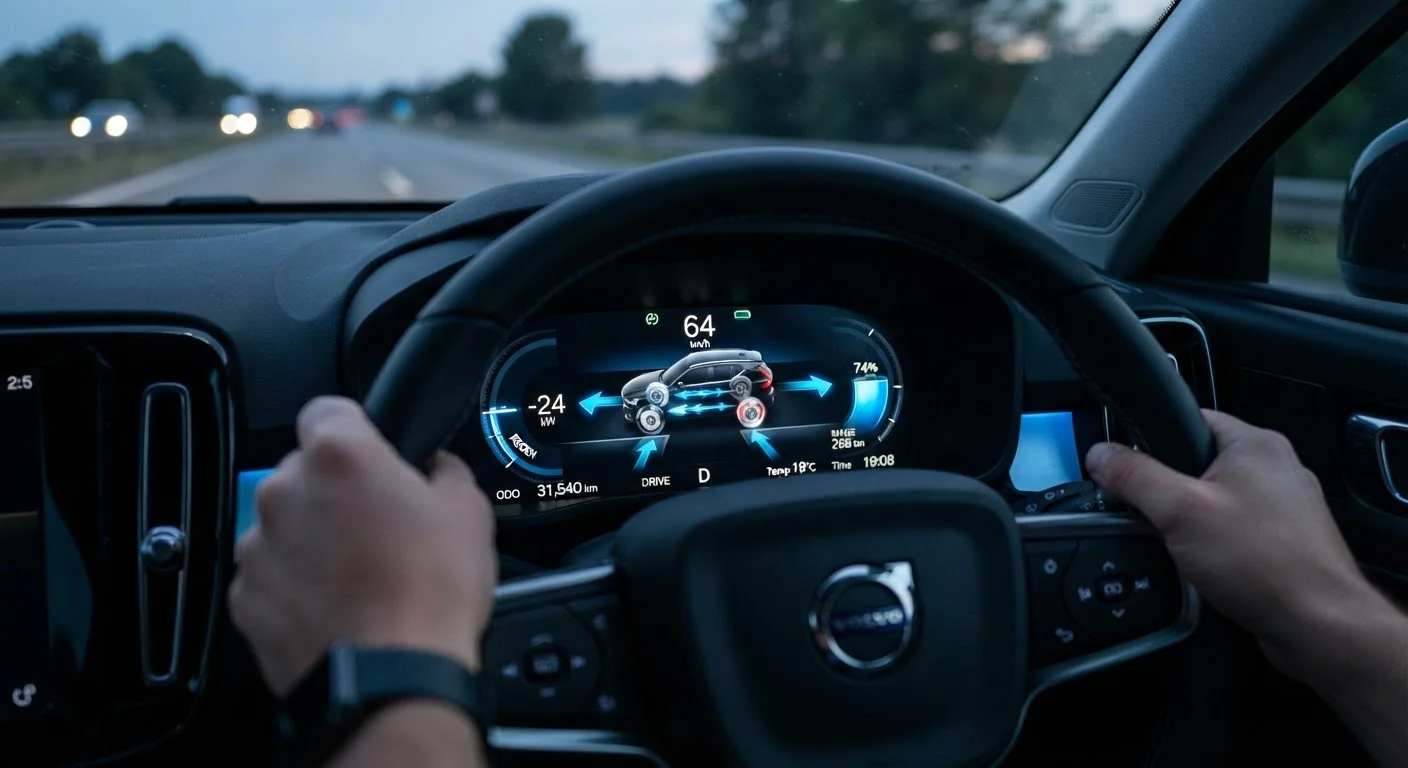
The Simple Physics Behind the System
Every time a moving vehicle slows down, it has to get rid of energy. In a conventional car, friction brakes accomplish this by pressing brake pads against rotating discs or drums, converting motion into heat — energy that simply escapes into the air and is gone. Regenerative braking takes a fundamentally different approach.
In electric and hybrid vehicles, the same electric motor that drives the wheels forward can also spin in reverse when you ease off the accelerator or apply the brakes. Running backward, the motor acts like a generator, converting the vehicle's forward motion — its kinetic energy — into electrical energy. That electricity is channeled back into the car's battery pack for later use.
Think of it this way: a conventional car's brakes are essentially a disposal system for energy you've already paid for. Regenerative braking is a recycling system instead.
Up to 70%
Kinetic energy recoverable in ideal conditions
Engineering analyses of regenerative braking systems suggest up to 70% of kinetic energy can be recaptured under optimal braking conditions, though real-world recovery is typically lower.
~25%
Efficiency gain in stop-and-go city driving
Hybrid and EV studies commonly cite efficiency improvements in the range of 10–25% in urban driving cycles where frequent braking enables more energy recovery.
Longer
Brake pad lifespan vs. conventional vehicles
EV owners frequently report extended brake pad life due to reduced reliance on friction braking, though intervals still vary by vehicle type and driving habits.
How It Works Alongside Conventional Brakes
Regenerative braking does not eliminate the need for traditional friction brakes. The two systems operate together, with the vehicle's computer deciding how much braking force comes from each source depending on how quickly you need to stop.
During gentle deceleration — coasting to a red light, for example — regenerative braking handles most of the work. In a harder stop or emergency situation, friction brakes engage fully to ensure reliable, immediate stopping power. For most drivers, the transition between the two systems is virtually imperceptible.
Some vehicles let you select how aggressively the regenerative system engages. A higher setting creates stronger resistance when you lift your foot from the accelerator, a feature some drivers call one-pedal driving because you can slow the car considerably without touching the brake pedal at all. For those who prefer a more conventional feel, lower settings are available.
To understand braking terminology more broadly, see our plain-language braking glossary for helpful context.
Try One-Pedal Driving on a Test Drive
When test-driving an electric or hybrid vehicle, ask the salesperson to demonstrate the regenerative braking settings. Try the higher-intensity setting in a parking lot or quiet road at low speed to experience one-pedal driving firsthand. It takes only a few minutes to decide whether the feel suits you, and many drivers find it becomes second nature quickly.
Why It Matters for Fuel Efficiency and Range
The practical benefit of regenerative braking is straightforward: the energy recovered while slowing down means the battery doesn't have to work as hard to move the vehicle forward again. In city driving — where stopping and starting happen frequently — this advantage adds up significantly over time.
For fully electric vehicles, recovered energy directly extends driving range between charges. For hybrid vehicles, it reduces how often and how hard the gasoline engine needs to run. Either way, the result is improved overall efficiency without any extra effort from the driver.
There is a secondary benefit worth noting: because friction brakes are used less intensively, brake pads and rotors tend to last longer. This can translate into less frequent brake service appointments and lower maintenance costs over time. For an overview of what brake maintenance typically involves, our article on what a brake job really covers explains the components involved.
What to Expect as a Driver
If you are considering an electric or hybrid vehicle for the first time, regenerative braking is worth understanding before your test drive. The sensation of the car slowing when you lift your foot — without pressing the brake — can feel unfamiliar at first. Most drivers find it intuitive within a few drives.
It is also worth knowing that regenerative braking has its limits. At very low speeds, the system contributes little, and friction brakes do the final work of bringing the car to a complete stop. Cold temperatures can temporarily reduce battery efficiency and affect how much energy is recovered. These are normal characteristics of the technology, not defects.
Regenerative braking is a distinct system from features like automatic emergency braking, which uses sensors to detect hazards and apply brakes independently of the driver. For a clear comparison, our article explaining automatic emergency braking covers how that separate safety feature works.
This article is for general informational and educational purposes only. Vehicle performance, efficiency, and maintenance needs vary by make, model, and individual driving conditions. Consult a qualified automotive professional or dealership for guidance specific to any vehicle you are considering.
Frequently Asked Questions
No. Regenerative braking assists in slowing the vehicle but works alongside conventional friction brakes. At lower speeds or in emergency stops, traditional brakes take over to ensure full stopping power. The two systems are designed to work together seamlessly.
Some drivers notice a slightly firmer or more immediate resistance when lifting off the accelerator. Manufacturers tune the system to feel as natural as possible, and most drivers adjust within a short period. Many vehicles allow the driver to adjust the intensity of regenerative braking.
The amount varies by vehicle, driving conditions, and how often you brake. Stop-and-go city driving typically yields more energy recovery than highway cruising. Some automakers estimate a meaningful improvement in overall efficiency, though exact figures depend on individual driving patterns.
Yes, generally. Because the electric motor handles much of the deceleration, friction brakes are applied less frequently. Owners of electric and hybrid vehicles often report longer intervals between brake pad replacements, though brake system maintenance is still necessary.
Most modern electric vehicles and many hybrid models include some form of regenerative braking. The strength and adjustability of the system varies by manufacturer and model. It is worth asking about this feature when evaluating any EV or hybrid purchase.
The content on this site is for informational purposes only and is not a substitute for professional advice. Always consult a qualified professional for guidance specific to your situation.