

Our Verdict
Clip-on aids work well for seniors with mild or intermittent mobility challenges who want flexibility without commitment. Permanent modifications are better suited to drivers with consistent, significant physical limitations where stability and reliability are non-negotiable. Many seniors ultimately use a combination of both.
| Best for | Recommended |
|---|---|
| Seniors with mild stiffness or occasional difficulty entering and exiting vehicles | Clip-on or removable aids |
| Drivers with significant limb or joint conditions requiring consistent adaptive controls | Permanent vehicle modifications |
| Those who drive multiple vehicles or lease their car | Clip-on or removable aids |
| Seniors whose condition is stable and long-term, owning their vehicle outright | Permanent vehicle modifications |
Understanding the Two Approaches
Adaptive car accessories for senior drivers generally fall into two broad categories: those that attach temporarily — often without any tools — and those that are installed permanently as part of the vehicle's structure. Both categories aim to improve ease of entry and exit, comfort while seated, and control while driving, but they differ significantly in how they work and who they serve best.
If you're new to this topic, the introduction to comfort and mobility aids for senior drivers covers the fundamentals of what these products do and why they exist. This article builds on that foundation by comparing the two installation philosophies directly.
| Clip-On / Removable Aids | Permanent Modifications | |
|---|---|---|
| Installation | No tools required; attaches in seconds | Professional fitting typically required |
| Stability | Moderate; suitable for light support | High; engineered for load-bearing use |
| Cost | Generally lower upfront cost | Higher cost; may include labor and assessment fees |
| Vehicle impact | No effect on resale value or warranty | May affect resale value; some require disclosure |
| Portability | Easily moved between vehicles | Fixed to one vehicle |
| Best suited for | Mild or intermittent mobility needs | Consistent or significant physical limitations |
| Insurance/licensing implications | Typically none | May require insurer notification or license update |
Clip-On and Removable Aids: Flexibility First
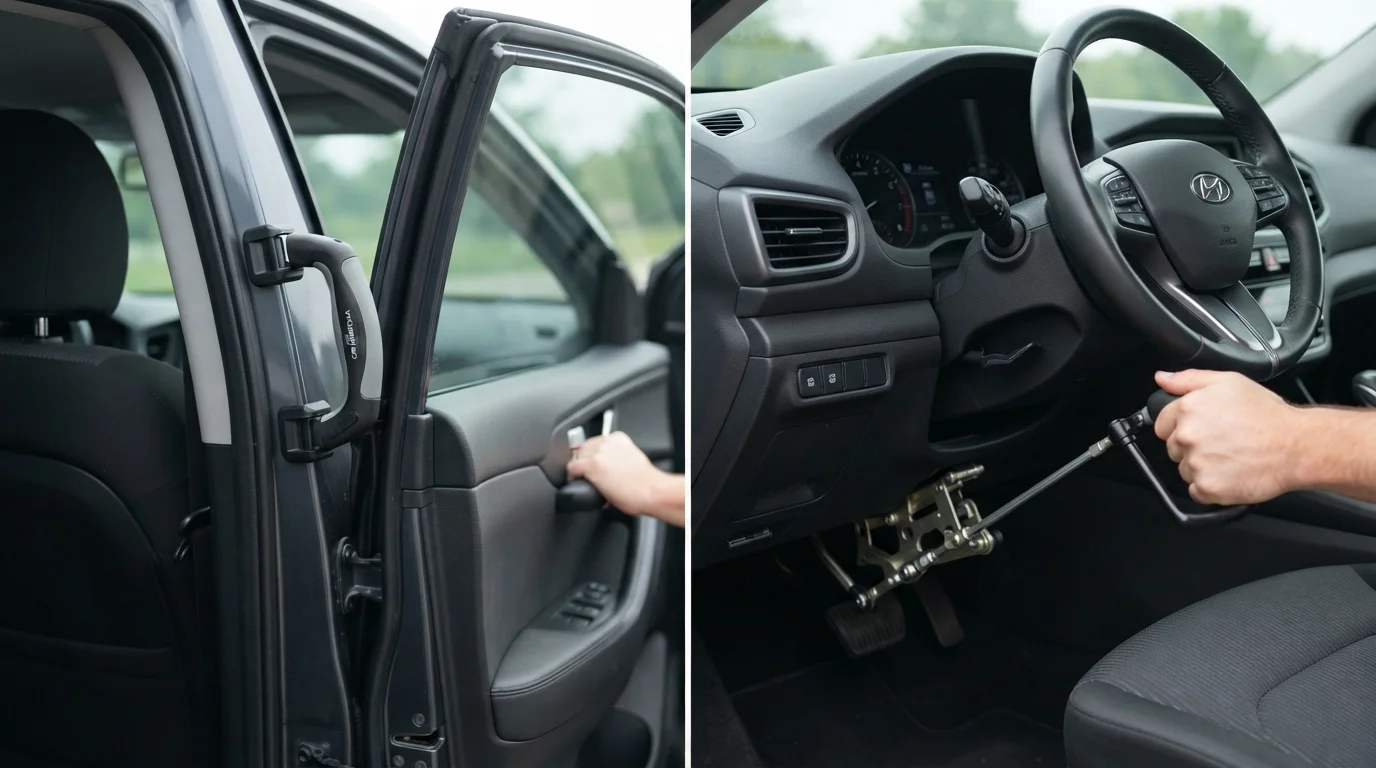
Removable aids include items such as door-frame grab handles that hook over the door latch, swivel seat cushions that reduce twisting on entry, and steering wheel covers with grip-enhancing textures. These require no drilling, no wiring, and no professional fitting. Most can be transferred between vehicles in seconds.
The advantages are straightforward: low upfront cost, no impact on vehicle warranty or resale value, and no paperwork. For someone who alternates between their own car and a family member's vehicle — or who is still testing which aids actually help — the low commitment is genuinely useful.
The limitations are equally real. A grab handle that clips over a door frame is only as secure as that clip mechanism. Under heavy use or if a user leans on it unevenly, some designs can shift or disengage. Removable aids are generally suited to users who need moderate support, not those whose safety depends on a fixed, load-bearing anchor point. See our guide to grab handles, assist grips, and swivel cushions for a closer look at how individual products perform in practice.
Test Before You Commit
If you're considering a removable aid, ask whether the retailer or occupational therapist offers a trial period or demonstration. Fitting a swivel cushion or grab handle to your actual vehicle before purchasing helps confirm it works with your door frame style, seat height, and the way you personally move. What works well for one person may feel awkward for another.
Permanent Modifications: Stability and Precision
Permanent modifications include hand controls for drivers who cannot use foot pedals, left-foot accelerator pedals, wheelchair and scooter lifts, driver seat lowering systems, and roof-mounted swivel bases. These are bolted or welded into the vehicle's chassis and calibrated to the driver's specific reach, strength, and seating position.
The stability advantage is significant. A professionally installed hand control, for example, is engineered to handle the full force a driver applies during braking — something a clip-on aid is not designed to do. For drivers managing conditions such as leg weakness, paralysis, or severe arthritis, this reliability is not optional.
However, permanent modifications carry real obligations. Many require installation by a qualified technician — ideally one certified through a recognized mobility equipment program. Some states require updated licensing documentation after certain modifications. Auto insurers should also be informed, as modifications can affect coverage terms. The pre-installation checklist for mobility aids walks through these practical steps in detail.
Don't Skip the Professional Assessment
Installing permanent adaptive controls without a professional evaluation is risky. An ill-fitted hand control or incorrectly positioned pedal guard can create new hazards rather than resolving existing ones. Always involve a certified technician, and check with your state's DMV regarding any documentation requirements after modification.
Choosing the Right Fit for Your Situation
The decision often comes down to three factors: the nature and stability of your mobility challenge, how long you intend to keep your vehicle, and whether multiple people need to use the same car comfortably. A shared family vehicle might not be a good candidate for highly personalized permanent controls. A leased car rules out most permanent modifications entirely.
A certified driver rehabilitation specialist (CDRS) or a dealer affiliated with the National Mobility Equipment Dealers Association (NMEDA) can conduct a formal driving assessment and recommend the most appropriate solution. This is general guidance — specific recommendations should always come from a qualified professional who evaluates your individual needs in person.
For a broader overview of how mobility aids intersect with safety equipment and what common misconceptions surround them, the article on mobility aids and car safety accessories is a helpful companion read. You can also consult the quick-reference guide to adaptive car accessories for a structured overview of product categories.
This article provides general educational information about adaptive vehicle aids. It is not a substitute for a professional driving assessment or advice from a licensed mobility equipment specialist. Consult a qualified professional before making modifications to any vehicle.
The content on this site is for informational purposes only and is not a substitute for professional advice. Always consult a qualified professional for guidance specific to your situation.