

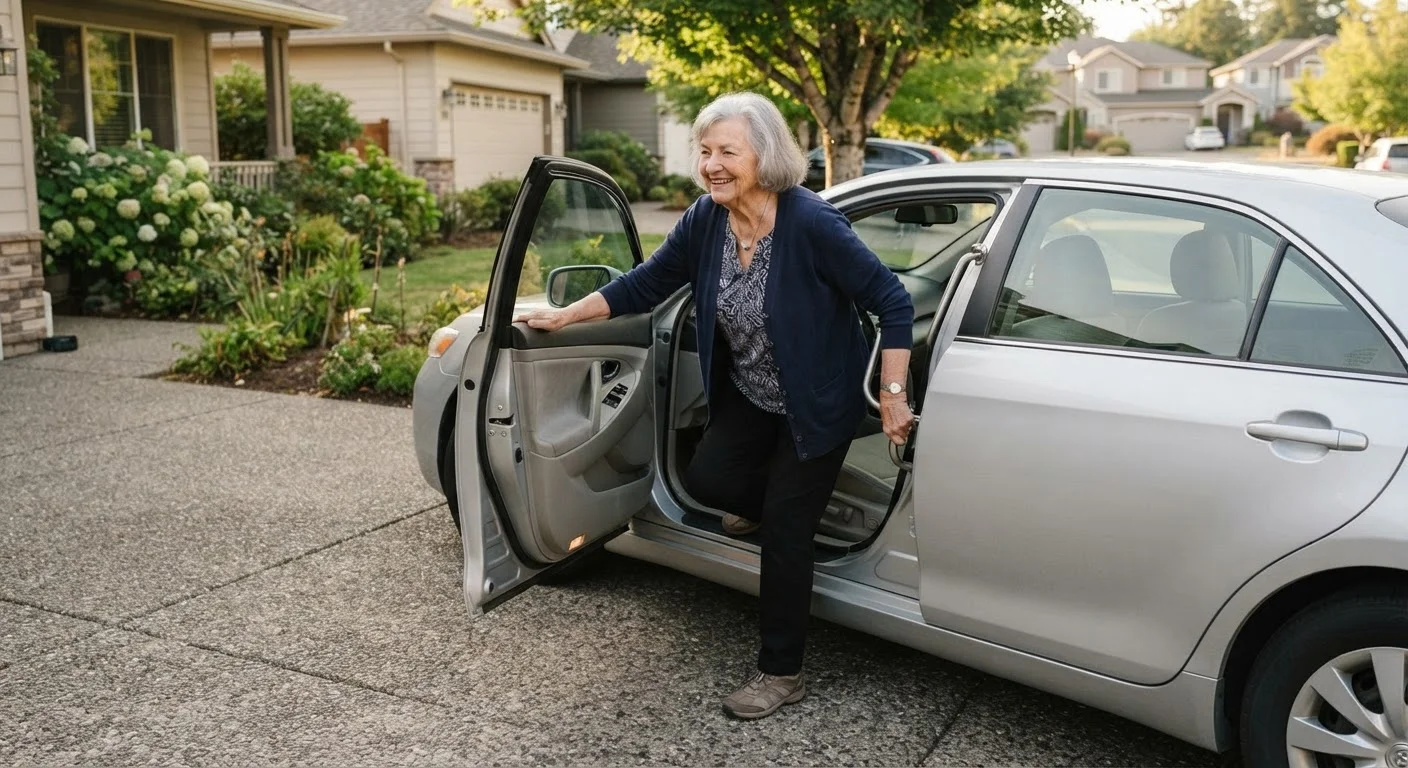
Why Getting In and Out of a Car Becomes More Challenging
Entering and exiting a vehicle involves a complex sequence of movements: bending the knees, hinging at the hips, lowering or raising body weight with one arm while maintaining balance, and rotating the torso and legs. For many older adults, conditions such as arthritis, reduced hip flexibility, weakened grip strength, or balance impairment can make any one of these steps feel precarious.
The physical demands vary significantly by vehicle type. A low-slung sedan requires deep knee and hip flexion to lower into, while a tall pickup truck demands an almost step-up motion that loads the knees differently. Step-in height affects every entry and exit in ways many drivers don't anticipate until mobility changes.
Understanding the mechanics — and the points where technique and tools can intervene — is the first step toward making every trip feel less daunting. The steps below offer a structured approach that reduces physical strain and improves stability throughout the process.
Vehicle Choice Affects Every Entry and Exit
Mid-height vehicles — such as many crossovers and SUVs — often require less effort than very low sedans or very high trucks for people with hip and knee stiffness. Seat height is one of the most overlooked factors in senior vehicle comfort. Our overview of seat height and vehicle entry explains what to consider when evaluating a vehicle.
Tools and Setup That Support Safer Entry and Exit
Before working through technique, it helps to identify the tools that can reduce the physical effort involved. These are not complex devices — most are inexpensive, portable, and require no installation. They work by either providing grip support, reducing rotation strain, or bridging height differences.
Vehicle grab handle (portable door-mounted)
Provides a stable handhold to lower or raise yourself without relying on the door frame or door itself.
Swivel seat cushion
Allows you to rotate your legs in and out of the vehicle as a single unit, reducing hip and knee rotation strain.
Non-slip step stool or running board
Bridges the gap between ground level and a high cabin floor, reducing the height of each step.
Seatbelt extension or reacher
Brings the seatbelt buckle closer so you don't need to twist or reach awkwardly across your body.
If you're assessing a new or existing vehicle for how well it supports ease of access, the broader guide to comfort and access features for senior drivers walks through what to look for systematically.
What you will need
Step-by-Step Technique for Entering and Exiting Safely
The steps below apply whether you are the driver or a passenger. The same principles — deliberate sequencing, controlled weight transfer, and using support points strategically — carry through in either seat. Follow them in order each time until they become habitual.
Park in a position that gives you room to work
Before you open the door, think about space. Whenever possible, choose a parking spot that allows the door to open fully without obstruction. A wider space — such as an end spot in a parking lot — gives you room to maneuver comfortably. On the street, try to park where the curb is level rather than at a steep drop.
Flat, stable ground reduces the risk of losing your balance as you shift your weight. If you're a passenger, ask the driver to pull forward or back to find the best surface.
Open the door fully and secure it
Push the door open as wide as it will go and, where available, use the door's detent (the click mechanism that holds it in position) to keep it from swinging closed on you. A door swinging back unexpectedly is a common cause of loss of balance during exit.
If your vehicle doesn't hold the door open reliably, consider a portable door-stop wedge as an inexpensive add-on.
Attach or locate your grab handle
A portable grab handle that clips into the door latch gives you a firm, stable point of contact. Hook it in place before you begin moving. If your vehicle has a fixed grab handle above the door interior, that can work too — but note its position before you need it.
See our guide to mobility aids for vehicle entry for a detailed look at the options available.
Sit down first, then swing your legs in (entering)
Stand with your back to the seat, as close to it as comfortable. Lower yourself slowly onto the seat edge using your arms for control — one hand on the grab handle, one on the seat back or headrest. Do not try to step in leg-first; sitting first is far more stable.
Once seated, use both hands to lift one leg at a time into the vehicle, or — if you're using a swivel cushion — rotate both legs together as a unit. A swivel cushion is particularly helpful for people with hip stiffness or replacement joints. Learn more about how comfort and mobility aids support senior drivers day to day.
Pivot to exit: legs first, then stand
To exit, reverse the sequence deliberately. Rotate your body so both feet are on the ground before attempting to stand — this is the safest order of operations. Place one hand on the grab handle and one on the seat or door frame, then push up to standing in a single controlled movement rather than rocking or lurching forward.
Pause at the standing position for a moment before walking away. Brief dizziness upon standing (called orthostatic hypotension) is common and usually passes within a few seconds — rushing off immediately increases fall risk.
Retrieve your mobility aid before stepping away
If you use a cane, walker, or any other aid, retrieve it and confirm your footing is secure before taking your first step away from the vehicle. Many falls happen in the transition zone between the car and the destination — when attention shifts before the body is fully stable.
Consider where you store your aid inside the vehicle: keeping it within arm's reach of the door, rather than on the opposite side of the back seat, saves unnecessary reaching and twisting.
After Joint Replacement Surgery, Consult First
If you have recently had a hip or knee replacement, discuss vehicle entry and exit techniques with your surgeon or physiotherapist before returning to driving or riding. Certain movements — deep hip flexion or extreme rotation — may be restricted during recovery. General guidance in this article does not substitute for clinical advice specific to your recovery stage.
Adaptive Tools Require a Period of Practice
Grab handles, swivel cushions, and step aids all work best once you've practiced using them in a low-pressure situation — such as a parked car at home. Attempting an unfamiliar tool for the first time in a busy parking lot or while running late increases the chance of errors. Spend a few practice sessions at home before relying on any new aid in public.
For a broader look at how adaptive vehicle accessories fit into daily driving for older adults, see our complete overview of comfort and easy access in cars.
This article is for general informational and educational purposes only. It does not constitute medical, physiotherapy, or clinical advice. Readers with specific health conditions, recent surgeries, or significant mobility limitations should consult a qualified healthcare professional before attempting new techniques or using new mobility aids.
The content on this site is for informational purposes only and is not a substitute for professional advice. Always consult a qualified professional for guidance specific to your situation.