

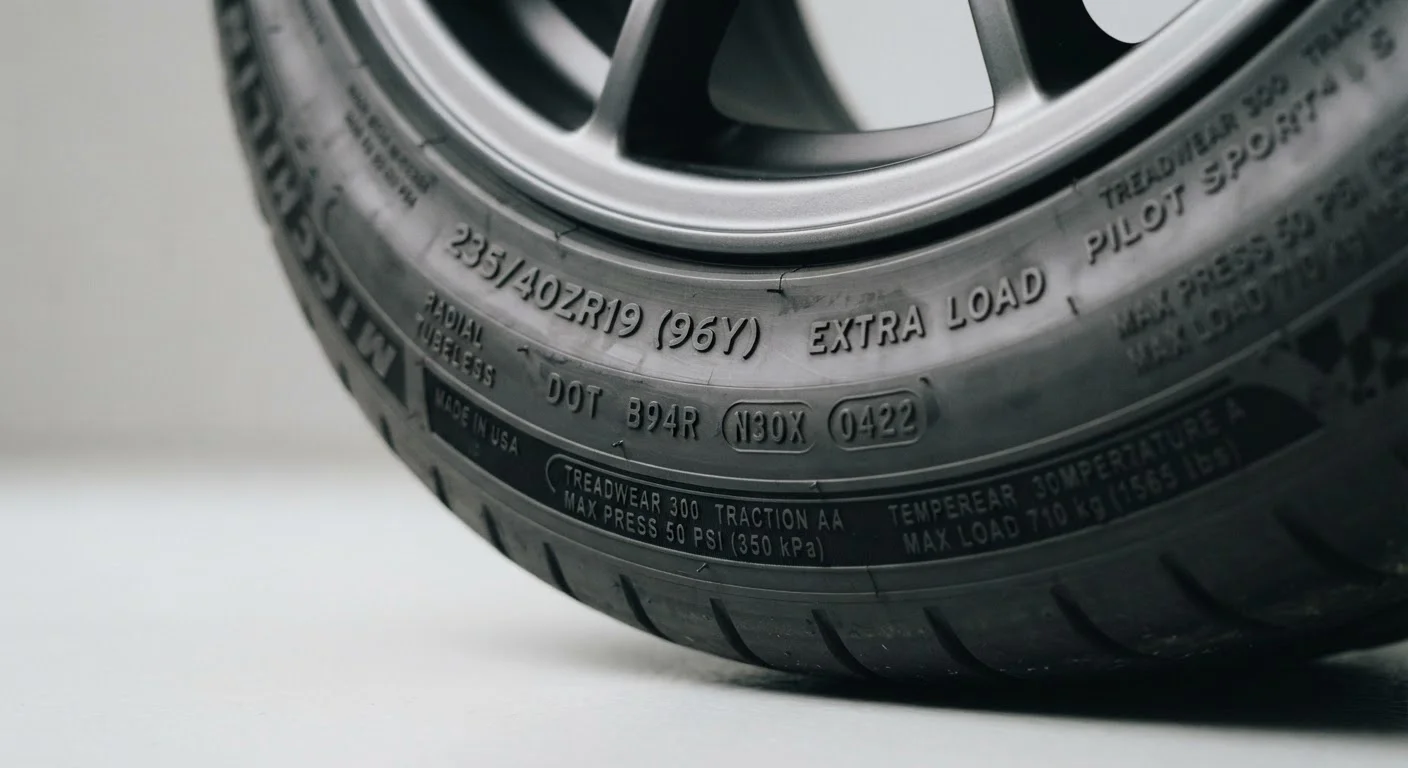
What That String of Characters Actually Means
Look at the side of any tire and you'll find a sequence that might read something like P215/65R16 98H. It looks cryptic, but each part carries a specific, practical meaning — and understanding it can help you confirm you have the right tires on your car and spot potential safety concerns before they become problems.
| Sidewall code example | P215/65R16 98H |
| Section width unit | Millimeters (e.g., 215mm) |
| Aspect ratio meaning | Sidewall height as % of width |
| Wheel diameter unit | Inches (must match rim exactly) |
| DOT date code format | Last 4 digits = week + year of manufacture |
| Suggested age for review | 6–10 years, regardless of tread depth (General industry guidance; consult your tire manufacturer) |
Here's how to read it left to right:
- P — The prefix indicates the tire's intended use. "P" stands for passenger vehicle. "LT" means light truck. Some tires have no prefix, which indicates a European metric designation with slightly different load standards.
- 215 — This three-digit number is the tire's section width in millimeters, measured from sidewall to sidewall at the widest point.
- 65 — This is the aspect ratio: the tire's sidewall height expressed as a percentage of its width. A ratio of 65 means the sidewall height is 65% of 215mm. Lower numbers mean a shorter, sportier sidewall; higher numbers mean a taller sidewall that generally provides a smoother ride on rough roads.
- R — Stands for radial construction, the standard for virtually all modern passenger tires. Radial tires have internal cords that run perpendicular to the direction of travel, improving durability and fuel efficiency.
- 16 — The wheel diameter in inches. This must match your rim size exactly.
- 98H — This final pairing is the load index and speed rating, covered in the next section.
Load Index and Speed Rating: Why They Matter
The two characters after the wheel diameter — 98H in our example — are easy to overlook but safety-critical.
The load index is a number that corresponds to the maximum weight each tire can safely carry. A load index of 98 means approximately 1,653 pounds per tire. Fitting tires with too low a load index for your vehicle is unsafe; always match or exceed the rating listed in your owner's manual or on the placard inside the driver's door jamb.
The speed rating is the letter that follows. Common ratings include:
- S — up to 112 mph
- T — up to 118 mph
- H — up to 130 mph
- V — up to 149 mph
For everyday driving, the speed rating also reflects the tire's heat tolerance and handling capability. Replacing tires with a lower speed rating than originally specified may compromise handling and durability, even if you never drive near those speeds. When in doubt, consult your vehicle's manual or ask a qualified tire technician.
Section width
The measurement in millimeters across the widest point of a tire from one sidewall to the other, measured when the tire is mounted and inflated but not under load.
Aspect ratio
A number expressing the tire sidewall's height as a percentage of the section width. A lower aspect ratio means a shorter sidewall, while a higher ratio means a taller, more cushioned sidewall.
Load index
A standardized number that corresponds to the maximum weight a single tire can safely carry when properly inflated. Always match or exceed your vehicle's required load index.
Speed rating
A letter code indicating the maximum sustained speed a tire is designed to handle safely. It also reflects heat tolerance and handling characteristics at lower speeds.
DOT code
A Department of Transportation identifier stamped on every tire sold in the US. The final four digits reveal the tire's manufacture week and year, which is essential for assessing its age.
Radial construction
A tire-building method in which internal fabric cords run at 90 degrees to the direction of travel, under the tread. Nearly all modern passenger tires are radial, indicated by the letter "R" in the sidewall code.
If your tires' load or speed ratings don't match what's recommended for your vehicle, discuss this with a mechanic. See our guide to talking with a mechanic about tires to help you ask the right questions.
Finding Your Tire's Age — and Why It's Critical
There's one more code on your tire sidewall that many drivers never notice: the DOT number. It begins with the letters "DOT" followed by a series of characters. The last four digits are the ones you need.
Those four digits represent the week and year the tire was manufactured. For example, 2319 means the tire was made in the 23rd week of 2019. This information matters enormously because rubber degrades over time — even when tread appears to look fine. Many tire manufacturers and safety organizations suggest considering replacement of tires that are six to ten years old, regardless of remaining tread depth.
The DOT Code May Be on the Inner Sidewall
Manufacturers are only required to stamp the full DOT code on one side of the tire, and it's often the inward-facing side. Use a flashlight and kneel beside the vehicle to locate it. If you're unsure, a tire shop can read all four tires during a routine visit and provide the manufacture dates for your records.
To find the DOT code, you may need to crouch down and look at the inner sidewall, as it's sometimes stamped on the inward-facing side. A flashlight helps. Once you find it, write down the four-digit date code for each tire so you can track their age over time.
For a deeper look at why age matters even when tires appear worn-in normally, see why tire age is a hidden safety factor. And if you want to understand what uneven wear on the tread surface might be signaling, our article on tire wear patterns and what they reveal is a practical next step.
The content on this site is for informational purposes only and is not a substitute for professional advice. Always consult a qualified professional for guidance specific to your situation.