

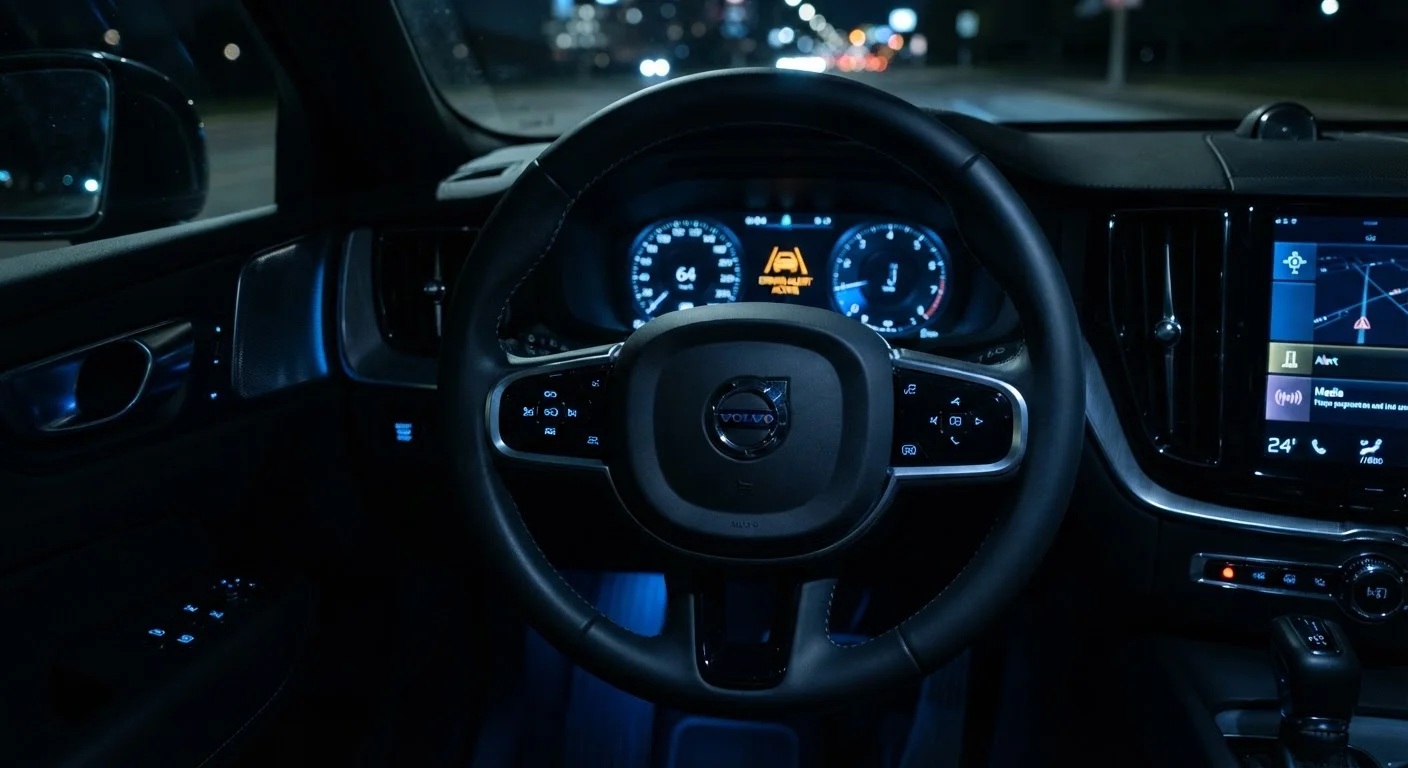
How These Systems Actually Work
Driver drowsiness detection relies on one or more data streams that the vehicle continuously reads while you drive. The most widely used method is steering pattern analysis. For the first five to ten minutes of a trip, the car quietly records how smoothly you steer — the rhythm, amplitude, and timing of your hand movements. That record becomes your personal baseline for the journey.
As the trip continues, the system compares your current inputs against that baseline. A rested, focused driver steers with small, deliberate corrections. A tired driver tends to make fewer corrections for longer stretches, then over-correct abruptly — a pattern the sensors can identify even when the driver is unaware of it.
More advanced vehicles add a driver monitoring camera, usually mounted on the steering column or above the instrument cluster. Using infrared light invisible to the human eye, the camera tracks where your eyes are looking, how long each blink lasts, and whether your head is tilting forward. Prolonged eye closure, a downward head droop, or a gaze that drifts away from the road can each trigger an alert independently of steering data.
Drowsiness Alerts Vary by Vehicle and Trim Level
Not every new vehicle includes drowsiness detection as standard equipment, and the sophistication of the system varies considerably. Steering-based detection is more common and usually standard at lower trim levels; camera-based driver monitoring is more often found on higher trims or as an optional package. When comparing vehicles, ask specifically whether the fatigue alert system uses a driver-facing camera or relies solely on steering sensors. You can find a broader breakdown of which safety technologies to look for in our guide to safety features that make the biggest difference for older drivers.
For a broader look at how these and related systems fit into today's vehicles, see driver-assist technology in modern cars.
What Happens When an Alert Fires
When the system decides the evidence for fatigue crosses its threshold, it acts through multiple senses at once. You will typically hear an audible chime or a series of beeps. Simultaneously, a dashboard icon — often a coffee cup or a face with drooping eyes — lights up. Some vehicles display a brief text message such as "Take a break." A small number of models also vibrate the driver's seat.
The alert is designed to be noticeable without being startling. After it fires, most systems expect you to either take an action — like pulling off the road — or resume a normal steering pattern. If neither happens within a set window, some vehicles will repeat the alert or escalate its intensity.
Always Respond to a Fatigue Alert
When your vehicle issues a drowsiness or attention alert, treat it as a meaningful warning rather than a nuisance. Find the nearest safe place to stop, get out of the car, and take at least a 15–20 minute rest before continuing. Caffeine can help in the short term, but it is not a substitute for actual sleep. If you are regularly fatigued on drives, speak with your doctor — it may point to an underlying sleep issue.
It is worth noting that these alerts are advisory, not automatic. The car will not brake or steer on your behalf in response to a drowsiness warning. The decision to pull over and rest always remains with the driver.
Why This Matters Especially for Older Drivers
Fatigue affects drivers of all ages, but several factors can make older drivers particularly vulnerable on longer trips. Sleep patterns often shift with age, meaning some seniors are naturally drowsier at certain times of day. Certain medications prescribed for common conditions — including blood pressure, anxiety, and allergy — list drowsiness as a known side effect.
~21%
Crash fatalities linked to drowsy driving
The U.S. National Highway Traffic Safety Administration (NHTSA) has estimated that drowsy driving contributes to a significant share of serious traffic crashes annually, with some analyses attributing roughly one in five fatal crashes to fatigue-related impairment.
4–6 sec
Eyes-off-road time at highway speed covers a football field
At 70 mph, closing your eyes or looking away for just four to six seconds means traveling the length of a football field without visual awareness — a figure cited in driver safety education materials to illustrate how quickly micro-sleep becomes dangerous.
Drowsiness alerts provide an external check-in that does not require self-awareness of fatigue — a genuine advantage, because one of the defining characteristics of sleepiness is impaired ability to judge one's own alertness level. The system notices what the driver may not.
Paired with other technologies covered in our guide to safety technologies for senior driving challenges, drowsiness detection forms part of a layered approach to keeping older drivers safe on the road.
When evaluating a vehicle, it is worth confirming whether the fatigue alert system uses steering-only detection or also includes a driver monitoring camera. The camera-based approach is generally more responsive to early-stage drowsiness because it measures the driver directly rather than inferring fatigue from vehicle behavior. More details on evaluating these features are available in our overview of senior safety features.
Frequently Asked Questions
Most systems are triggered by irregular steering patterns — small, erratic corrections that suggest reduced attention or muscle control. Advanced systems also detect heavy eyelids, prolonged blinks, or a drooping head using infrared cameras pointed at the driver. The alert fires when these signals exceed a threshold set by the manufacturer.
On most vehicles you can temporarily disable the alert through the settings menu, though the feature is usually re-enabled automatically at the next ignition cycle. Safety regulators and automakers generally recommend leaving these systems active, particularly on long trips.
These systems are a helpful safety net, but they are not infallible. They can miss subtle early-stage fatigue or, rarely, flag normal driving behaviour as a warning. Drivers should not rely on an alert as permission to push through fatigue — if you feel tired, pull over safely regardless of whether the car has flagged anything.
Not all new vehicles include this feature as standard equipment. It is increasingly common on mid-range and higher-trim vehicles, and regulatory momentum in several markets is pushing it toward wider adoption. When shopping, check the specific trim level's safety feature list rather than assuming it is included.
Driver monitoring systems (DMS) are a broader category that includes drowsiness detection but also covers distraction, hands-off-wheel alerts, and attentiveness tracking for semi-autonomous driving modes. A drowsiness alert is one specific function within a driver monitoring system.
The content on this site is for informational purposes only and is not a substitute for professional advice. Always consult a qualified professional for guidance specific to your situation.