

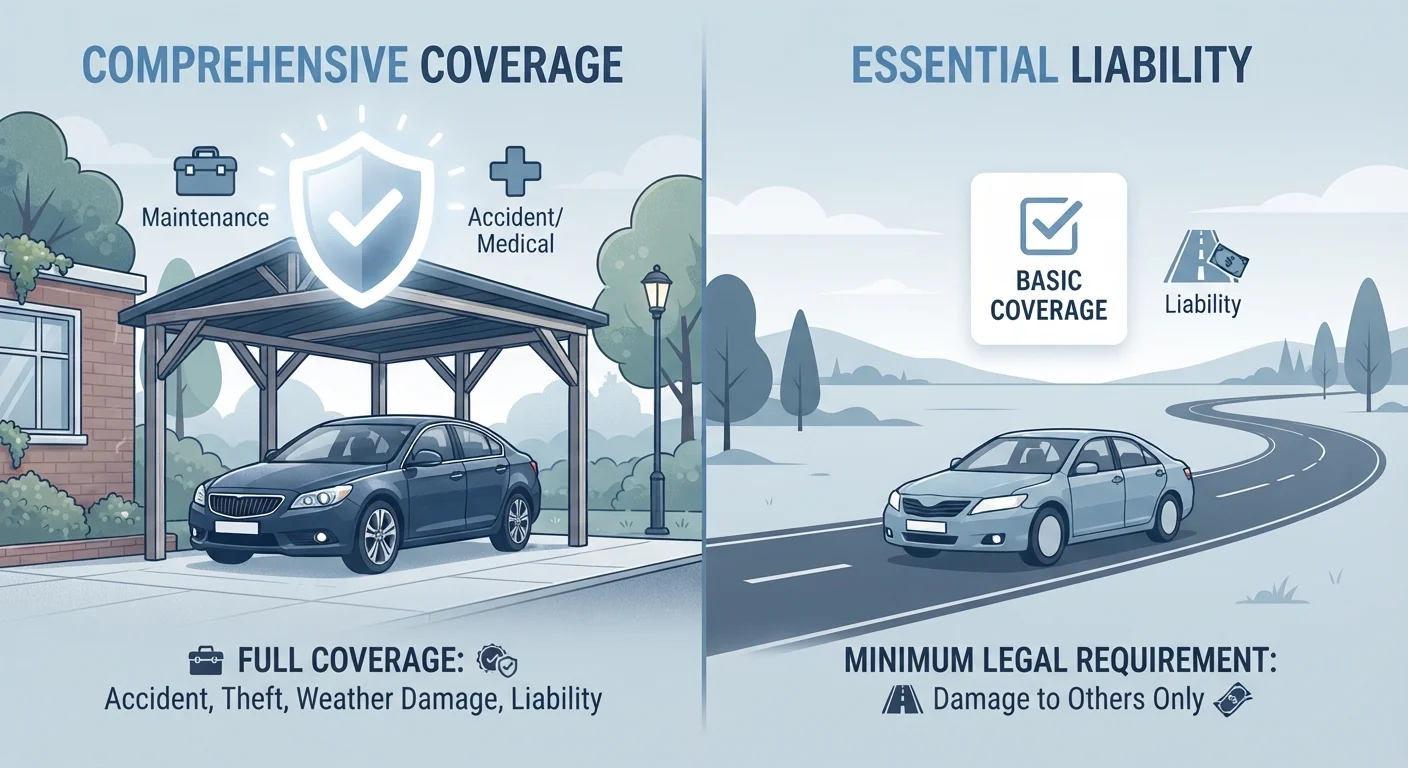
Option A
Comprehensive Insurance
The broadest protection available in a single policy.
Best for: Drivers who want coverage for damage to their own vehicle in addition to liability for others.
Option B
Third-Party Insurance
The streamlined, lower-cost baseline option.
Best for: Drivers of older, lower-value vehicles who primarily need legal liability protection.
What Each Coverage Level Actually Includes
The terms "comprehensive" and "third-party" describe how wide a net your policy casts — not just what the insurer calls the product. Understanding the scope of each is the starting point for any coverage decision.
Third-party insurance covers injuries or property damage you cause to other people. If you rear-end another driver, a third-party policy would help pay for their car repairs and medical bills up to your policy limits. What it does not cover is damage to your own vehicle. In the US, this liability protection is the legal minimum in most states. For a plain-language overview of how liability works alongside other core coverage types, see this breakdown of liability, comprehensive, and collision coverage.
Comprehensive insurance in everyday usage typically bundles liability protection with coverage for your own vehicle — including damage from theft, fire, weather events, and at-fault collisions (the latter often called collision coverage, which may be sold separately). If a tree falls on your car during a storm, comprehensive coverage would generally apply where a third-party-only policy would not. For a detailed comparison of collision and comprehensive as separate coverage types, see Collision vs. Comprehensive: Understanding the Difference.
| Criterion | Comprehensive Insurance | Third-Party Insurance |
|---|---|---|
| Covers damage to others' property | Yes | Yes |
| Covers your own vehicle's damage | Yes (typically) | No |
| Covers theft of your vehicle | Yes | No |
| Covers weather/natural events | Yes | No |
| Typical monthly premium | Higher | Lower |
| Meets state minimum requirements | Yes | Generally yes |
| Best suited for vehicle value | Newer or higher-value cars | Older or lower-value cars |
This article provides general insurance education and is not personalized advice. Coverage terms, availability, and regulations vary by state and provider. Read your actual policy documents and consult a licensed insurance agent before making coverage decisions.
How to Evaluate Which Level Fits Your Situation
There is no universal right answer — the appropriate coverage level depends on several practical factors specific to your situation.
~$900
Average annual comprehensive premium in the US
The National Association of Insurance Commissioners (NAIC) has reported average comprehensive coverage costs in roughly this range, though individual premiums vary widely by state, driver profile, and vehicle.
49 states
States requiring minimum liability coverage
Nearly all US states legally require drivers to carry at least some level of liability insurance, though required minimums differ significantly from state to state.
Your Vehicle's Current Market Value
One widely used rule of thumb is to compare what you pay annually in additional premiums for comprehensive coverage against the vehicle's current actual cash value (ACV), minus your deductible. If the gap is small, broader coverage may offer limited financial benefit. You can look up your car's approximate market value through resources like the National Automobile Dealers Association (NADA) guides or similar valuation tools. For a closer look at this trade-off on older vehicles, see The Pros and Cons of Dropping Collision or Comprehensive on an Older Car.
Your Financial Cushion for Out-of-Pocket Costs
Third-party insurance is less expensive month to month, but it shifts financial risk onto you. If your car were totaled or stolen, could you cover replacement costs comfortably? For seniors on fixed incomes, this question matters more than for those with accessible savings. Neither choice eliminates financial risk — they simply move it between you and the insurer.
Where and How Often You Drive
Drivers in areas with high rates of vehicle theft, severe weather, or heavy traffic may find comprehensive coverage's broader net more valuable. If you drive infrequently or mainly in low-risk environments, the calculus shifts. Also consider whether gaps like uninsured motorist protection — not included in basic third-party coverage — are relevant in your area. See Uninsured and Underinsured Motorist Coverage in Plain Language for more on that gap.
A Note on Terminology
In the US, insurers rarely use the label "third-party insurance" on policy documents — you are more likely to see "liability coverage" or "liability-only policy." The term "comprehensive" may refer either to the broader policy bundle or specifically to the non-collision portion of vehicle damage coverage, depending on context. Always confirm with your insurer exactly what is and is not included. For a plain-language guide to policy terminology, see Car Insurance Policies Explained: What Every Senior Driver Should Know.
Before finalizing any decision, review the full policy documents. Use a structured checklist to compare options — The Policy Comparison Checklist for Senior Drivers walks through deductibles, exclusions, and coverage limits worth scrutinizing. And if you are just beginning to compare options across insurers, Shopping Around for Insurance as a Senior offers a practical walkthrough of the quoting process.
The content on this site is for informational purposes only and is not a substitute for professional advice. Always consult a qualified professional for guidance specific to your situation.